

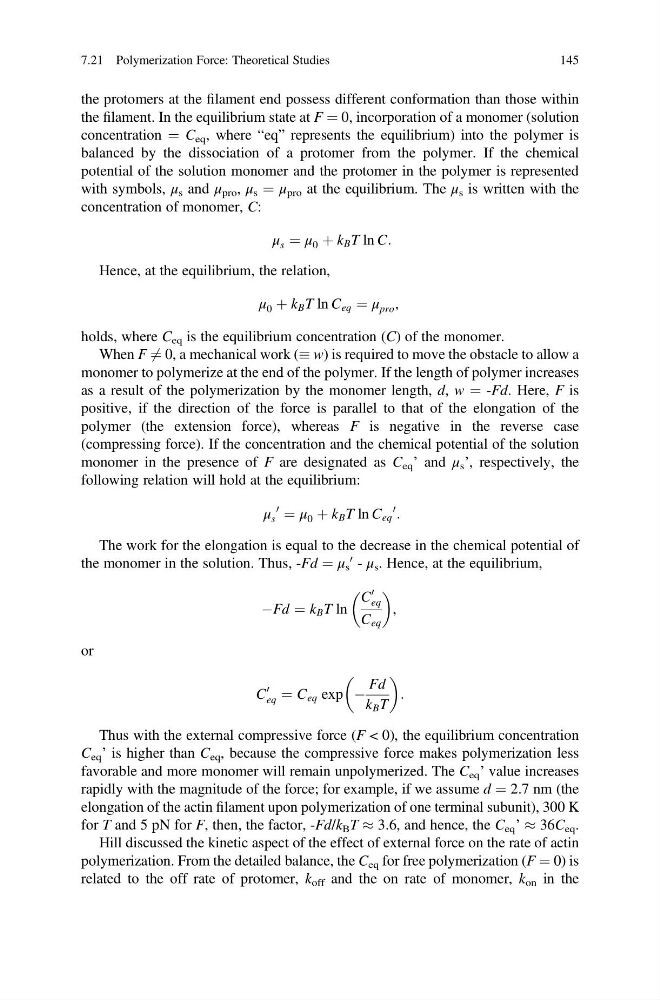
the protomers at the filament end possess different conformation than those within
the filament. In the equilibrium state at F ¼ 0, incorporation of a monomer (solution
concentration ¼ C eq , where “eq” represents the equilibrium) into the polymer is
balanced by the dissociation of a protomer from the polymer. If the chemical
potential of the solution monomer and the protomer in the polymer is represented
with symbols, μ s and μ pro , μ s ¼ μ pro at the equilibrium. The μ s is written with the
concentration of monomer, C:
μ s ¼ μ 0 þ k B T ln C:
Hence, at the equilibrium, the relation,
μ 0 þ k B T ln C eq ¼ μ pro ,
holds, where C eq is the equilibrium concentration (C) of the monomer.
When F 6 ¼ 0, a mechanical work ( w) is required to move the obstacle to allow a
monomer to polymerize at the end of the polymer. If the length of polymer increases
as a result of the polymerization by the monomer length, d, w ¼ -Fd. Here, F is
positive, if the direction of the force is parallel to that of the elongation of the
polymer (the extension force), whereas F is negative in the reverse case
(compressing force). If the concentration and the chemical potential of the solution
monomer in the presence of F are designated as C eq ’ and μ s ’, respectively, the
following relation will hold at the equilibrium:
μ s
0
¼ μ 0 þ k B T ln C eq
0
:
The work for the elongation is equal to the decrease in the chemical potential of
the monomer in the solution. Thus, -Fd ¼ μ s
0 - μ s . Hence, at the equilibrium,
ÀFd ¼ k B T ln
C
0
eq
C eq
,
or
C
0
eq ¼ C eq exp À
Fd
k B T
:
Thus with the external compressive force (F < 0), the equilibrium concentration
C eq ’ is higher than C eq , because the compressive force makes polymerization less
favorable and more monomer will remain unpolymerized. The C eq ’ value increases
rapidly with the magnitude of the force; for example, if we assume d ¼ 2.7 nm (the
elongation of the actin filament upon polymerization of one terminal subunit), 300 K
for T and 5 pN for F, then, the factor, -Fd/k B T % 3.6, and hence, the C eq ’ % 36C eq .
Hill discussed the kinetic aspect of the effect of external force on the rate of actin
polymerization. From the detailed balance, the C eq for free polymerization (F ¼ 0) is
related to the off rate of protomer, k off and the on rate of monomer, k on in the
7.21 Polymerization Force: Theoretical Studies
145
the filament. In the equilibrium state at F ¼ 0, incorporation of a monomer (solution
concentration ¼ C eq , where “eq” represents the equilibrium) into the polymer is
balanced by the dissociation of a protomer from the polymer. If the chemical
potential of the solution monomer and the protomer in the polymer is represented
with symbols, μ s and μ pro , μ s ¼ μ pro at the equilibrium. The μ s is written with the
concentration of monomer, C:
μ s ¼ μ 0 þ k B T ln C:
Hence, at the equilibrium, the relation,
μ 0 þ k B T ln C eq ¼ μ pro ,
holds, where C eq is the equilibrium concentration (C) of the monomer.
When F 6 ¼ 0, a mechanical work ( w) is required to move the obstacle to allow a
monomer to polymerize at the end of the polymer. If the length of polymer increases
as a result of the polymerization by the monomer length, d, w ¼ -Fd. Here, F is
positive, if the direction of the force is parallel to that of the elongation of the
polymer (the extension force), whereas F is negative in the reverse case
(compressing force). If the concentration and the chemical potential of the solution
monomer in the presence of F are designated as C eq ’ and μ s ’, respectively, the
following relation will hold at the equilibrium:
μ s
0
¼ μ 0 þ k B T ln C eq
0
:
The work for the elongation is equal to the decrease in the chemical potential of
the monomer in the solution. Thus, -Fd ¼ μ s
0 - μ s . Hence, at the equilibrium,
ÀFd ¼ k B T ln
C
0
eq
C eq
,
or
C
0
eq ¼ C eq exp À
Fd
k B T
:
Thus with the external compressive force (F < 0), the equilibrium concentration
C eq ’ is higher than C eq , because the compressive force makes polymerization less
favorable and more monomer will remain unpolymerized. The C eq ’ value increases
rapidly with the magnitude of the force; for example, if we assume d ¼ 2.7 nm (the
elongation of the actin filament upon polymerization of one terminal subunit), 300 K
for T and 5 pN for F, then, the factor, -Fd/k B T % 3.6, and hence, the C eq ’ % 36C eq .
Hill discussed the kinetic aspect of the effect of external force on the rate of actin
polymerization. From the detailed balance, the C eq for free polymerization (F ¼ 0) is
related to the off rate of protomer, k off and the on rate of monomer, k on in the
7.21 Polymerization Force: Theoretical Studies
145