

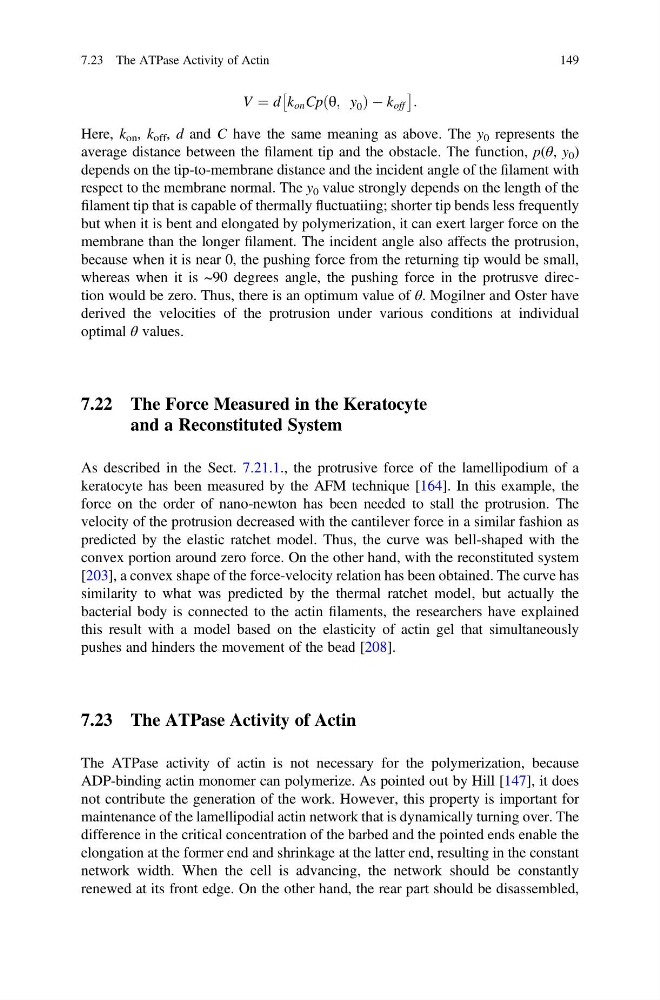
V ¼ d k on Cp θ; y 0
ð
ÞÀk off
Â
à :
Here, k on , k off , d and C have the same meaning as above. The y 0 represents the
average distance between the filament tip and the obstacle. The function, p(θ, y 0 )
depends on the tip-to-membrane distance and the incident angle of the filament with
respect to the membrane normal. The y 0 value strongly depends on the length of the
filament tip that is capable of thermally fluctuatiing; shorter tip bends less frequently
but when it is bent and elongated by polymerization, it can exert larger force on the
membrane than the longer filament. The incident angle also affects the protrusion,
because when it is near 0, the pushing force from the returning tip would be small,
whereas when it is ~90 degrees angle, the pushing force in the protrusve direction would be zero. Thus, there is an optimum value of θ. Mogilner and Oster have
derived the velocities of the protrusion under various conditions at individual
optimal θ values.
7.22 The Force Measured in the Keratocyte
and a Reconstituted System
As described in the Sect. 7.21.1., the protrusive force of the lamellipodium of a
keratocyte has been measured by the AFM technique [164]. In this example, the
force on the order of nano-newton has been needed to stall the protrusion. The
velocity of the protrusion decreased with the cantilever force in a similar fashion as
predicted by the elastic ratchet model. Thus, the curve was bell-shaped with the
convex portion around zero force. On the other hand, with the reconstituted system
[203], a convex shape of the force-velocity relation has been obtained. The curve has
similarity to what was predicted by the thermal ratchet model, but actually the
bacterial body is connected to the actin filaments, the researchers have explained
this result with a model based on the elasticity of actin gel that simultaneously
pushes and hinders the movement of the bead [208].
7.23 The ATPase Activity of Actin
The ATPase activity of actin is not necessary for the polymerization, because
ADP-binding actin monomer can polymerize. As pointed out by Hill [147], it does
not contribute the generation of the work. However, this property is important for
maintenance of the lamellipodial actin network that is dynamically turning over. The
difference in the critical concentration of the barbed and the pointed ends enable the
elongation at the former end and shrinkage at the latter end, resulting in the constant
network width. When the cell is advancing, the network should be constantly
renewed at its front edge. On the other hand, the rear part should be disassembled,
7.23 The ATPase Activity of Actin
149
ð
ÞÀk off
Â
à :
Here, k on , k off , d and C have the same meaning as above. The y 0 represents the
average distance between the filament tip and the obstacle. The function, p(θ, y 0 )
depends on the tip-to-membrane distance and the incident angle of the filament with
respect to the membrane normal. The y 0 value strongly depends on the length of the
filament tip that is capable of thermally fluctuatiing; shorter tip bends less frequently
but when it is bent and elongated by polymerization, it can exert larger force on the
membrane than the longer filament. The incident angle also affects the protrusion,
because when it is near 0, the pushing force from the returning tip would be small,
whereas when it is ~90 degrees angle, the pushing force in the protrusve direction would be zero. Thus, there is an optimum value of θ. Mogilner and Oster have
derived the velocities of the protrusion under various conditions at individual
optimal θ values.
7.22 The Force Measured in the Keratocyte
and a Reconstituted System
As described in the Sect. 7.21.1., the protrusive force of the lamellipodium of a
keratocyte has been measured by the AFM technique [164]. In this example, the
force on the order of nano-newton has been needed to stall the protrusion. The
velocity of the protrusion decreased with the cantilever force in a similar fashion as
predicted by the elastic ratchet model. Thus, the curve was bell-shaped with the
convex portion around zero force. On the other hand, with the reconstituted system
[203], a convex shape of the force-velocity relation has been obtained. The curve has
similarity to what was predicted by the thermal ratchet model, but actually the
bacterial body is connected to the actin filaments, the researchers have explained
this result with a model based on the elasticity of actin gel that simultaneously
pushes and hinders the movement of the bead [208].
7.23 The ATPase Activity of Actin
The ATPase activity of actin is not necessary for the polymerization, because
ADP-binding actin monomer can polymerize. As pointed out by Hill [147], it does
not contribute the generation of the work. However, this property is important for
maintenance of the lamellipodial actin network that is dynamically turning over. The
difference in the critical concentration of the barbed and the pointed ends enable the
elongation at the former end and shrinkage at the latter end, resulting in the constant
network width. When the cell is advancing, the network should be constantly
renewed at its front edge. On the other hand, the rear part should be disassembled,
7.23 The ATPase Activity of Actin
149