

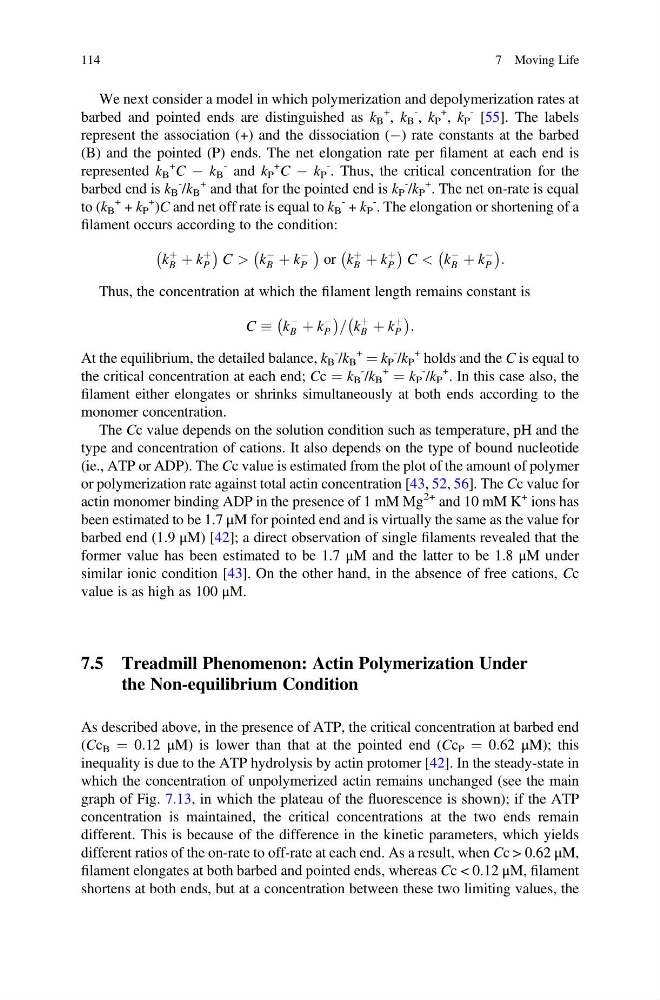
We next consider a model in which polymerization and depolymerization rates at
barbed and pointed ends are distinguished as k B
+
, k B
- , k P
+
, k P
- [55]. The labels
represent the association (+) and the dissociation (À) rate constants at the barbed
(B) and the pointed (P) ends. The net elongation rate per filament at each end is
represented k B
+
C À k B
- and k P
+ C À k P
- . Thus, the critical concentration for the
barbed end is k B
- /k B
+ and that for the pointed end is k P
-
/k P
+
. The net on-rate is equal
to (k B
+ + k P
+
)C and net off rate is equal to k B
- + k P
-
. The elongation or shortening of a
filament occurs according to the condition:
k
þ
B þ k
þ
P
À
Á
C > k
À
B þ k
À
P
À
Á
or k
þ
B þ k
þ
P
À
Á
C < k
À
B þ k
À
P
À
Á :
Thus, the concentration at which the filament length remains constant is
C k
À
B þ k
À
P
À
Á = k
þ
B þ k
þ
P
À
Á :
At the equilibrium, the detailed balance, k B
-
/k B
+
¼ k P
- /k P
+ holds and the C is equal to
the critical concentration at each end; Cc ¼ k B
- /k B
+
¼ k P
- /k P
+ . In this case also, the
filament either elongates or shrinks simultaneously at both ends according to the
monomer concentration.
The Cc value depends on the solution condition such as temperature, pH and the
type and concentration of cations. It also depends on the type of bound nucleotide
(ie., ATP or ADP). The Cc value is estimated from the plot of the amount of polymer
or polymerization rate against total actin concentration [43, 52, 56]. The Cc value for
actin monomer binding ADP in the presence of 1 mM Mg
2+ and 10 mM K
+ ions has
been estimated to be 1.7 μM for pointed end and is virtually the same as the value for
barbed end (1.9 μM) [42]; a direct observation of single filaments revealed that the
former value has been estimated to be 1.7 μM and the latter to be 1.8 μM under
similar ionic condition [43]. On the other hand, in the absence of free cations, Cc
value is as high as 100 μM.
7.5 Treadmill Phenomenon: Actin Polymerization Under
the Non-equilibrium Condition
As described above, in the presence of ATP, the critical concentration at barbed end
(Cc B ¼ 0.12 μM) is lower than that at the pointed end (Cc P ¼ 0.62 μM); this
inequality is due to the ATP hydrolysis by actin protomer [42]. In the steady-state in
which the concentration of unpolymerized actin remains unchanged (see the main
graph of Fig. 7.13, in which the plateau of the fluorescence is shown); if the ATP
concentration is maintained, the critical concentrations at the two ends remain
different. This is because of the difference in the kinetic parameters, which yields
different ratios of the on-rate to off-rate at each end. As a result, when Cc > 0.62 μM,
filament elongates at both barbed and pointed ends, whereas Cc < 0.12 μM, filament
shortens at both ends, but at a concentration between these two limiting values, the
114
7 Moving Life
barbed and pointed ends are distinguished as k B
+
, k B
- , k P
+
, k P
- [55]. The labels
represent the association (+) and the dissociation (À) rate constants at the barbed
(B) and the pointed (P) ends. The net elongation rate per filament at each end is
represented k B
+
C À k B
- and k P
+ C À k P
- . Thus, the critical concentration for the
barbed end is k B
- /k B
+ and that for the pointed end is k P
-
/k P
+
. The net on-rate is equal
to (k B
+ + k P
+
)C and net off rate is equal to k B
- + k P
-
. The elongation or shortening of a
filament occurs according to the condition:
k
þ
B þ k
þ
P
À
Á
C > k
À
B þ k
À
P
À
Á
or k
þ
B þ k
þ
P
À
Á
C < k
À
B þ k
À
P
À
Á :
Thus, the concentration at which the filament length remains constant is
C k
À
B þ k
À
P
À
Á = k
þ
B þ k
þ
P
À
Á :
At the equilibrium, the detailed balance, k B
-
/k B
+
¼ k P
- /k P
+ holds and the C is equal to
the critical concentration at each end; Cc ¼ k B
- /k B
+
¼ k P
- /k P
+ . In this case also, the
filament either elongates or shrinks simultaneously at both ends according to the
monomer concentration.
The Cc value depends on the solution condition such as temperature, pH and the
type and concentration of cations. It also depends on the type of bound nucleotide
(ie., ATP or ADP). The Cc value is estimated from the plot of the amount of polymer
or polymerization rate against total actin concentration [43, 52, 56]. The Cc value for
actin monomer binding ADP in the presence of 1 mM Mg
2+ and 10 mM K
+ ions has
been estimated to be 1.7 μM for pointed end and is virtually the same as the value for
barbed end (1.9 μM) [42]; a direct observation of single filaments revealed that the
former value has been estimated to be 1.7 μM and the latter to be 1.8 μM under
similar ionic condition [43]. On the other hand, in the absence of free cations, Cc
value is as high as 100 μM.
7.5 Treadmill Phenomenon: Actin Polymerization Under
the Non-equilibrium Condition
As described above, in the presence of ATP, the critical concentration at barbed end
(Cc B ¼ 0.12 μM) is lower than that at the pointed end (Cc P ¼ 0.62 μM); this
inequality is due to the ATP hydrolysis by actin protomer [42]. In the steady-state in
which the concentration of unpolymerized actin remains unchanged (see the main
graph of Fig. 7.13, in which the plateau of the fluorescence is shown); if the ATP
concentration is maintained, the critical concentrations at the two ends remain
different. This is because of the difference in the kinetic parameters, which yields
different ratios of the on-rate to off-rate at each end. As a result, when Cc > 0.62 μM,
filament elongates at both barbed and pointed ends, whereas Cc < 0.12 μM, filament
shortens at both ends, but at a concentration between these two limiting values, the
114
7 Moving Life