

7.4 Kinetics of Actin Polymerization
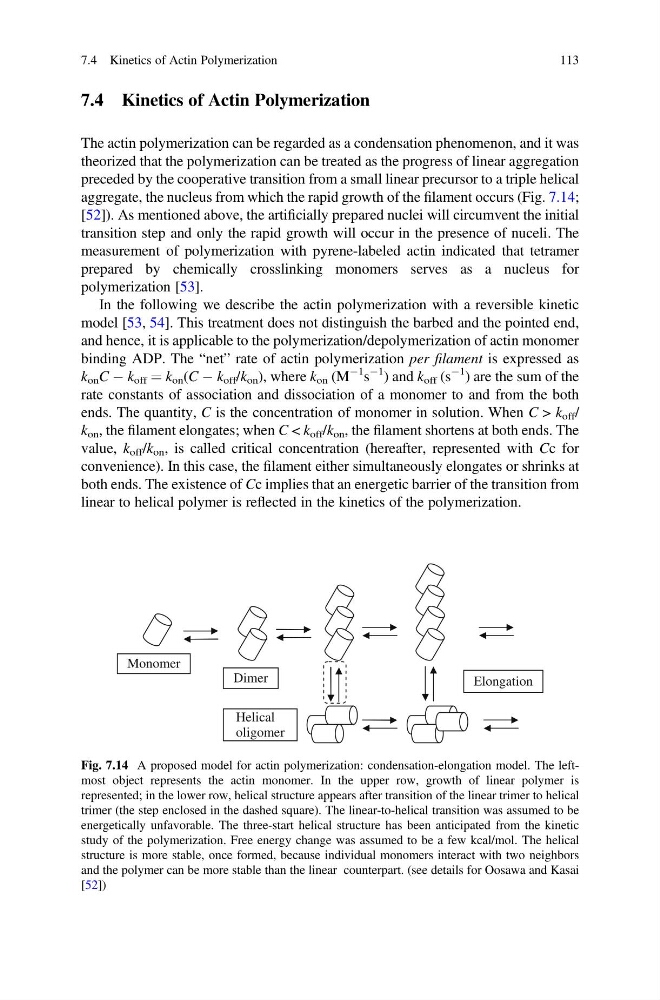
The actin polymerization can be regarded as a condensation phenomenon, and it was
theorized that the polymerization can be treated as the progress of linear aggregation
preceded by the cooperative transition from a small linear precursor to a triple helical
aggregate, the nucleus from which the rapid growth of the filament occurs (Fig. 7.14;
[52]). As mentioned above, the artificially prepared nuclei will circumvent the initial
transition step and only the rapid growth will occur in the presence of nuceli. The
measurement of polymerization with pyrene-labeled actin indicated that tetramer
prepared by chemically crosslinking monomers serves as a nucleus for
polymerization [53].
In the following we describe the actin polymerization with a reversible kinetic
model [53, 54]. This treatment does not distinguish the barbed and the pointed end,
and hence, it is applicable to the polymerization/depolymerization of actin monomer
binding ADP. The “net” rate of actin polymerization per filament is expressed as
k on C À k off ¼ k on (C À k off /k on ), where k on (M
À1 s
À1 ) and k off (s
À1 ) are the sum of the
rate constants of association and dissociation of a monomer to and from the both
ends. The quantity, C is the concentration of monomer in solution. When C > k off /
k on , the filament elongates; when C < k off /k on , the filament shortens at both ends. The
value, k off /k on , is called critical concentration (hereafter, represented with Cc for
convenience). In this case, the filament either simultaneously elongates or shrinks at
both ends. The existence of Cc implies that an energetic barrier of the transition from
linear to helical polymer is reflected in the kinetics of the polymerization.
Dimer
Helical
oligomer
Elongation
Monomer
Fig. 7.14 A proposed model for actin polymerization: condensation-elongation model. The leftmost object represents the actin monomer. In the upper row, growth of linear polymer is
represented; in the lower row, helical structure appears after transition of the linear trimer to helical
trimer (the step enclosed in the dashed square). The linear-to-helical transition was assumed to be
energetically unfavorable. The three-start helical structure has been anticipated from the kinetic
study of the polymerization. Free energy change was assumed to be a few kcal/mol. The helical
structure is more stable, once formed, because individual monomers interact with two neighbors
and the polymer can be more stable than the linear counterpart. (see details for Oosawa and Kasai
[52])
7.4 Kinetics of Actin Polymerization
113
The actin polymerization can be regarded as a condensation phenomenon, and it was
theorized that the polymerization can be treated as the progress of linear aggregation
preceded by the cooperative transition from a small linear precursor to a triple helical
aggregate, the nucleus from which the rapid growth of the filament occurs (Fig. 7.14;
[52]). As mentioned above, the artificially prepared nuclei will circumvent the initial
transition step and only the rapid growth will occur in the presence of nuceli. The
measurement of polymerization with pyrene-labeled actin indicated that tetramer
prepared by chemically crosslinking monomers serves as a nucleus for
polymerization [53].
In the following we describe the actin polymerization with a reversible kinetic
model [53, 54]. This treatment does not distinguish the barbed and the pointed end,
and hence, it is applicable to the polymerization/depolymerization of actin monomer
binding ADP. The “net” rate of actin polymerization per filament is expressed as
k on C À k off ¼ k on (C À k off /k on ), where k on (M
À1 s
À1 ) and k off (s
À1 ) are the sum of the
rate constants of association and dissociation of a monomer to and from the both
ends. The quantity, C is the concentration of monomer in solution. When C > k off /
k on , the filament elongates; when C < k off /k on , the filament shortens at both ends. The
value, k off /k on , is called critical concentration (hereafter, represented with Cc for
convenience). In this case, the filament either simultaneously elongates or shrinks at
both ends. The existence of Cc implies that an energetic barrier of the transition from
linear to helical polymer is reflected in the kinetics of the polymerization.
Dimer
Helical
oligomer
Elongation
Monomer
Fig. 7.14 A proposed model for actin polymerization: condensation-elongation model. The leftmost object represents the actin monomer. In the upper row, growth of linear polymer is
represented; in the lower row, helical structure appears after transition of the linear trimer to helical
trimer (the step enclosed in the dashed square). The linear-to-helical transition was assumed to be
energetically unfavorable. The three-start helical structure has been anticipated from the kinetic
study of the polymerization. Free energy change was assumed to be a few kcal/mol. The helical
structure is more stable, once formed, because individual monomers interact with two neighbors
and the polymer can be more stable than the linear counterpart. (see details for Oosawa and Kasai
[52])
7.4 Kinetics of Actin Polymerization
113