

rate of elongation occurring at the pointed end and that of the shortening occurring at
the barbed end can be equal. If one assumes that the dissociation occurs with
ADP-bound protomer and the association occurs with ATP-bound monomer, this
occurs at
C 0 ¼ k
À
BD þ k
À
PD
À
Á = k
þ
BT þ k
þ
PT
À
Á
[55]. Parameter values estimated from the electron microscopy yield 0.58 μM for C 0
value. As far as this monomer concentration is maintained, the length of the filament
remains constant. The actin monomer at C 0 associates with the barbed end, because
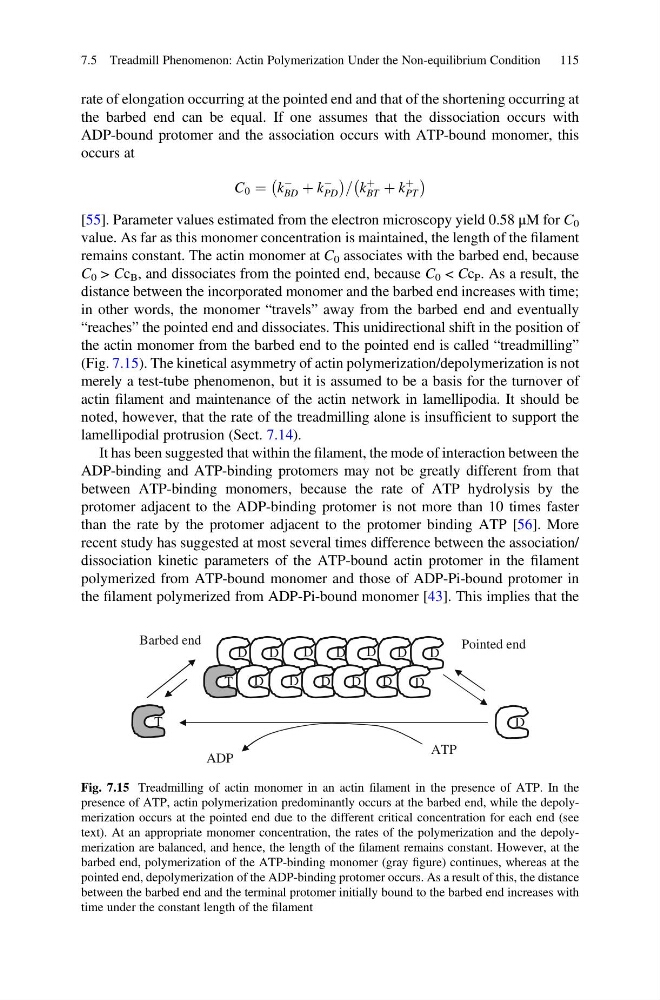
C 0 > Cc B , and dissociates from the pointed end, because C 0 < Cc P . As a result, the
distance between the incorporated monomer and the barbed end increases with time;
in other words, the monomer “travels” away from the barbed end and eventually
“reaches” the pointed end and dissociates. This unidirectional shift in the position of
the actin monomer from the barbed end to the pointed end is called “treadmilling”
(Fig. 7.15). The kinetical asymmetry of actin polymerization/depolymerization is not
merely a test-tube phenomenon, but it is assumed to be a basis for the turnover of
actin filament and maintenance of the actin network in lamellipodia. It should be
noted, however, that the rate of the treadmilling alone is insufficient to support the
lamellipodial protrusion (Sect. 7.14).
It has been suggested that within the filament, the mode of interaction between the
ADP-binding and ATP-binding protomers may not be greatly different from that
between ATP-binding monomers, because the rate of ATP hydrolysis by the
protomer adjacent to the ADP-binding protomer is not more than 10 times faster
than the rate by the protomer adjacent to the protomer binding ATP [56]. More
recent study has suggested at most several times difference between the association/
dissociation kinetic parameters of the ATP-bound actin protomer in the filament
polymerized from ATP-bound monomer and those of ADP-Pi-bound protomer in
the filament polymerized from ADP-Pi-bound monomer [43]. This implies that the
Barbed end
Pointed end
ADP
ATP
D
D
D
D
D
D
D
D
D
D
D
D
D
D
T
T
Fig. 7.15 Treadmilling of actin monomer in an actin filament in the presence of ATP. In the
presence of ATP, actin polymerization predominantly occurs at the barbed end, while the depolymerization occurs at the pointed end due to the different critical concentration for each end (see
text). At an appropriate monomer concentration, the rates of the polymerization and the depolymerization are balanced, and hence, the length of the filament remains constant. However, at the
barbed end, polymerization of the ATP-binding monomer (gray figure) continues, whereas at the
pointed end, depolymerization of the ADP-binding protomer occurs. As a result of this, the distance
between the barbed end and the terminal protomer initially bound to the barbed end increases with
time under the constant length of the filament
7.5 Treadmill Phenomenon: Actin Polymerization Under the Non-equilibrium Condition
115
the barbed end can be equal. If one assumes that the dissociation occurs with
ADP-bound protomer and the association occurs with ATP-bound monomer, this
occurs at
C 0 ¼ k
À
BD þ k
À
PD
À
Á = k
þ
BT þ k
þ
PT
À
Á
[55]. Parameter values estimated from the electron microscopy yield 0.58 μM for C 0
value. As far as this monomer concentration is maintained, the length of the filament
remains constant. The actin monomer at C 0 associates with the barbed end, because
C 0 > Cc B , and dissociates from the pointed end, because C 0 < Cc P . As a result, the
distance between the incorporated monomer and the barbed end increases with time;
in other words, the monomer “travels” away from the barbed end and eventually
“reaches” the pointed end and dissociates. This unidirectional shift in the position of
the actin monomer from the barbed end to the pointed end is called “treadmilling”
(Fig. 7.15). The kinetical asymmetry of actin polymerization/depolymerization is not
merely a test-tube phenomenon, but it is assumed to be a basis for the turnover of
actin filament and maintenance of the actin network in lamellipodia. It should be
noted, however, that the rate of the treadmilling alone is insufficient to support the
lamellipodial protrusion (Sect. 7.14).
It has been suggested that within the filament, the mode of interaction between the
ADP-binding and ATP-binding protomers may not be greatly different from that
between ATP-binding monomers, because the rate of ATP hydrolysis by the
protomer adjacent to the ADP-binding protomer is not more than 10 times faster
than the rate by the protomer adjacent to the protomer binding ATP [56]. More
recent study has suggested at most several times difference between the association/
dissociation kinetic parameters of the ATP-bound actin protomer in the filament
polymerized from ATP-bound monomer and those of ADP-Pi-bound protomer in
the filament polymerized from ADP-Pi-bound monomer [43]. This implies that the
Barbed end
Pointed end
ADP
ATP
D
D
D
D
D
D
D
D
D
D
D
D
D
D
T
T
Fig. 7.15 Treadmilling of actin monomer in an actin filament in the presence of ATP. In the
presence of ATP, actin polymerization predominantly occurs at the barbed end, while the depolymerization occurs at the pointed end due to the different critical concentration for each end (see
text). At an appropriate monomer concentration, the rates of the polymerization and the depolymerization are balanced, and hence, the length of the filament remains constant. However, at the
barbed end, polymerization of the ATP-binding monomer (gray figure) continues, whereas at the
pointed end, depolymerization of the ADP-binding protomer occurs. As a result of this, the distance
between the barbed end and the terminal protomer initially bound to the barbed end increases with
time under the constant length of the filament
7.5 Treadmill Phenomenon: Actin Polymerization Under the Non-equilibrium Condition
115