

during its ATPase cycle thereby generating the contractile force (power stroke; [5]).
This has been called mechanochemical coupling.
As mentioned above, the motor domain binds to the actin filament. The affinity of
the motor domain to actin should be high enough for generation of the force (a few
pN, [1]; see next section). Thus, the swinging lever-arm pulls the myosin or myosin
filament (Fig. 7.4). It has been suggested that the lever arm action is a result of
amplification of more localized change in the intramolecular structure that accompanies the ATP hydrolysis. This is similar to the amplification of a small distortion of
the heme in hemoglobin resulting in the relative displacement and rotation of
hemoglobin subunits [5].
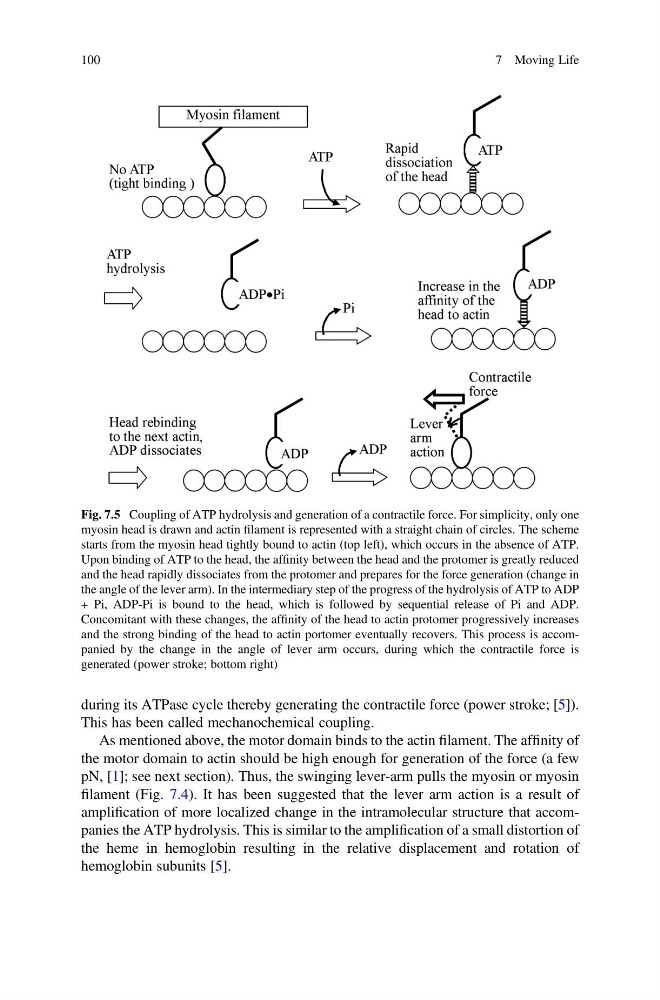
Fig. 7.5 Coupling of ATP hydrolysis and generation of a contractile force. For simplicity, only one
myosin head is drawn and actin filament is represented with a straight chain of circles. The scheme
starts from the myosin head tightly bound to actin (top left), which occurs in the absence of ATP.
Upon binding of ATP to the head, the affinity between the head and the protomer is greatly reduced
and the head rapidly dissociates from the protomer and prepares for the force generation (change in
the angle of the lever arm). In the intermediary step of the progress of the hydrolysis of ATP to ADP
+ Pi, ADP-Pi is bound to the head, which is followed by sequential release of Pi and ADP.
Concomitant with these changes, the affinity of the head to actin protomer progressively increases
and the strong binding of the head to actin portomer eventually recovers. This process is accompanied by the change in the angle of lever arm occurs, during which the contractile force is
generated (power stroke; bottom right)
100
7 Moving Life
This has been called mechanochemical coupling.
As mentioned above, the motor domain binds to the actin filament. The affinity of
the motor domain to actin should be high enough for generation of the force (a few
pN, [1]; see next section). Thus, the swinging lever-arm pulls the myosin or myosin
filament (Fig. 7.4). It has been suggested that the lever arm action is a result of
amplification of more localized change in the intramolecular structure that accompanies the ATP hydrolysis. This is similar to the amplification of a small distortion of
the heme in hemoglobin resulting in the relative displacement and rotation of
hemoglobin subunits [5].
Fig. 7.5 Coupling of ATP hydrolysis and generation of a contractile force. For simplicity, only one
myosin head is drawn and actin filament is represented with a straight chain of circles. The scheme
starts from the myosin head tightly bound to actin (top left), which occurs in the absence of ATP.
Upon binding of ATP to the head, the affinity between the head and the protomer is greatly reduced
and the head rapidly dissociates from the protomer and prepares for the force generation (change in
the angle of the lever arm). In the intermediary step of the progress of the hydrolysis of ATP to ADP
+ Pi, ADP-Pi is bound to the head, which is followed by sequential release of Pi and ADP.
Concomitant with these changes, the affinity of the head to actin protomer progressively increases
and the strong binding of the head to actin portomer eventually recovers. This process is accompanied by the change in the angle of lever arm occurs, during which the contractile force is
generated (power stroke; bottom right)
100
7 Moving Life