

the head dissociates from the actin with the rate of ~1000 s
-1 . After ATP is
hydrolyzed, the reaction product, inorganic phosphate (Pi) dissociates from the
head. As a result, the high affinity of the head to actin is recovered and the head
again binds to actin. The rapid dissociation and enhancement of the ATP hydrolyzing activity of myosin head upon its re-binding to actin is necessary for the head to
perform the rapid contraction of a skeletal muscle, because during the contraction at
the maximum velocity, the time for each head to pass individual actin protomer will
be only a few milliseconds. On the other hand, the recovery of the strong affinity of
the head to actin with the progress of hydrolysis will be necessary to produce
contractile forces of sufficient magnitudes. Thus, the biochemical properties of the
skeletal actomyosin seem to be optimized for the contractile property of skeletal
muscle.
7.1.2 Muscle Contraction at the Molecular Level
The crystal structure of myosin head [4] revealed distinctive features of the myosin
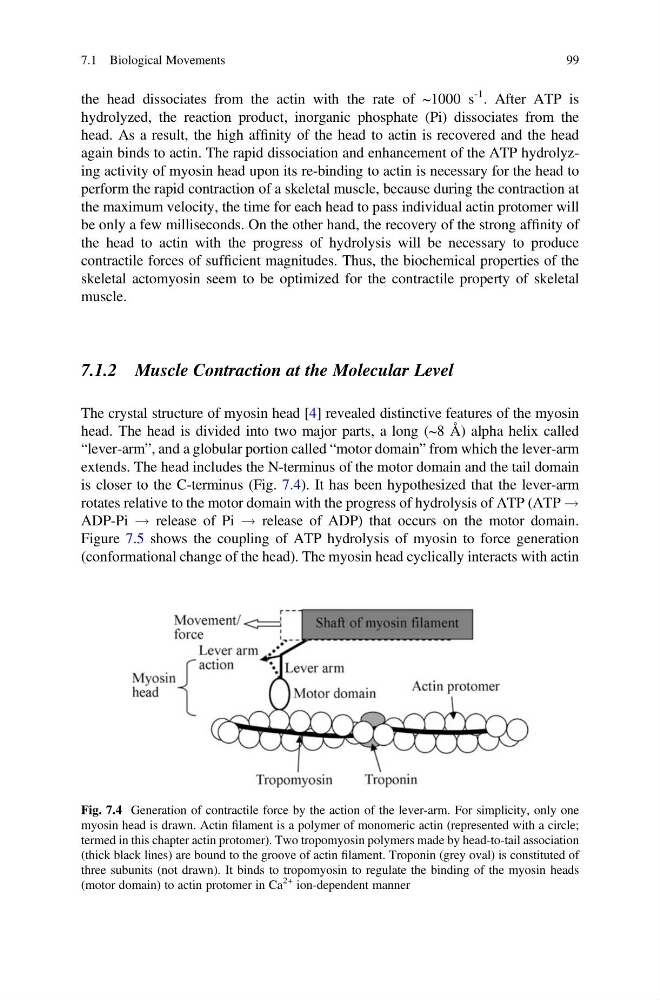
head. The head is divided into two major parts, a long (~8 Å) alpha helix called
“lever-arm”, and a globular portion called “motor domain” from which the lever-arm
extends. The head includes the N-terminus of the motor domain and the tail domain
is closer to the C-terminus (Fig. 7.4). It has been hypothesized that the lever-arm
rotates relative to the motor domain with the progress of hydrolysis of ATP (ATP !
ADP-Pi ! release of Pi ! release of ADP) that occurs on the motor domain.
Figure 7.5 shows the coupling of ATP hydrolysis of myosin to force generation
(conformational change of the head). The myosin head cyclically interacts with actin
Fig. 7.4 Generation of contractile force by the action of the lever-arm. For simplicity, only one
myosin head is drawn. Actin filament is a polymer of monomeric actin (represented with a circle;
termed in this chapter actin protomer). Two tropomyosin polymers made by head-to-tail association
(thick black lines) are bound to the groove of actin filament. Troponin (grey oval) is constituted of
three subunits (not drawn). It binds to tropomyosin to regulate the binding of the myosin heads
(motor domain) to actin protomer in Ca
2+ ion-dependent manner
7.1 Biological Movements
99
-1 . After ATP is
hydrolyzed, the reaction product, inorganic phosphate (Pi) dissociates from the
head. As a result, the high affinity of the head to actin is recovered and the head
again binds to actin. The rapid dissociation and enhancement of the ATP hydrolyzing activity of myosin head upon its re-binding to actin is necessary for the head to
perform the rapid contraction of a skeletal muscle, because during the contraction at
the maximum velocity, the time for each head to pass individual actin protomer will
be only a few milliseconds. On the other hand, the recovery of the strong affinity of
the head to actin with the progress of hydrolysis will be necessary to produce
contractile forces of sufficient magnitudes. Thus, the biochemical properties of the
skeletal actomyosin seem to be optimized for the contractile property of skeletal
muscle.
7.1.2 Muscle Contraction at the Molecular Level
The crystal structure of myosin head [4] revealed distinctive features of the myosin
head. The head is divided into two major parts, a long (~8 Å) alpha helix called
“lever-arm”, and a globular portion called “motor domain” from which the lever-arm
extends. The head includes the N-terminus of the motor domain and the tail domain
is closer to the C-terminus (Fig. 7.4). It has been hypothesized that the lever-arm
rotates relative to the motor domain with the progress of hydrolysis of ATP (ATP !
ADP-Pi ! release of Pi ! release of ADP) that occurs on the motor domain.
Figure 7.5 shows the coupling of ATP hydrolysis of myosin to force generation
(conformational change of the head). The myosin head cyclically interacts with actin
Fig. 7.4 Generation of contractile force by the action of the lever-arm. For simplicity, only one
myosin head is drawn. Actin filament is a polymer of monomeric actin (represented with a circle;
termed in this chapter actin protomer). Two tropomyosin polymers made by head-to-tail association
(thick black lines) are bound to the groove of actin filament. Troponin (grey oval) is constituted of
three subunits (not drawn). It binds to tropomyosin to regulate the binding of the myosin heads
(motor domain) to actin protomer in Ca
2+ ion-dependent manner
7.1 Biological Movements
99