

M´ ethodes de calcul de d´ eriv´ ees, d´ eriv´ ees d’ordre sup´ erieur
35
3.2.4
D´ eriv´ ees de « fonctions vectorielles »
D ´ efinition. Soit a(t) une fonction vectorielle; alors :
a
(t) = lim
∆t→0
a(t + ∆t) − a(t)
∆t
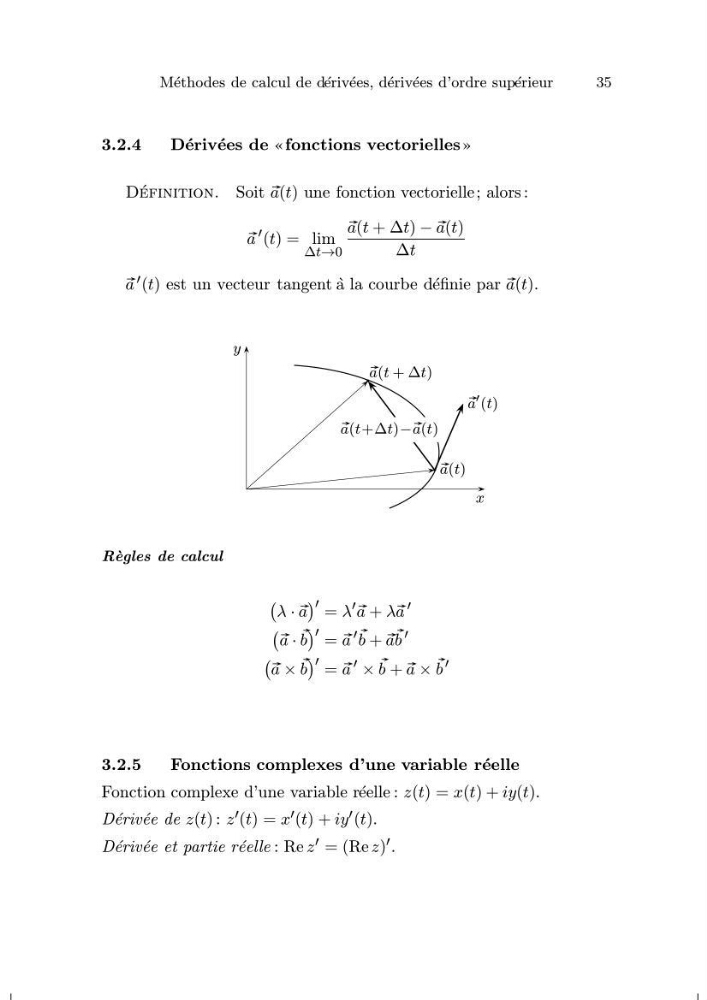
a (t) est un vecteur tangent `
a la courbe d´ efinie par a(t).
y
x
a(t)
a(t + ∆t)
a(t+∆t)−a(t)
a
(t)
R` egles de calcul
λ · a
= λ
a + λa
a · b
= a
b + ab
a × b
= a
× b + a × b
3.2.5
Fonctions complexes d’une variable r´ eelle
Fonction complexe d’une variable r´ eelle : z(t) = x(t) + iy(t).
D´ eriv´ ee de z(t) : z (t) = x (t) + iy (t).
D´ eriv´ ee et partie r´ eelle : Re z = (Re z) .
35
3.2.4
D´ eriv´ ees de « fonctions vectorielles »
D ´ efinition. Soit a(t) une fonction vectorielle; alors :
a
(t) = lim
∆t→0
a(t + ∆t) − a(t)
∆t
a (t) est un vecteur tangent `
a la courbe d´ efinie par a(t).
y
x
a(t)
a(t + ∆t)
a(t+∆t)−a(t)
a
(t)
R` egles de calcul
λ · a
= λ
a + λa
a · b
= a
b + ab
a × b
= a
× b + a × b
3.2.5
Fonctions complexes d’une variable r´ eelle
Fonction complexe d’une variable r´ eelle : z(t) = x(t) + iy(t).
D´ eriv´ ee de z(t) : z (t) = x (t) + iy (t).
D´ eriv´ ee et partie r´ eelle : Re z = (Re z) .