

32
Calcul diff´ erentiel de fonctions d’une variable
y
x
a
ξ
b
y = f (x)
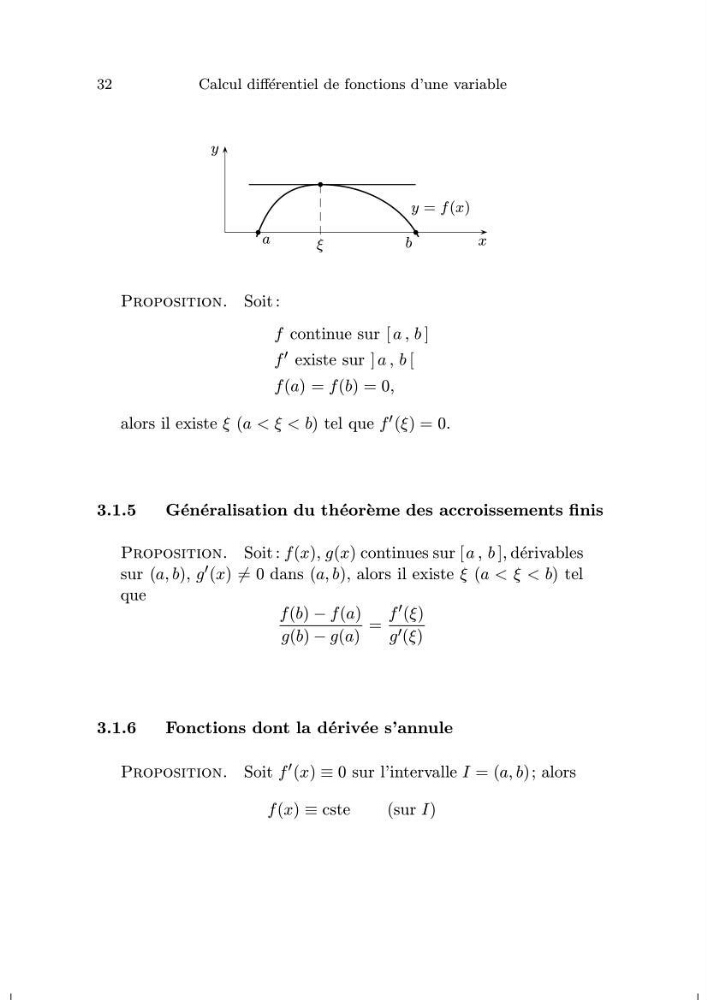
Proposition. Soit :
f continue sur [ a , b ]
f existe sur ] a , b [
f(a) = f(b) = 0,
alors il existe ξ (a < ξ < b) tel que f (ξ) = 0.
3.1.5
G´ en´ eralisation du th´ eor` eme des accroissements finis
Proposition. Soit : f(x), g(x) continues sur [ a , b ], d´ erivables
sur (a, b), g (x) = 0 dans (a, b), alors il existe ξ (a < ξ < b) tel
que
f(b) − f(a)
g(b) − g(a)
=
f (ξ)
g (ξ)
3.1.6
Fonctions dont la d´ eriv´ ee s’annule
Proposition. Soit f (x) ≡ 0 sur l’intervalle I = (a, b); alors
f(x) ≡ cste
(sur I)
Calcul diff´ erentiel de fonctions d’une variable
y
x
a
ξ
b
y = f (x)
Proposition. Soit :
f continue sur [ a , b ]
f existe sur ] a , b [
f(a) = f(b) = 0,
alors il existe ξ (a < ξ < b) tel que f (ξ) = 0.
3.1.5
G´ en´ eralisation du th´ eor` eme des accroissements finis
Proposition. Soit : f(x), g(x) continues sur [ a , b ], d´ erivables
sur (a, b), g (x) = 0 dans (a, b), alors il existe ξ (a < ξ < b) tel
que
f(b) − f(a)
g(b) − g(a)
=
f (ξ)
g (ξ)
3.1.6
Fonctions dont la d´ eriv´ ee s’annule
Proposition. Soit f (x) ≡ 0 sur l’intervalle I = (a, b); alors
f(x) ≡ cste
(sur I)