

11.3 Exercices d’approfondissement
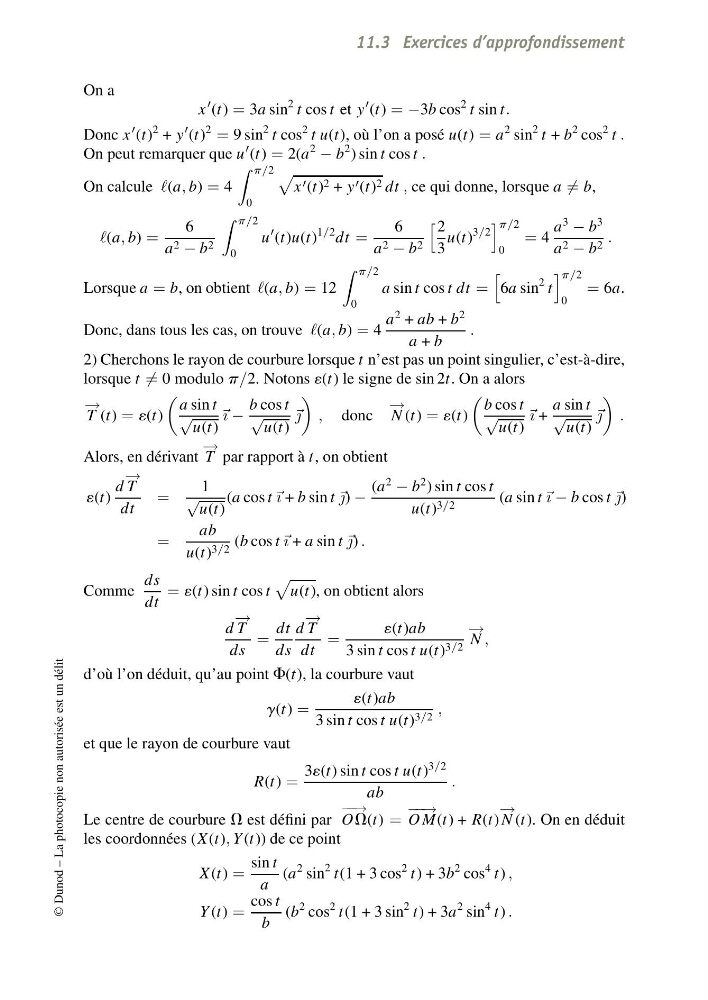
On a
x
(t) = 3a sin
2 t cos t et y
(t) = −3b cos
2 t sin t.
Donc x
(t)
2 + y
(t)
2 = 9 sin
2 t cos
2 t u(t), où l’on a posé u(t) = a
2 sin
2 t + b
2 cos
2 t .
On peut remarquer que u
(t) = 2(a
2
− b
2 ) sin t cos t .
On calcule (a, b) = 4
p/2
0
x (t) 2 + y (t) 2 dt , ce qui donne, lorsque a = b,
(a, b) =
6
a 2 − b 2
p/2
0
u
(t)u(t)
1/2 dt =
6
a 2 − b 2
2
3
u(t)
3/2
p/2
0
= 4
a
3
− b
3
a 2 − b 2 .
Lorsque a = b, on obtient (a, b) = 12
p/2
0
a sin t cos t dt =
6a sin
2 t
p/2
0
= 6a.
Donc, dans tous les cas, on trouve (a, b) = 4
a
2 + ab + b
2
a + b
.
2) Cherchons le rayon de courbure lorsque t n’est pas un point singulier, c’est-à-dire,
lorsque t = 0 modulo p/2. Notons ´(t) le signe de sin 2t. On a alors
→
T (t) = ´(t)
a sin t
√
u(t)
ı −
b cos t
√
u(t)
j
, donc
→
N (t) = ´(t)
b cos t
√
u(t)
ı +
a sin t
√
u(t)
j
.
Alors, en dérivant
→
T par rapport à t, on obtient
´(t)
d
→
T
dt
=
1
√
u(t)
(a cos t ı + b sin t j) −
(a
2
− b
2 ) sin t cos t
u(t) 3/2
(a sin t ı − b cos t j)
=
ab
u(t) 3/2 (b cos t ı + a sin t j) .
Comme
ds
dt
= ´(t) sin t cos t
u(t), on obtient alors
d
→
T
ds
=
dt
ds
d
→
T
dt
=
´(t)ab
3 sin t cos t u(t) 3/2
→
N ,
d’où l’on déduit, qu’au point F(t), la courbure vaut
g(t) =
´(t)ab
3 sin t cos t u(t) 3/2 ,
et que le rayon de courbure vaut
R(t) =
3´(t) sin t cos t u(t)
3/2
ab
.
Le centre de courbure V est défini par
− − →
OV(t) =
− − →
O M(t) + R(t)
→
N (t). On en déduit
les coordonnées (X (t), Y (t)) de ce point
X (t) =
sin t
a
(a
2 sin
2 t(1 + 3 cos
2 t) + 3b
2 cos
4 t) ,
Y (t) =
cos t
b
(b
2 cos
2 t(1 + 3 sin
2 t) + 3a
2 sin
4 t) .
© Dunod – La photocopie non autorisée est un délit
On a
x
(t) = 3a sin
2 t cos t et y
(t) = −3b cos
2 t sin t.
Donc x
(t)
2 + y
(t)
2 = 9 sin
2 t cos
2 t u(t), où l’on a posé u(t) = a
2 sin
2 t + b
2 cos
2 t .
On peut remarquer que u
(t) = 2(a
2
− b
2 ) sin t cos t .
On calcule (a, b) = 4
p/2
0
x (t) 2 + y (t) 2 dt , ce qui donne, lorsque a = b,
(a, b) =
6
a 2 − b 2
p/2
0
u
(t)u(t)
1/2 dt =
6
a 2 − b 2
2
3
u(t)
3/2
p/2
0
= 4
a
3
− b
3
a 2 − b 2 .
Lorsque a = b, on obtient (a, b) = 12
p/2
0
a sin t cos t dt =
6a sin
2 t
p/2
0
= 6a.
Donc, dans tous les cas, on trouve (a, b) = 4
a
2 + ab + b
2
a + b
.
2) Cherchons le rayon de courbure lorsque t n’est pas un point singulier, c’est-à-dire,
lorsque t = 0 modulo p/2. Notons ´(t) le signe de sin 2t. On a alors
→
T (t) = ´(t)
a sin t
√
u(t)
ı −
b cos t
√
u(t)
j
, donc
→
N (t) = ´(t)
b cos t
√
u(t)
ı +
a sin t
√
u(t)
j
.
Alors, en dérivant
→
T par rapport à t, on obtient
´(t)
d
→
T
dt
=
1
√
u(t)
(a cos t ı + b sin t j) −
(a
2
− b
2 ) sin t cos t
u(t) 3/2
(a sin t ı − b cos t j)
=
ab
u(t) 3/2 (b cos t ı + a sin t j) .
Comme
ds
dt
= ´(t) sin t cos t
u(t), on obtient alors
d
→
T
ds
=
dt
ds
d
→
T
dt
=
´(t)ab
3 sin t cos t u(t) 3/2
→
N ,
d’où l’on déduit, qu’au point F(t), la courbure vaut
g(t) =
´(t)ab
3 sin t cos t u(t) 3/2 ,
et que le rayon de courbure vaut
R(t) =
3´(t) sin t cos t u(t)
3/2
ab
.
Le centre de courbure V est défini par
− − →
OV(t) =
− − →
O M(t) + R(t)
→
N (t). On en déduit
les coordonnées (X (t), Y (t)) de ce point
X (t) =
sin t
a
(a
2 sin
2 t(1 + 3 cos
2 t) + 3b
2 cos
4 t) ,
Y (t) =
cos t
b
(b
2 cos
2 t(1 + 3 sin
2 t) + 3a
2 sin
4 t) .
© Dunod – La photocopie non autorisée est un délit