

2.4 Pulse 3
67
The epistemic function of [causal] mechanisms is this: they are free-floating intelligibilityproducing devices that fill in between inputs and outputs in a way that is more satisfying—
more understanding-producing—than “predictors which cannot be excluded a priori as “no
affect” relations.
When we identify a causal mechanism, the integration of an isolated piece of
causal knowledge to a much larger body of knowledge takes place. This larger body of
knowledge assists in answering numerous follow-up questions about the conditions
that are necessary for the causal dependence to occur, which I have already referred
to above. Hedström and Ylikoski (2010: 10) formulate this question in the following
way: ‘…what are the necessary background conditions and what are the possible
intervening factors that have to be absent for the effect to be present?’ By asking
and answering this question, we expand our understanding of the causal mechanisms
operating within a specific context (Hedström and Ylikoski 2010).
These notions of causal mechanisms and their functions shed light on the nature
of a causal mechanism as an explanatory account, condition, relation and process.
In a previous publication (Meissner et al. 2018), these descriptions were utilised to
identify the nature of specific causal mechanisms that were contained in the face-toface interviews that we conducted in two municipalities on water security, namely,
the eThekwini Metropolitan and Sekhukhune District Municipalities. This enabled
the research team to isolate causal variables that influence people’s perceptions of
what constitutes water security, at a local government level, and to see whether their
perceptions are positive or negative and characterised by either a short- or long-term
view of water (in) security (Meissner et al. 2018, 2019). Such an analysis could shed
further light on what practitioners could do to change negative situations into more
positive ones. I will be using the same procedure to identity the causal mechanisms
expressed by the respondents that were interviewed during the green and ecological
policy landscape research project.
2.4.2.3 Theories for Practice
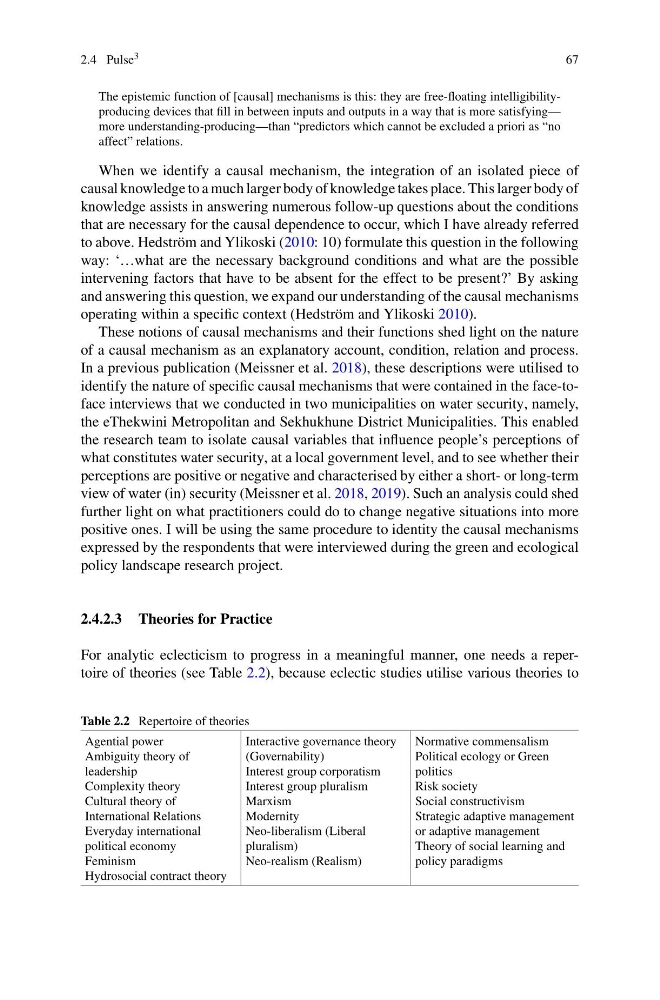
For analytic eclecticism to progress in a meaningful manner, one needs a repertoire of theories (see Table 2.2), because eclectic studies utilise various theories to
Table 2.2 Repertoire of theories
Agential power
Ambiguity theory of
leadership
Complexity theory
Cultural theory of
International Relations
Everyday international
political economy
Feminism
Hydrosocial contract theory
Interactive governance theory
(Governability)
Interest group corporatism
Interest group pluralism
Marxism
Modernity
Neo-liberalism (Liberal
pluralism)
Neo-realism (Realism)
Normative commensalism
Political ecology or Green
politics
Risk society
Social constructivism
Strategic adaptive management
or adaptive management
Theory of social learning and
policy paradigms
67
The epistemic function of [causal] mechanisms is this: they are free-floating intelligibilityproducing devices that fill in between inputs and outputs in a way that is more satisfying—
more understanding-producing—than “predictors which cannot be excluded a priori as “no
affect” relations.
When we identify a causal mechanism, the integration of an isolated piece of
causal knowledge to a much larger body of knowledge takes place. This larger body of
knowledge assists in answering numerous follow-up questions about the conditions
that are necessary for the causal dependence to occur, which I have already referred
to above. Hedström and Ylikoski (2010: 10) formulate this question in the following
way: ‘…what are the necessary background conditions and what are the possible
intervening factors that have to be absent for the effect to be present?’ By asking
and answering this question, we expand our understanding of the causal mechanisms
operating within a specific context (Hedström and Ylikoski 2010).
These notions of causal mechanisms and their functions shed light on the nature
of a causal mechanism as an explanatory account, condition, relation and process.
In a previous publication (Meissner et al. 2018), these descriptions were utilised to
identify the nature of specific causal mechanisms that were contained in the face-toface interviews that we conducted in two municipalities on water security, namely,
the eThekwini Metropolitan and Sekhukhune District Municipalities. This enabled
the research team to isolate causal variables that influence people’s perceptions of
what constitutes water security, at a local government level, and to see whether their
perceptions are positive or negative and characterised by either a short- or long-term
view of water (in) security (Meissner et al. 2018, 2019). Such an analysis could shed
further light on what practitioners could do to change negative situations into more
positive ones. I will be using the same procedure to identity the causal mechanisms
expressed by the respondents that were interviewed during the green and ecological
policy landscape research project.
2.4.2.3 Theories for Practice
For analytic eclecticism to progress in a meaningful manner, one needs a repertoire of theories (see Table 2.2), because eclectic studies utilise various theories to
Table 2.2 Repertoire of theories
Agential power
Ambiguity theory of
leadership
Complexity theory
Cultural theory of
International Relations
Everyday international
political economy
Feminism
Hydrosocial contract theory
Interactive governance theory
(Governability)
Interest group corporatism
Interest group pluralism
Marxism
Modernity
Neo-liberalism (Liberal
pluralism)
Neo-realism (Realism)
Normative commensalism
Political ecology or Green
politics
Risk society
Social constructivism
Strategic adaptive management
or adaptive management
Theory of social learning and
policy paradigms