

52
2 The Use of Paradigms and Theories in the PULSE 3 …
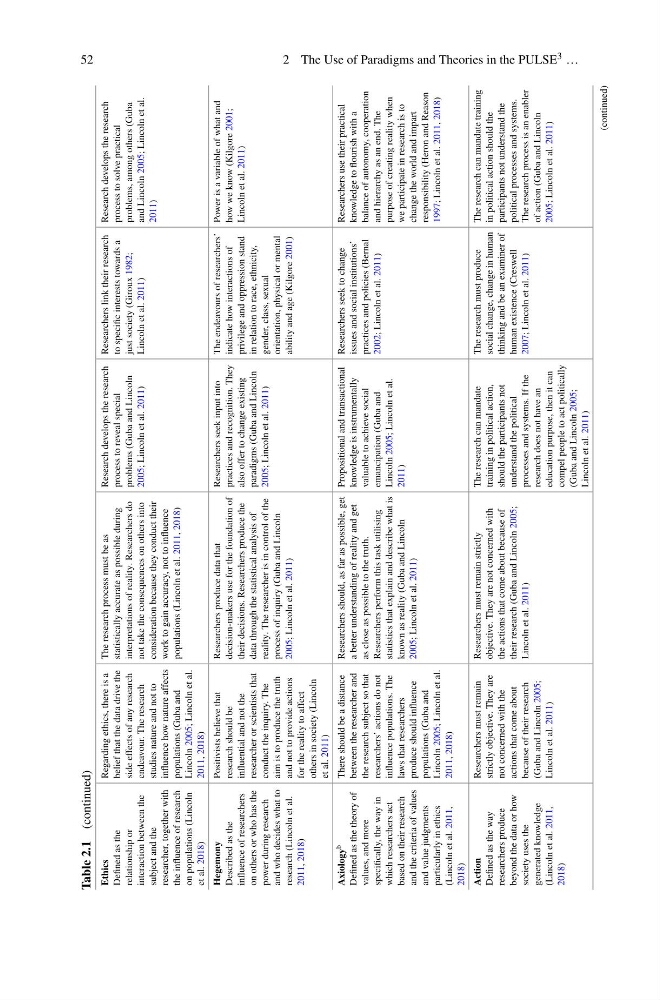
Table 2.1
(continued)
Ethics
Defined as the
relationship or
interaction between the
subject and the
researcher, together with
the influence of research
on populations (Lincoln
et al. 2018)
Regarding ethics, there is a
belief that the data drive the
side effects of any research
endeavour. The research
studies nature and not to
influence how nature affects
populations (Guba and
Lincoln 2005; Lincoln et al.
2011, 2018)
The research process must be as
statistically accurate as possible during
interpretations of reality. Researchers do
not take the consequences on others into
consideration because they conduct their
work to gain accuracy, not to influence
populations (Lincoln et al. 2011, 2018)
Research develops the research
process to reveal special
problems (Guba and Lincoln
2005; Lincoln et al. 2011)
Researchers link their research
to specific interests towards a
just society (Giroux 1982;
Lincoln et al. 2011)
Research develops the research
process to solve practical
problems, among others (Guba
and Lincoln 2005; Lincoln et al.
2011)
Hegemony
Described as the
influence of researchers
on others or who has the
power during research
and who decides what to
research (Lincoln et al.
2011, 2018)
Positivists believe that
research should be
influential and not the
researcher or scientists that
conduct the inquiry. The
aim is to produce the truth
and not to provide actions
for the reality to affect
others in society (Lincoln
et al. 2011)
Researchers produce data that
decision-makers use for the foundation of
their decisions. Researchers produce the
data through the statistical analysis of
reality. The researcher is in control of the
process of inquiry (Guba and Lincoln
2005; Lincoln et al. 2011)
Researchers seek input into
practices and recognition. They
also offer to change existing
paradigms (Guba and Lincoln
2005; Lincoln et al. 2011)
The endeavours of researchers’
indicate how interactions of
privilege and oppression stand
in relation to race, ethnicity,
gender, class, sexual
orientation, physical or mental
ability and age (Kilgore 2001)
Power is a variable of what and
how we know (Kilgore 2001;
Lincoln et al. 2011)
Axiology b
Defined as the theory of
values, and more
specifically, the way in
which researchers act
based on their research
and the criteria of values
and value judgments
particularly in ethics
(Lincoln et al. 2011,
2018)
There should be a distance
between the researcher and
the research subject so that
researchers’ actions do not
influence populations. The
laws that researchers
produce should influence
populations (Guba and
Lincoln 2005; Lincoln et al.
2011, 2018)
Researchers should, as far as possible, get
a better understanding of reality and get
as close as possible to the truth.
Researchers perform this task utilising
statistics that explain and describe what is
known as reality (Guba and Lincoln
2005; Lincoln et al. 2011)
Propositional and transactional
knowledge is instrumentally
valuable to achieve social
emancipation (Guba and
Lincoln 2005; Lincoln et al.
2011)
Researchers seek to change
issues and social institutions’
practices and policies (Bernal
2002; Lincoln et al. 2011)
Researchers use their practical
knowledge to flourish with a
balance of autonomy, cooperation
and hierarchy as an end. The
purpose of creating reality when
we participate in research is to
change the world and impart
responsibility (Heron and Reason
1997; Lincoln et al. 2011, 2018)
Action
Defined as the way
researchers produce
beyond the data or how
society uses the
generated knowledge
(Lincoln et al. 2011,
2018)
Researchers must remain
strictly objective. They are
not concerned with the
actions that come about
because of their research
(Guba and Lincoln 2005;
Lincoln et al. 2011)
Researchers must remain strictly
objective. They are not concerned with
the actions that come about because of
their research (Guba and Lincoln 2005;
Lincoln et al. 2011)
The research can mandate
training in political action,
should the participants not
understand the political
processes and systems. If the
research does not have an
education purpose, then it can
compel people to act politically
(Guba and Lincoln 2005;
Lincoln et al. 2011)
The research must produce
social change, change in human
thinking and be an examiner of
human existence (Creswell
2007; Lincoln et al. 2011)
The research can mandate training
in political action should the
participants not understand the
political processes and systems.
The research process is an enabler
of action (Guba and Lincoln
2005; Lincoln et al. 2011)
(continued)
2 The Use of Paradigms and Theories in the PULSE 3 …
Table 2.1
(continued)
Ethics
Defined as the
relationship or
interaction between the
subject and the
researcher, together with
the influence of research
on populations (Lincoln
et al. 2018)
Regarding ethics, there is a
belief that the data drive the
side effects of any research
endeavour. The research
studies nature and not to
influence how nature affects
populations (Guba and
Lincoln 2005; Lincoln et al.
2011, 2018)
The research process must be as
statistically accurate as possible during
interpretations of reality. Researchers do
not take the consequences on others into
consideration because they conduct their
work to gain accuracy, not to influence
populations (Lincoln et al. 2011, 2018)
Research develops the research
process to reveal special
problems (Guba and Lincoln
2005; Lincoln et al. 2011)
Researchers link their research
to specific interests towards a
just society (Giroux 1982;
Lincoln et al. 2011)
Research develops the research
process to solve practical
problems, among others (Guba
and Lincoln 2005; Lincoln et al.
2011)
Hegemony
Described as the
influence of researchers
on others or who has the
power during research
and who decides what to
research (Lincoln et al.
2011, 2018)
Positivists believe that
research should be
influential and not the
researcher or scientists that
conduct the inquiry. The
aim is to produce the truth
and not to provide actions
for the reality to affect
others in society (Lincoln
et al. 2011)
Researchers produce data that
decision-makers use for the foundation of
their decisions. Researchers produce the
data through the statistical analysis of
reality. The researcher is in control of the
process of inquiry (Guba and Lincoln
2005; Lincoln et al. 2011)
Researchers seek input into
practices and recognition. They
also offer to change existing
paradigms (Guba and Lincoln
2005; Lincoln et al. 2011)
The endeavours of researchers’
indicate how interactions of
privilege and oppression stand
in relation to race, ethnicity,
gender, class, sexual
orientation, physical or mental
ability and age (Kilgore 2001)
Power is a variable of what and
how we know (Kilgore 2001;
Lincoln et al. 2011)
Axiology b
Defined as the theory of
values, and more
specifically, the way in
which researchers act
based on their research
and the criteria of values
and value judgments
particularly in ethics
(Lincoln et al. 2011,
2018)
There should be a distance
between the researcher and
the research subject so that
researchers’ actions do not
influence populations. The
laws that researchers
produce should influence
populations (Guba and
Lincoln 2005; Lincoln et al.
2011, 2018)
Researchers should, as far as possible, get
a better understanding of reality and get
as close as possible to the truth.
Researchers perform this task utilising
statistics that explain and describe what is
known as reality (Guba and Lincoln
2005; Lincoln et al. 2011)
Propositional and transactional
knowledge is instrumentally
valuable to achieve social
emancipation (Guba and
Lincoln 2005; Lincoln et al.
2011)
Researchers seek to change
issues and social institutions’
practices and policies (Bernal
2002; Lincoln et al. 2011)
Researchers use their practical
knowledge to flourish with a
balance of autonomy, cooperation
and hierarchy as an end. The
purpose of creating reality when
we participate in research is to
change the world and impart
responsibility (Heron and Reason
1997; Lincoln et al. 2011, 2018)
Action
Defined as the way
researchers produce
beyond the data or how
society uses the
generated knowledge
(Lincoln et al. 2011,
2018)
Researchers must remain
strictly objective. They are
not concerned with the
actions that come about
because of their research
(Guba and Lincoln 2005;
Lincoln et al. 2011)
Researchers must remain strictly
objective. They are not concerned with
the actions that come about because of
their research (Guba and Lincoln 2005;
Lincoln et al. 2011)
The research can mandate
training in political action,
should the participants not
understand the political
processes and systems. If the
research does not have an
education purpose, then it can
compel people to act politically
(Guba and Lincoln 2005;
Lincoln et al. 2011)
The research must produce
social change, change in human
thinking and be an examiner of
human existence (Creswell
2007; Lincoln et al. 2011)
The research can mandate training
in political action should the
participants not understand the
political processes and systems.
The research process is an enabler
of action (Guba and Lincoln
2005; Lincoln et al. 2011)
(continued)