

2.4 Pulse 3
51
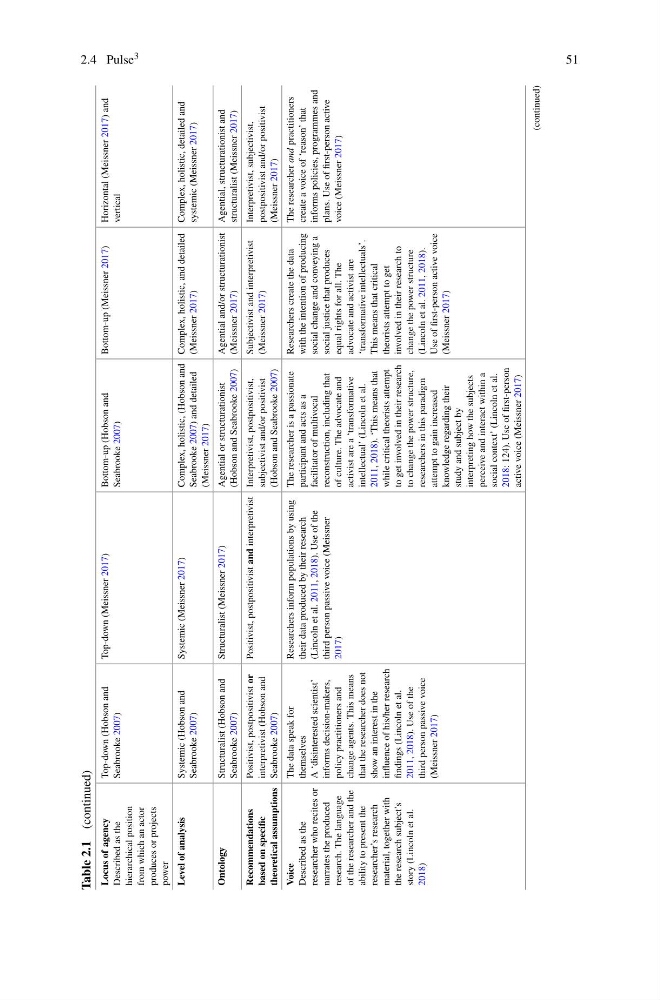
Table 2.1
(continued)
Locus of agency
Described as the
hierarchical position
from which an actor
produces or projects
power
Top-down (Hobson and
Seabrooke 2007)
Top-down (Meissner 2017)
Bottom-up (Hobson and
Seabrooke 2007)
Bottom-up (Meissner 2017)
Horizontal (Meissner 2017) and
vertical
Level of analysis
Systemic (Hobson and
Seabrooke 2007)
Systemic (Meissner 2017)
Complex, holistic, (Hobson and
Seabrooke 2007) and detailed
(Meissner 2017)
Complex, holistic, and detailed
(Meissner 2017)
Complex, holistic, detailed and
systemic (Meissner 2017)
Ontology
Structuralist (Hobson and
Seabrooke 2007)
Structuralist (Meissner 2017)
Agential or structurationist
(Hobson and Seabrooke 2007)
Agential and/or structurationist
(Meissner 2017)
Agential, structurationist and
structuralist (Meissner 2017)
Recommendations
based on specific
theoretical assumptions
Positivist, postpositivist or
interpretivist (Hobson and
Seabrooke 2007)
Positivist, postpositivist and
interpretivist Interpretivist, postpositivist,
subjectivist and/or positivist
(Hobson and Seabrooke 2007)
Subjectivist and interpretivist
(Meissner 2017)
Interpretivist, subjectivist,
postpositivist and/or positivist
(Meissner 2017)
Voice
Described as the
researcher who recites or
narrates the produced
research. The language
of the researcher and the
ability to present the
researcher’s research
material, together with
the research subject’s
story (Lincoln et al.
2018)
The data speak for
themselves
A ‘disinterested scientist’
informs decision-makers,
policy practitioners and
change agents. This means
that the researcher does not
show an interest in the
influence of his/her research
findings (Lincoln et al.
2011, 2018). Use of the
third person passive voice
(Meissner 2017)
Researchers inform populations by using
their data produced by their research
(Lincoln et al. 2011, 2018). Use of the
third person passive voice (Meissner
2017)
The researcher is a passionate
participant and acts as a
facilitator of multivocal
reconstruction, including that
of culture. The advocate and
activist are a ‘transformative
intellectual’ (Lincoln et al.
2011, 2018). ‘This means that
while critical theorists attempt
to get involved in their research
to change the power structure,
researchers in this paradigm
attempt to gain increased
knowledge regarding their
study and subject by
interpreting how the subjects
perceive and interact within a
social context’ (Lincoln et al.
2018: 124). Use of first-person
active voice (Meissner 2017)
Researchers create the data
with the intention of producing
social change and conveying a
social justice that produces
equal rights for all. The
advocate and activist are
‘transformative intellectuals’.
This means that critical
theorists attempt to get
involved in their research to
change the power structure
(Lincoln et al. 2011, 2018).
Use of first-person active voice
(Meissner 2017)
The researcher and
practitioners
create a voice of ‘reason’ that
informs policies, programmes and
plans. Use of first-person active
voice (Meissner 2017)
(continued)
51
Table 2.1
(continued)
Locus of agency
Described as the
hierarchical position
from which an actor
produces or projects
power
Top-down (Hobson and
Seabrooke 2007)
Top-down (Meissner 2017)
Bottom-up (Hobson and
Seabrooke 2007)
Bottom-up (Meissner 2017)
Horizontal (Meissner 2017) and
vertical
Level of analysis
Systemic (Hobson and
Seabrooke 2007)
Systemic (Meissner 2017)
Complex, holistic, (Hobson and
Seabrooke 2007) and detailed
(Meissner 2017)
Complex, holistic, and detailed
(Meissner 2017)
Complex, holistic, detailed and
systemic (Meissner 2017)
Ontology
Structuralist (Hobson and
Seabrooke 2007)
Structuralist (Meissner 2017)
Agential or structurationist
(Hobson and Seabrooke 2007)
Agential and/or structurationist
(Meissner 2017)
Agential, structurationist and
structuralist (Meissner 2017)
Recommendations
based on specific
theoretical assumptions
Positivist, postpositivist or
interpretivist (Hobson and
Seabrooke 2007)
Positivist, postpositivist and
interpretivist Interpretivist, postpositivist,
subjectivist and/or positivist
(Hobson and Seabrooke 2007)
Subjectivist and interpretivist
(Meissner 2017)
Interpretivist, subjectivist,
postpositivist and/or positivist
(Meissner 2017)
Voice
Described as the
researcher who recites or
narrates the produced
research. The language
of the researcher and the
ability to present the
researcher’s research
material, together with
the research subject’s
story (Lincoln et al.
2018)
The data speak for
themselves
A ‘disinterested scientist’
informs decision-makers,
policy practitioners and
change agents. This means
that the researcher does not
show an interest in the
influence of his/her research
findings (Lincoln et al.
2011, 2018). Use of the
third person passive voice
(Meissner 2017)
Researchers inform populations by using
their data produced by their research
(Lincoln et al. 2011, 2018). Use of the
third person passive voice (Meissner
2017)
The researcher is a passionate
participant and acts as a
facilitator of multivocal
reconstruction, including that
of culture. The advocate and
activist are a ‘transformative
intellectual’ (Lincoln et al.
2011, 2018). ‘This means that
while critical theorists attempt
to get involved in their research
to change the power structure,
researchers in this paradigm
attempt to gain increased
knowledge regarding their
study and subject by
interpreting how the subjects
perceive and interact within a
social context’ (Lincoln et al.
2018: 124). Use of first-person
active voice (Meissner 2017)
Researchers create the data
with the intention of producing
social change and conveying a
social justice that produces
equal rights for all. The
advocate and activist are
‘transformative intellectuals’.
This means that critical
theorists attempt to get
involved in their research to
change the power structure
(Lincoln et al. 2011, 2018).
Use of first-person active voice
(Meissner 2017)
The researcher and
practitioners
create a voice of ‘reason’ that
informs policies, programmes and
plans. Use of first-person active
voice (Meissner 2017)
(continued)