

50
2 The Use of Paradigms and Theories in the PULSE 3 …
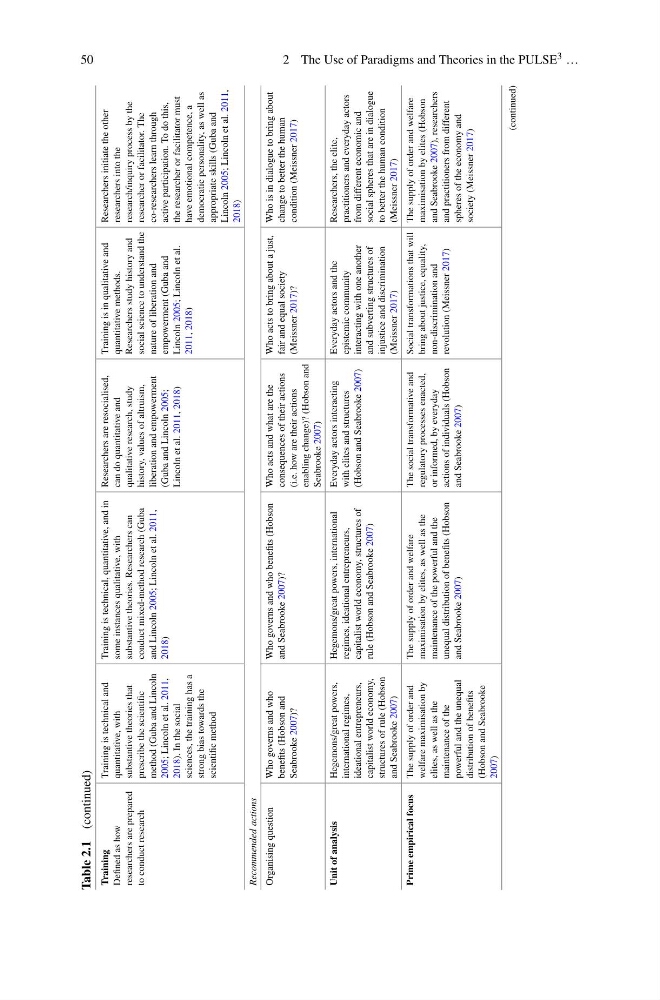
Table 2.1
(continued)
Training
Defined as how
researchers are prepared
to conduct research
Training is technical and
quantitative, with
substantive theories that
prescribe the scientific
method (Guba and Lincoln
2005; Lincoln et al. 2011,
2018). In the social
sciences, the training has a
strong bias towards the
scientific method
Training is technical, quantitative, and in
some instances qualitative, with
substantive theories. Researchers can
conduct mixed-method research (Guba
and Lincoln 2005; Lincoln et al. 2011,
2018)
Researchers are resocialised,
can do quantitative and
qualitative research, study
history, values of altruism,
liberation and empowerment
(Guba and Lincoln 2005;
Lincoln et al. 2011, 2018)
Training is in qualitative and
quantitative methods.
Researchers study history and
social science to understand the
nature of liberation and
empowerment (Guba and
Lincoln 2005; Lincoln et al.
2011, 2018)
Researchers initiate the other
researchers into the
research/inquiry process by the
researcher or facilitator. The
co-researchers learn through
active participation. To do this,
the researcher or facilitator must
have emotional competence, a
democratic personality, as well as
appropriate skills (Guba and
Lincoln 2005; Lincoln et al. 2011,
2018)
Recommended actions
Organising question
Who governs and who
benefits (Hobson and
Seabrooke 2007)?
Who governs and who benefits (Hobson
and Seabrooke 2007)?
Who acts and what are the
consequences of their actions
(i.e. how are their actions
enabling change)? (Hobson and
Seabrooke 2007)
Who acts to bring about a just,
fair and equal society
(Meissner 2017)?
Who is in dialogue to bring about
change to better the human
condition (Meissner 2017)
Unit of analysis
Hegemons/great powers,
international regimes,
ideational entrepreneurs,
capitalist world economy,
structures of rule (Hobson
and Seabrooke 2007)
Hegemons/great powers, international
regimes, ideational entrepreneurs,
capitalist world economy, structures of
rule (Hobson and Seabrooke 2007)
Everyday actors interacting
with elites and structures
(Hobson and Seabrooke 2007)
Everyday actors and the
epistemic community
interacting with one another
and subverting structures of
injustice and discrimination
(Meissner 2017)
Researchers, the elite,
practitioners and everyday actors
from different economic and
social spheres that are in dialogue
to better the human condition
(Meissner 2017)
Prime empirical focus
The supply of order and
welfare maximisation by
elites, as well as the
maintenance of the
powerful and the unequal
distribution of benefits
(Hobson and Seabrooke
2007)
The supply of order and welfare
maximisation by elites, as well as the
maintenance of the powerful and the
unequal distribution of benefits (Hobson
and Seabrooke 2007)
The social transformative and
regulatory processes enacted,
or informed, by everyday
actions of individuals (Hobson
and Seabrooke 2007)
Social transformations that will
bring about justice, equality,
non-discrimination and
revolution (Meissner 2017)
The supply of order and welfare
maximisation by elites (Hobson
and Seabrooke 2007), researchers
and practitioners from different
spheres of the economy and
society (Meissner 2017)
(continued)
2 The Use of Paradigms and Theories in the PULSE 3 …
Table 2.1
(continued)
Training
Defined as how
researchers are prepared
to conduct research
Training is technical and
quantitative, with
substantive theories that
prescribe the scientific
method (Guba and Lincoln
2005; Lincoln et al. 2011,
2018). In the social
sciences, the training has a
strong bias towards the
scientific method
Training is technical, quantitative, and in
some instances qualitative, with
substantive theories. Researchers can
conduct mixed-method research (Guba
and Lincoln 2005; Lincoln et al. 2011,
2018)
Researchers are resocialised,
can do quantitative and
qualitative research, study
history, values of altruism,
liberation and empowerment
(Guba and Lincoln 2005;
Lincoln et al. 2011, 2018)
Training is in qualitative and
quantitative methods.
Researchers study history and
social science to understand the
nature of liberation and
empowerment (Guba and
Lincoln 2005; Lincoln et al.
2011, 2018)
Researchers initiate the other
researchers into the
research/inquiry process by the
researcher or facilitator. The
co-researchers learn through
active participation. To do this,
the researcher or facilitator must
have emotional competence, a
democratic personality, as well as
appropriate skills (Guba and
Lincoln 2005; Lincoln et al. 2011,
2018)
Recommended actions
Organising question
Who governs and who
benefits (Hobson and
Seabrooke 2007)?
Who governs and who benefits (Hobson
and Seabrooke 2007)?
Who acts and what are the
consequences of their actions
(i.e. how are their actions
enabling change)? (Hobson and
Seabrooke 2007)
Who acts to bring about a just,
fair and equal society
(Meissner 2017)?
Who is in dialogue to bring about
change to better the human
condition (Meissner 2017)
Unit of analysis
Hegemons/great powers,
international regimes,
ideational entrepreneurs,
capitalist world economy,
structures of rule (Hobson
and Seabrooke 2007)
Hegemons/great powers, international
regimes, ideational entrepreneurs,
capitalist world economy, structures of
rule (Hobson and Seabrooke 2007)
Everyday actors interacting
with elites and structures
(Hobson and Seabrooke 2007)
Everyday actors and the
epistemic community
interacting with one another
and subverting structures of
injustice and discrimination
(Meissner 2017)
Researchers, the elite,
practitioners and everyday actors
from different economic and
social spheres that are in dialogue
to better the human condition
(Meissner 2017)
Prime empirical focus
The supply of order and
welfare maximisation by
elites, as well as the
maintenance of the
powerful and the unequal
distribution of benefits
(Hobson and Seabrooke
2007)
The supply of order and welfare
maximisation by elites, as well as the
maintenance of the powerful and the
unequal distribution of benefits (Hobson
and Seabrooke 2007)
The social transformative and
regulatory processes enacted,
or informed, by everyday
actions of individuals (Hobson
and Seabrooke 2007)
Social transformations that will
bring about justice, equality,
non-discrimination and
revolution (Meissner 2017)
The supply of order and welfare
maximisation by elites (Hobson
and Seabrooke 2007), researchers
and practitioners from different
spheres of the economy and
society (Meissner 2017)
(continued)