

2.4 Pulse 3
53
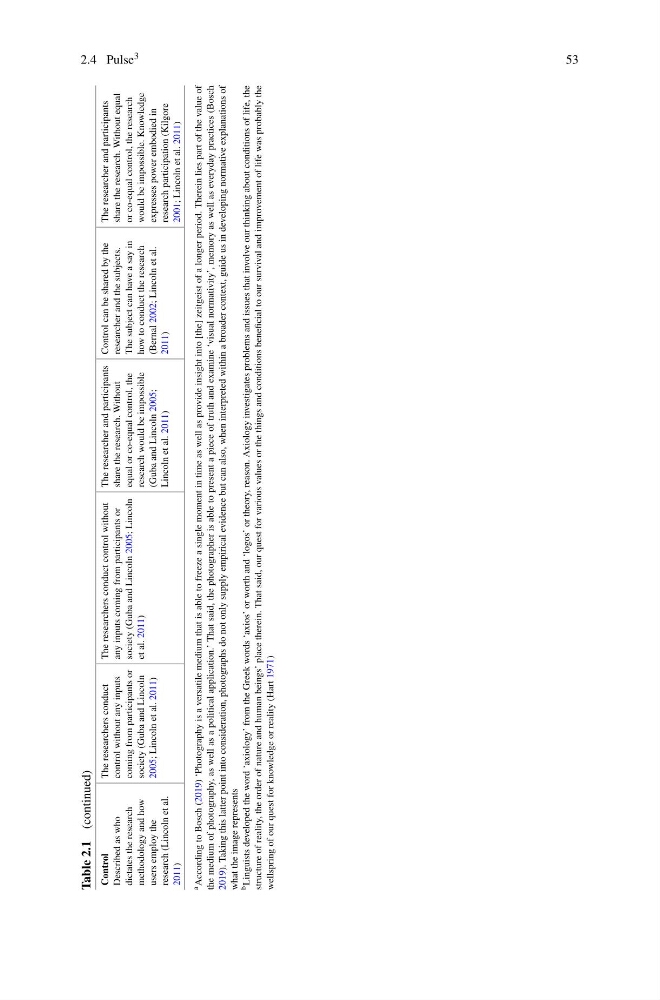
Table 2.1
(continued)
Control
Described as who
dictates the research
methodology and how
users employ the
research (Lincoln et al.
2011)
The researchers conduct
control without any inputs
coming from participants or
society (Guba and Lincoln
2005; Lincoln et al. 2011)
The researchers conduct control without
any inputs coming from participants or
society (Guba and Lincoln 2005; Lincoln
et al. 2011)
The researcher and participants
share the research. Without
equal or co-equal control, the
research would be impossible
(Guba and Lincoln 2005;
Lincoln et al. 2011)
Control can be shared by the
researcher and the subjects.
The subject can have a say in
how to conduct the research
(Bernal 2002; Lincoln et al.
2011)
The researcher and participants
share the research. Without equal
or co-equal control, the research
would be impossible. Knowledge
expresses power embodied in
research participation (Kilgore
2001; Lincoln et al. 2011)
a
According to Bosch (2019) ‘Photography is a versatile medium that is able to freeze a single moment in time as well as provide insight into [the] zeitgeist of a longer period. Therein lies part of the value of
the medium of photography, as well as a political application.’ That said, the photographer is able to present a piece of truth and examine ‘visual normativity’, memory as well as everyday practices (Bosch
2019). Taking this latter point into consideration, photographs do not only supply empirical evidence but can also, when interpreted within a broader context, guide us in developing normative explanations of
what the image represents
b
Linguists developed the word ‘axiology’ from the Greek words ‘axios’ or worth and ‘logos’ or theory, reason. Axiology investigates problems and issues that involve our thinking about conditions of life, the
structure of reality, the order of nature and human beings’ place therein. That said, our quest for various values or the things and conditions beneficial to our survival and improvement of life was probably the
wellspring of our quest for knowledge or reality (Hart 1971)
53
Table 2.1
(continued)
Control
Described as who
dictates the research
methodology and how
users employ the
research (Lincoln et al.
2011)
The researchers conduct
control without any inputs
coming from participants or
society (Guba and Lincoln
2005; Lincoln et al. 2011)
The researchers conduct control without
any inputs coming from participants or
society (Guba and Lincoln 2005; Lincoln
et al. 2011)
The researcher and participants
share the research. Without
equal or co-equal control, the
research would be impossible
(Guba and Lincoln 2005;
Lincoln et al. 2011)
Control can be shared by the
researcher and the subjects.
The subject can have a say in
how to conduct the research
(Bernal 2002; Lincoln et al.
2011)
The researcher and participants
share the research. Without equal
or co-equal control, the research
would be impossible. Knowledge
expresses power embodied in
research participation (Kilgore
2001; Lincoln et al. 2011)
a
According to Bosch (2019) ‘Photography is a versatile medium that is able to freeze a single moment in time as well as provide insight into [the] zeitgeist of a longer period. Therein lies part of the value of
the medium of photography, as well as a political application.’ That said, the photographer is able to present a piece of truth and examine ‘visual normativity’, memory as well as everyday practices (Bosch
2019). Taking this latter point into consideration, photographs do not only supply empirical evidence but can also, when interpreted within a broader context, guide us in developing normative explanations of
what the image represents
b
Linguists developed the word ‘axiology’ from the Greek words ‘axios’ or worth and ‘logos’ or theory, reason. Axiology investigates problems and issues that involve our thinking about conditions of life, the
structure of reality, the order of nature and human beings’ place therein. That said, our quest for various values or the things and conditions beneficial to our survival and improvement of life was probably the
wellspring of our quest for knowledge or reality (Hart 1971)