

2.4 Pulse 3
47
Table 2.1
(continued)
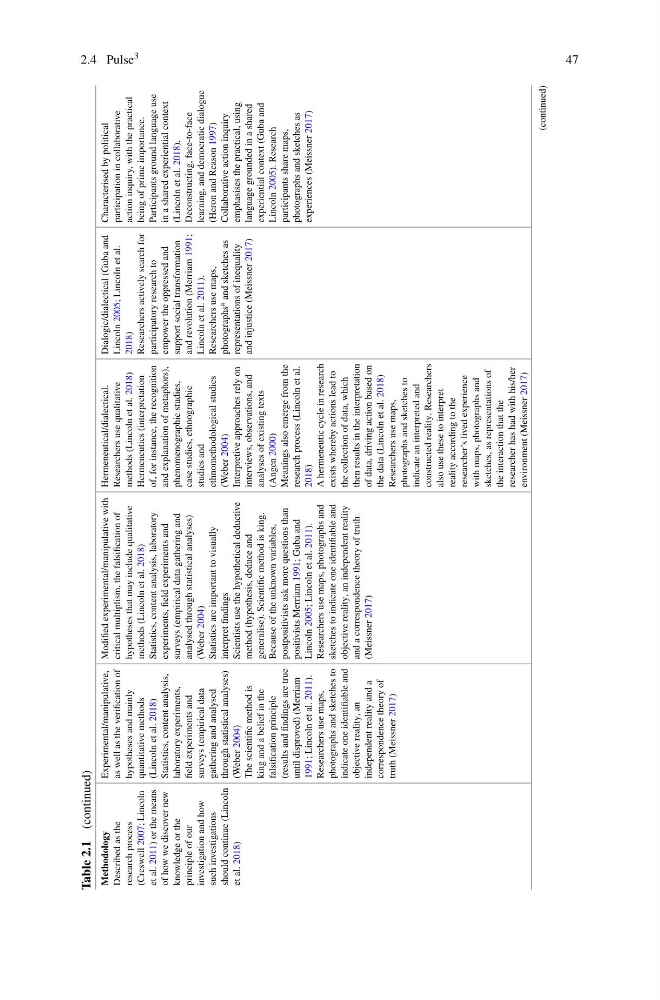
Methodology
Described as the
research process
(Creswell 2007; Lincoln
et al. 2011) or the means
of how we discover new
knowledge or the
principle of our
investigation and how
such investigations
should continue (Lincoln
et al. 2018)
Experimental/manipulative,
as well as the verification of
hypotheses and mainly
quantitative methods
(Lincoln et al. 2018)
Statistics, content analysis,
laboratory experiments,
field experiments and
surveys (empirical data
gathering and analysed
through statistical analyses)
(Weber 2004)
The scientific method is
king and a belief in the
falsification principle
(results and findings are true
until disproved) (Merriam
1991; Lincoln et al. 2011).
Researchers use maps,
photographs and sketches to
indicate one identifiable and
objective reality, an
independent reality and a
correspondence theory of
truth (Meissner 2017)
Modified experimental/manipulative with
critical multiplism, the falsification of
hypotheses that may include qualitative
methods (Lincoln et al. 2018)
Statistics, content analysis, laboratory
experiments, field experiments and
surveys (empirical data gathering and
analysed through statistical analyses)
(Weber 2004)
Statistics are important to visually
interpret findings
Scientists use the hypothetical deductive
method (hypothesis, deduce and
generalise). Scientific method is king.
Because of the unknown variables,
postpositivists ask more questions than
positivists Merriam 1991; Guba and
Lincoln 2005; Lincoln et al. 2011).
Researchers use maps, photographs and
sketches to indicate one identifiable and
objective reality, an independent reality
and a correspondence theory of truth
(Meissner 2017)
Hermeneutical/dialectical.
Researchers use qualitative
methods (Lincoln et al. 2018)
Hermeneutics (interpretation
of, for instance, the recognition
and explanation of metaphors),
phenomenographic studies,
case studies, ethnographic
studies and
ethnomethodological studies
(Weber 2004)
Interpretive approaches rely on
interviews, observations, and
analyses of existing texts
(Angen 2000)
Meanings also emerge from the
research process (Lincoln et al.
2018)
A hermeneutic cycle in research
exists whereby actions lead to
the collection of data, which
then results in the interpretation
of data, driving action based on
the data (Lincoln et al. 2018)
Researchers use maps,
photographs and sketches to
indicate an interpreted and
constructed reality. Researchers
also use these to interpret
reality according to the
researcher’s lived experience
with maps, photographs and
sketches, as representations of
the interaction that the
researcher has had with his/her
environment (Meissner 2017)
Dialogic/dialectical (Guba and
Lincoln 2005; Lincoln et al.
2018)
Researchers actively search for
participatory research to
empower the oppressed and
support social transformation
and revolution (Merriam 1991;
Lincoln et al. 2011).
Researchers use maps,
photographs a
and sketches as
representations of inequality
and injustice (Meissner 2017)
Characterised by political
participation in collaborative
action inquiry, with the practical
being of prime importance.
Participants ground language use
in a shared experiential context
(Lincoln et al. 2018).
Deconstructing, face-to-face
learning, and democratic dialogue
(Heron and Reason 1997)
Collaborative action inquiry
emphasises the practical, using
language grounded in a shared
experiential context (Guba and
Lincoln 2005). Research
participants share maps,
photographs and sketches as
experiences (Meissner 2017)
(continued)
47
Table 2.1
(continued)
Methodology
Described as the
research process
(Creswell 2007; Lincoln
et al. 2011) or the means
of how we discover new
knowledge or the
principle of our
investigation and how
such investigations
should continue (Lincoln
et al. 2018)
Experimental/manipulative,
as well as the verification of
hypotheses and mainly
quantitative methods
(Lincoln et al. 2018)
Statistics, content analysis,
laboratory experiments,
field experiments and
surveys (empirical data
gathering and analysed
through statistical analyses)
(Weber 2004)
The scientific method is
king and a belief in the
falsification principle
(results and findings are true
until disproved) (Merriam
1991; Lincoln et al. 2011).
Researchers use maps,
photographs and sketches to
indicate one identifiable and
objective reality, an
independent reality and a
correspondence theory of
truth (Meissner 2017)
Modified experimental/manipulative with
critical multiplism, the falsification of
hypotheses that may include qualitative
methods (Lincoln et al. 2018)
Statistics, content analysis, laboratory
experiments, field experiments and
surveys (empirical data gathering and
analysed through statistical analyses)
(Weber 2004)
Statistics are important to visually
interpret findings
Scientists use the hypothetical deductive
method (hypothesis, deduce and
generalise). Scientific method is king.
Because of the unknown variables,
postpositivists ask more questions than
positivists Merriam 1991; Guba and
Lincoln 2005; Lincoln et al. 2011).
Researchers use maps, photographs and
sketches to indicate one identifiable and
objective reality, an independent reality
and a correspondence theory of truth
(Meissner 2017)
Hermeneutical/dialectical.
Researchers use qualitative
methods (Lincoln et al. 2018)
Hermeneutics (interpretation
of, for instance, the recognition
and explanation of metaphors),
phenomenographic studies,
case studies, ethnographic
studies and
ethnomethodological studies
(Weber 2004)
Interpretive approaches rely on
interviews, observations, and
analyses of existing texts
(Angen 2000)
Meanings also emerge from the
research process (Lincoln et al.
2018)
A hermeneutic cycle in research
exists whereby actions lead to
the collection of data, which
then results in the interpretation
of data, driving action based on
the data (Lincoln et al. 2018)
Researchers use maps,
photographs and sketches to
indicate an interpreted and
constructed reality. Researchers
also use these to interpret
reality according to the
researcher’s lived experience
with maps, photographs and
sketches, as representations of
the interaction that the
researcher has had with his/her
environment (Meissner 2017)
Dialogic/dialectical (Guba and
Lincoln 2005; Lincoln et al.
2018)
Researchers actively search for
participatory research to
empower the oppressed and
support social transformation
and revolution (Merriam 1991;
Lincoln et al. 2011).
Researchers use maps,
photographs a
and sketches as
representations of inequality
and injustice (Meissner 2017)
Characterised by political
participation in collaborative
action inquiry, with the practical
being of prime importance.
Participants ground language use
in a shared experiential context
(Lincoln et al. 2018).
Deconstructing, face-to-face
learning, and democratic dialogue
(Heron and Reason 1997)
Collaborative action inquiry
emphasises the practical, using
language grounded in a shared
experiential context (Guba and
Lincoln 2005). Research
participants share maps,
photographs and sketches as
experiences (Meissner 2017)
(continued)