

48
2 The Use of Paradigms and Theories in the PULSE 3 …
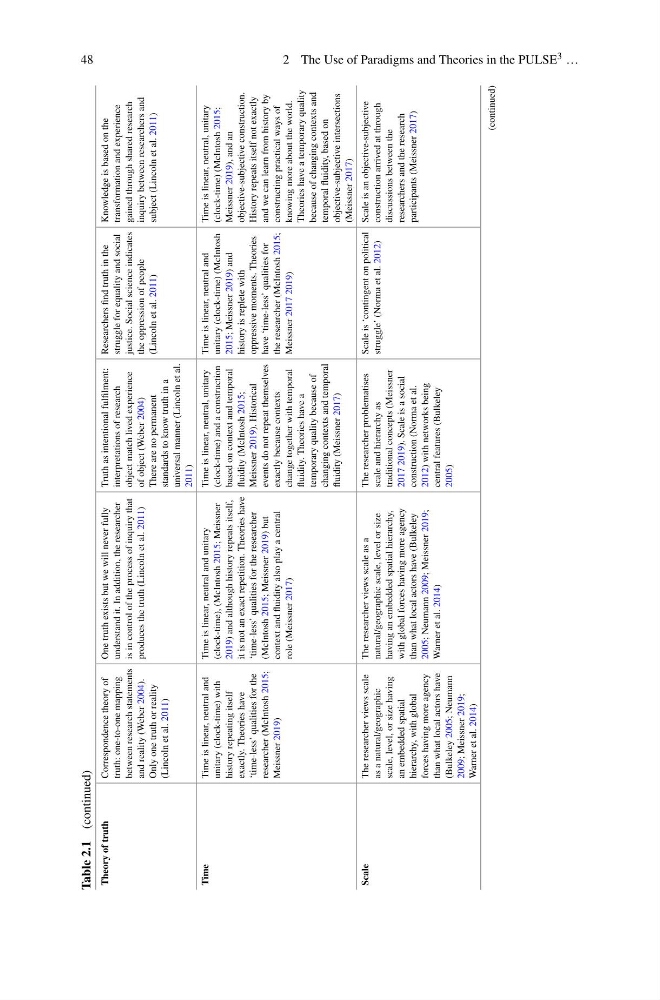
Table 2.1
(continued)
Theory of truth
Correspondence theory of
truth: one-to-one mapping
between research statements
and reality (Weber 2004).
Only one truth or reality
(Lincoln et al. 2011)
One truth exists but we will never fully
understand it. In addition, the researcher
is in control of the process of inquiry that
produces the truth (Lincoln et al. 2011)
Truth as intentional fulfilment:
interpretations of research
object match lived experience
of object (Weber 2004)
There are no permanent
standards to know truth in a
universal manner (Lincoln et al.
2011)
Researchers find truth in the
struggle for equality and social
justice. Social science indicates
the oppression of people
(Lincoln et al. 2011)
Knowledge is based on the
transformation and experience
gained through shared research
inquiry between researchers and
subject (Lincoln et al. 2011)
Time
Time is linear, neutral and
unitary (clock-time) with
history repeating itself
exactly. Theories have
‘time-less’ qualities for the
researcher (McIntosh 2015;
Meissner 2019)
Time is linear, neutral and unitary
(clock-time), (McIntosh 2015; Meissner
2019) and although history repeats itself,
it is not an exact repetition. Theories have
‘time-less’ qualities for the researcher
(McIntosh 2015; Meissner 2019) but
context and fluidity also play a central
role (Meissner 2017)
Time is linear, neutral, unitary
(clock-time) and a construction
based on context and temporal
fluidity (McIntosh 2015;
Meissner 2019). Historical
events do not repeat themselves
exactly because contexts
change together with temporal
fluidity. Theories have a
temporary quality because of
changing contexts and temporal
fluidity (Meissner 2017)
Time is linear, neutral and
unitary (clock-time) (McIntosh
2015; Meissner 2019) and
history is replete with
oppressive moments. Theories
have ‘time-less’ qualities for
the researcher (McIntosh 2015;
Meissner 2017 2019)
Time is linear, neutral, unitary
(clock-time) (McIntosh 2015;
Meissner 2019), and an
objective-subjective construction.
History repeats itself not exactly
and we can learn from history by
constructing practical ways of
knowing more about the world.
Theories have a temporary quality
because of changing contexts and
temporal fluidity, based on
objective-subjective intersections
(Meissner 2017)
Scale
The researcher views scale
as a natural/geographic
scale, level, or size having
an embedded spatial
hierarchy, with global
forces having more agency
than what local actors have
(Bulkeley 2005; Neumann
2009; Meissner 2019;
Warner et al. 2014)
The researcher views scale as a
natural/geographic scale, level or size
having an embedded spatial hierarchy,
with global forces having more agency
than what local actors have (Bulkeley
2005; Neumann 2009; Meissner 2019;
Warner et al. 2014)
The researcher problematises
scale and hierarchy as
traditional concepts (Meissner
2017 2019). Scale is a social
construction (Norma et al.
2012) with networks being
central features (Bulkeley
2005)
Scale is ‘contingent on political
struggle’ (Norma et al. 2012)
Scale is an objective-subjective
construction arrived at through
discussions between the
researchers and the research
participants (Meissner 2017)
(continued)
2 The Use of Paradigms and Theories in the PULSE 3 …
Table 2.1
(continued)
Theory of truth
Correspondence theory of
truth: one-to-one mapping
between research statements
and reality (Weber 2004).
Only one truth or reality
(Lincoln et al. 2011)
One truth exists but we will never fully
understand it. In addition, the researcher
is in control of the process of inquiry that
produces the truth (Lincoln et al. 2011)
Truth as intentional fulfilment:
interpretations of research
object match lived experience
of object (Weber 2004)
There are no permanent
standards to know truth in a
universal manner (Lincoln et al.
2011)
Researchers find truth in the
struggle for equality and social
justice. Social science indicates
the oppression of people
(Lincoln et al. 2011)
Knowledge is based on the
transformation and experience
gained through shared research
inquiry between researchers and
subject (Lincoln et al. 2011)
Time
Time is linear, neutral and
unitary (clock-time) with
history repeating itself
exactly. Theories have
‘time-less’ qualities for the
researcher (McIntosh 2015;
Meissner 2019)
Time is linear, neutral and unitary
(clock-time), (McIntosh 2015; Meissner
2019) and although history repeats itself,
it is not an exact repetition. Theories have
‘time-less’ qualities for the researcher
(McIntosh 2015; Meissner 2019) but
context and fluidity also play a central
role (Meissner 2017)
Time is linear, neutral, unitary
(clock-time) and a construction
based on context and temporal
fluidity (McIntosh 2015;
Meissner 2019). Historical
events do not repeat themselves
exactly because contexts
change together with temporal
fluidity. Theories have a
temporary quality because of
changing contexts and temporal
fluidity (Meissner 2017)
Time is linear, neutral and
unitary (clock-time) (McIntosh
2015; Meissner 2019) and
history is replete with
oppressive moments. Theories
have ‘time-less’ qualities for
the researcher (McIntosh 2015;
Meissner 2017 2019)
Time is linear, neutral, unitary
(clock-time) (McIntosh 2015;
Meissner 2019), and an
objective-subjective construction.
History repeats itself not exactly
and we can learn from history by
constructing practical ways of
knowing more about the world.
Theories have a temporary quality
because of changing contexts and
temporal fluidity, based on
objective-subjective intersections
(Meissner 2017)
Scale
The researcher views scale
as a natural/geographic
scale, level, or size having
an embedded spatial
hierarchy, with global
forces having more agency
than what local actors have
(Bulkeley 2005; Neumann
2009; Meissner 2019;
Warner et al. 2014)
The researcher views scale as a
natural/geographic scale, level or size
having an embedded spatial hierarchy,
with global forces having more agency
than what local actors have (Bulkeley
2005; Neumann 2009; Meissner 2019;
Warner et al. 2014)
The researcher problematises
scale and hierarchy as
traditional concepts (Meissner
2017 2019). Scale is a social
construction (Norma et al.
2012) with networks being
central features (Bulkeley
2005)
Scale is ‘contingent on political
struggle’ (Norma et al. 2012)
Scale is an objective-subjective
construction arrived at through
discussions between the
researchers and the research
participants (Meissner 2017)
(continued)