

170
3 eThekwini’s Green and Ecological Infrastructure Policy Landscape
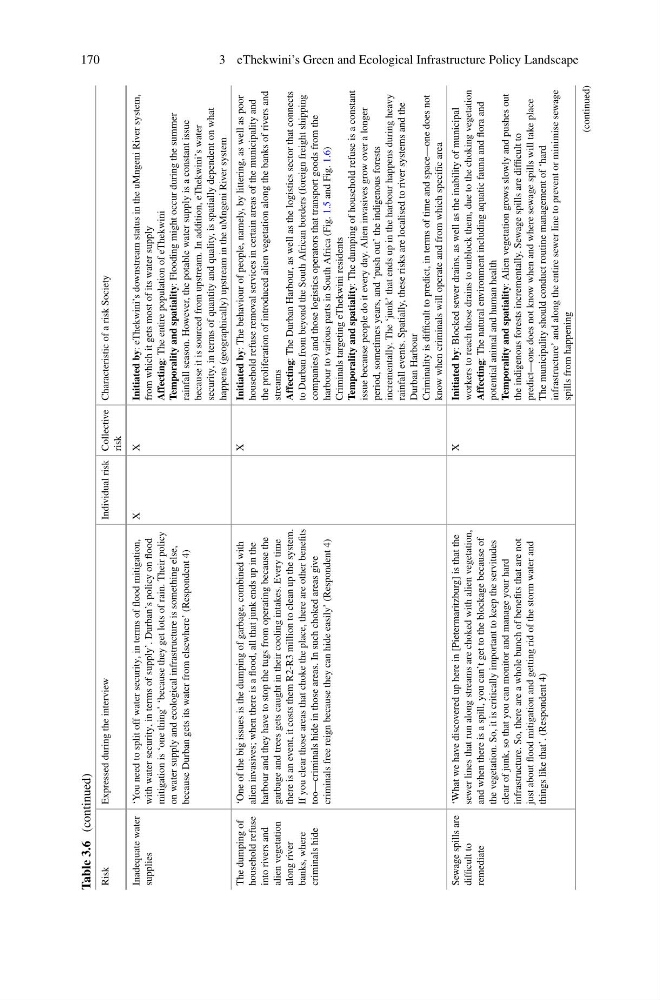
Table 3.6
(continued)
Risk
Expressed during the interview
Individual risk Collective
risk
Characteristic of a risk Society
Inadequate water
supplies
‘You need to split off water security, in terms of flood mitigation,
with water security, in terms of supply’. Durban’s policy on flood
mitigation is ‘one thing’ ‘because they get lots of rain. Their policy
on water supply and ecological infrastructure is something else,
because Durban gets its water from elsewhere’ (Respondent 4)
X
X
Initiated by:
eThekwini’s downstream status in the uMngeni River system,
from which it gets most of its water supply
Affecting:
The entire population of eThekwini
Temporality and spatiality:
Flooding might occur during the summer
rainfall season. However, the potable water supply is a constant issue
because it is sourced from upstream. In addition, eThekwini’s water
security, in terms of quantity and quality, is spatially dependent on what
happens (geographically) upstream in the uMngeni River system
The dumping of
household refuse
into rivers and
alien vegetation
along river
banks, where
criminals hide
‘One of the big issues is the dumping of garbage, combined with
alien invasives; when there is a flood, all that junk ends up in the
harbour and they have to stop the tugs from operating because the
garbage and trees gets caught in their cooling intakes. Every time
there is an event, it costs them R2-R3 million to clean up the system.
If you clear those areas that choke the place, there are other benefits
too—criminals hide in those areas. In such choked areas give
criminals free reign because they can hide easily’ (Respondent 4)
X
Initiated by:
The behaviour of people, namely, by littering, as well as poor
household refuse removal services in certain areas of the municipality and
the proliferation of introduced alien vegetation along the banks of rivers and
streams
Affecting:
The Durban Harbour, as well as the logistics sector that connects
to Durban from beyond the South African borders (foreign freight shipping
companies) and those logistics operators that transport goods from the
harbour to various parts in South Africa (Fig. 1.5 and Fig. 1.6)
Criminals targeting eThekwini residents
Temporality and spatiality:
The dumping of household refuse is a constant
issue because people do it every day. Alien invasives grow over a longer
period, sometimes years, and ‘push out’ the indigenous forests
incrementally. The ‘junk’ that ends up in the harbour happens during heavy
rainfall events. Spatially, these risks are localised to river systems and the
Durban Harbour
Criminality is difficult to predict, in terms of time and space—one does not
know when criminals will operate and from which specific area
Sewage spills are
difficult to
remediate
‘What we have discovered up here in [Pietermaritzburg] is that the
sewer lines that run along streams are choked with alien vegetation,
and when there is a spill, you can’t get to the blockage because of
the vegetation. So, it is critically important to keep the servitudes
clear of junk, so that you can monitor and manage your hard
infrastructure. So, there are a whole bunch of benefits that are not
just about flood mitigation and getting rid of the storm water and
things like that’. (Respondent 4)
X
Initiated by:
Blocked sewer drains, as well as the inability of municipal
workers to reach those drains to unblock them, due to the choking vegetation
Affecting:
The natural environment including aquatic fauna and flora and
potential animal and human health
Temporality and spatiality:
Alien vegetation grows slowly and pushes out
the indigenous forests incrementally. Sewage spills are difficult to
predict—one does not know when and where sewage spills will take place
The municipality should conduct routine management of ‘hard
infrastructure’ and along the entire sewer line to prevent or minimise sewage
spills from happening
(continued)
3 eThekwini’s Green and Ecological Infrastructure Policy Landscape
Table 3.6
(continued)
Risk
Expressed during the interview
Individual risk Collective
risk
Characteristic of a risk Society
Inadequate water
supplies
‘You need to split off water security, in terms of flood mitigation,
with water security, in terms of supply’. Durban’s policy on flood
mitigation is ‘one thing’ ‘because they get lots of rain. Their policy
on water supply and ecological infrastructure is something else,
because Durban gets its water from elsewhere’ (Respondent 4)
X
X
Initiated by:
eThekwini’s downstream status in the uMngeni River system,
from which it gets most of its water supply
Affecting:
The entire population of eThekwini
Temporality and spatiality:
Flooding might occur during the summer
rainfall season. However, the potable water supply is a constant issue
because it is sourced from upstream. In addition, eThekwini’s water
security, in terms of quantity and quality, is spatially dependent on what
happens (geographically) upstream in the uMngeni River system
The dumping of
household refuse
into rivers and
alien vegetation
along river
banks, where
criminals hide
‘One of the big issues is the dumping of garbage, combined with
alien invasives; when there is a flood, all that junk ends up in the
harbour and they have to stop the tugs from operating because the
garbage and trees gets caught in their cooling intakes. Every time
there is an event, it costs them R2-R3 million to clean up the system.
If you clear those areas that choke the place, there are other benefits
too—criminals hide in those areas. In such choked areas give
criminals free reign because they can hide easily’ (Respondent 4)
X
Initiated by:
The behaviour of people, namely, by littering, as well as poor
household refuse removal services in certain areas of the municipality and
the proliferation of introduced alien vegetation along the banks of rivers and
streams
Affecting:
The Durban Harbour, as well as the logistics sector that connects
to Durban from beyond the South African borders (foreign freight shipping
companies) and those logistics operators that transport goods from the
harbour to various parts in South Africa (Fig. 1.5 and Fig. 1.6)
Criminals targeting eThekwini residents
Temporality and spatiality:
The dumping of household refuse is a constant
issue because people do it every day. Alien invasives grow over a longer
period, sometimes years, and ‘push out’ the indigenous forests
incrementally. The ‘junk’ that ends up in the harbour happens during heavy
rainfall events. Spatially, these risks are localised to river systems and the
Durban Harbour
Criminality is difficult to predict, in terms of time and space—one does not
know when criminals will operate and from which specific area
Sewage spills are
difficult to
remediate
‘What we have discovered up here in [Pietermaritzburg] is that the
sewer lines that run along streams are choked with alien vegetation,
and when there is a spill, you can’t get to the blockage because of
the vegetation. So, it is critically important to keep the servitudes
clear of junk, so that you can monitor and manage your hard
infrastructure. So, there are a whole bunch of benefits that are not
just about flood mitigation and getting rid of the storm water and
things like that’. (Respondent 4)
X
Initiated by:
Blocked sewer drains, as well as the inability of municipal
workers to reach those drains to unblock them, due to the choking vegetation
Affecting:
The natural environment including aquatic fauna and flora and
potential animal and human health
Temporality and spatiality:
Alien vegetation grows slowly and pushes out
the indigenous forests incrementally. Sewage spills are difficult to
predict—one does not know when and where sewage spills will take place
The municipality should conduct routine management of ‘hard
infrastructure’ and along the entire sewer line to prevent or minimise sewage
spills from happening
(continued)