

3.4 Analysis
171
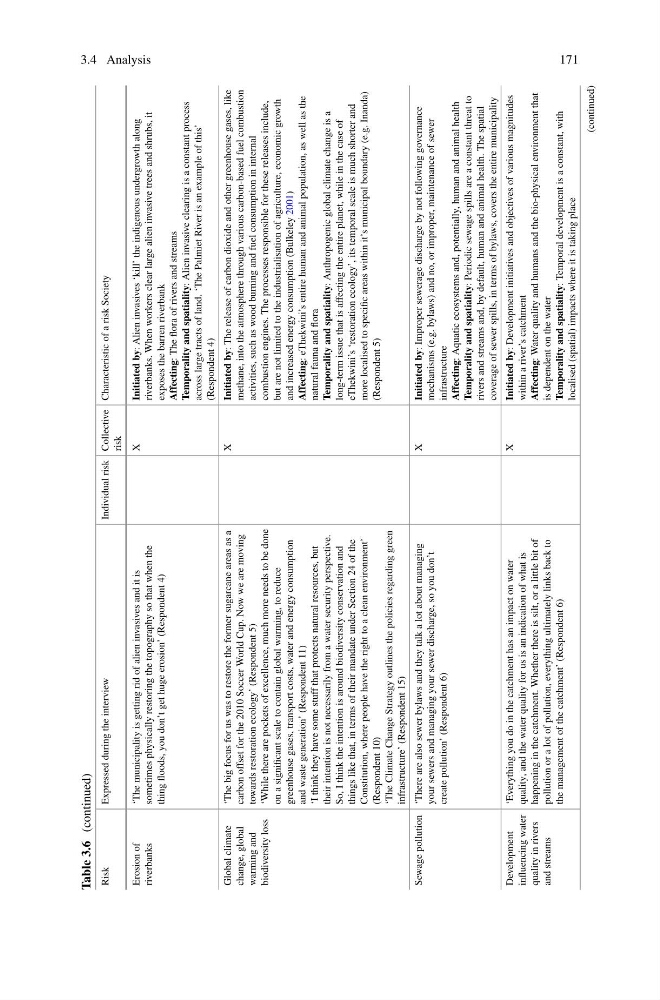
Table 3.6
(continued)
Risk
Expressed during the interview
Individual risk Collective
risk
Characteristic of a risk Society
Erosion of
riverbanks
‘The municipality is getting rid of alien invasives and it is
sometimes physically restoring the topography so that when the
thing floods, you don’t get huge erosion’ (Respondent 4)
X
Initiated by:
Alien invasives ‘kill’ the indigenous undergrowth along
riverbanks. When workers clear large alien invasive trees and shrubs, it
exposes the barren riverbank
Affecting:
The flora of rivers and streams
Temporality and spatiality:
Alien invasive clearing is a constant process
across large tracts of land. ‘The Palmiet River is an example of this’
(Respondent 4)
Global climate
change, global
warming and
biodiversity loss
‘The big focus for us was to restore the former sugarcane areas as a
carbon offset for the 2010 Soccer World Cup. Now we are moving
towards restoration ecology’ (Respondent 5)
‘While there are pockets of excellence, much more needs to be done
on a significant scale to contain global warming, to reduce
greenhouse gases, transport costs, water and energy consumption
and waste generation’ (Respondent 11)
‘I think they have some stuff that protects natural resources, but
their intention is not necessarily from a water security perspective.
So, I think the intention is around biodiversity conservation and
things like that, in terms of their mandate under Section 24 of the
Constitution, where people have the right to a clean environment’
(Respondent 10)
‘The Climate Change Strategy outlines the policies regarding green
infrastructure’ (Respondent 15)
X
Initiated by:
The release of carbon dioxide and other greenhouse gases, like
methane, into the atmosphere through various carbon-based fuel combustion
activities, such as wood burning and fuel consumption in internal
combustion engines. The processes responsible for these releases include,
but are not limited to the industrialisation of agriculture, economic growth
and increased energy consumption (Bulkeley 2001)
Affecting:
eThekwini’s entire human and animal population, as well as the
natural fauna and flora
Temporality and spatiality:
Anthropogenic global climate change is a
long-term issue that is affecting the entire planet, while in the case of
eThekwini’s ‘restoration ecology’, its temporal scale is much shorter and
more localised to specific areas within it’s municipal boundary (e.g. Inanda)
(Respondent 5)
Sewage pollution ‘There are also sewer bylaws and they talk a lot about managing
your sewers and managing your sewer discharge, so you don’t
create pollution’ (Respondent 6)
X
Initiated by:
Improper sewerage discharge by not following governance
mechanisms (e.g. bylaws) and no, or improper, maintenance of sewer
infrastructure
Affecting:
Aquatic ecosystems and, potentially, human and animal health
Temporality and spatiality:
Periodic sewage spills are a constant threat to
rivers and streams and, by default, human and animal health. The spatial
coverage of sewer spills, in terms of bylaws, covers the entire municipality
Development
influencing water
quality in rivers
and streams
‘Everything you do in the catchment has an impact on water
quality, and the water quality for us is an indication of what is
happening in the catchment. Whether there is silt, or a little bit of
pollution or a lot of pollution, everything ultimately links back to
the management of the catchment’ (Respondent 6)
X
Initiated by:
Development initiatives and objectives of various magnitudes
within a river’s catchment
Affecting:
Water quality and humans and the bio-physical environment that
is dependent on the water
Temporality and spatiality:
Temporal development is a constant, with
localised (spatial) impacts where it is taking place
(continued)
171
Table 3.6
(continued)
Risk
Expressed during the interview
Individual risk Collective
risk
Characteristic of a risk Society
Erosion of
riverbanks
‘The municipality is getting rid of alien invasives and it is
sometimes physically restoring the topography so that when the
thing floods, you don’t get huge erosion’ (Respondent 4)
X
Initiated by:
Alien invasives ‘kill’ the indigenous undergrowth along
riverbanks. When workers clear large alien invasive trees and shrubs, it
exposes the barren riverbank
Affecting:
The flora of rivers and streams
Temporality and spatiality:
Alien invasive clearing is a constant process
across large tracts of land. ‘The Palmiet River is an example of this’
(Respondent 4)
Global climate
change, global
warming and
biodiversity loss
‘The big focus for us was to restore the former sugarcane areas as a
carbon offset for the 2010 Soccer World Cup. Now we are moving
towards restoration ecology’ (Respondent 5)
‘While there are pockets of excellence, much more needs to be done
on a significant scale to contain global warming, to reduce
greenhouse gases, transport costs, water and energy consumption
and waste generation’ (Respondent 11)
‘I think they have some stuff that protects natural resources, but
their intention is not necessarily from a water security perspective.
So, I think the intention is around biodiversity conservation and
things like that, in terms of their mandate under Section 24 of the
Constitution, where people have the right to a clean environment’
(Respondent 10)
‘The Climate Change Strategy outlines the policies regarding green
infrastructure’ (Respondent 15)
X
Initiated by:
The release of carbon dioxide and other greenhouse gases, like
methane, into the atmosphere through various carbon-based fuel combustion
activities, such as wood burning and fuel consumption in internal
combustion engines. The processes responsible for these releases include,
but are not limited to the industrialisation of agriculture, economic growth
and increased energy consumption (Bulkeley 2001)
Affecting:
eThekwini’s entire human and animal population, as well as the
natural fauna and flora
Temporality and spatiality:
Anthropogenic global climate change is a
long-term issue that is affecting the entire planet, while in the case of
eThekwini’s ‘restoration ecology’, its temporal scale is much shorter and
more localised to specific areas within it’s municipal boundary (e.g. Inanda)
(Respondent 5)
Sewage pollution ‘There are also sewer bylaws and they talk a lot about managing
your sewers and managing your sewer discharge, so you don’t
create pollution’ (Respondent 6)
X
Initiated by:
Improper sewerage discharge by not following governance
mechanisms (e.g. bylaws) and no, or improper, maintenance of sewer
infrastructure
Affecting:
Aquatic ecosystems and, potentially, human and animal health
Temporality and spatiality:
Periodic sewage spills are a constant threat to
rivers and streams and, by default, human and animal health. The spatial
coverage of sewer spills, in terms of bylaws, covers the entire municipality
Development
influencing water
quality in rivers
and streams
‘Everything you do in the catchment has an impact on water
quality, and the water quality for us is an indication of what is
happening in the catchment. Whether there is silt, or a little bit of
pollution or a lot of pollution, everything ultimately links back to
the management of the catchment’ (Respondent 6)
X
Initiated by:
Development initiatives and objectives of various magnitudes
within a river’s catchment
Affecting:
Water quality and humans and the bio-physical environment that
is dependent on the water
Temporality and spatiality:
Temporal development is a constant, with
localised (spatial) impacts where it is taking place
(continued)