

3.4 Analysis
169
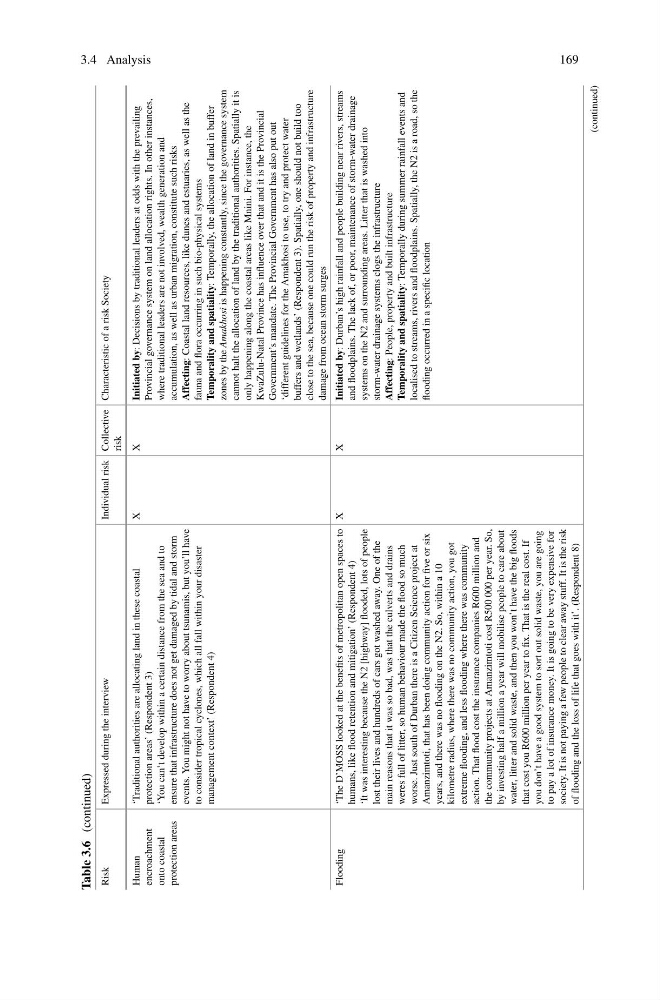
Table 3.6
(continued)
Risk
Expressed during the interview
Individual risk Collective
risk
Characteristic of a risk Society
Human
encroachment
onto coastal
protection areas
‘Traditional authorities are allocating land in these coastal
protection areas’ (Respondent 3)
‘You can’t develop within a certain distance from the sea and to
ensure that infrastructure does not get damaged by tidal and storm
events. You might not have to worry about tsunamis, but you’ll have
to consider tropical cyclones, which all fall within your disaster
management context’ (Respondent 4)
X
X
Initiated by:
Decisions by traditional leaders at odds with the prevailing
Provincial governance system on land allocation rights. In other instances,
where traditional leaders are not involved, wealth generation and
accumulation, as well as urban migration, constitute such risks
Affecting:
Coastal land resources, like dunes and estuaries, as well as the
fauna and flora occurring in such bio-physical systems
Temporality and spatiality:
Temporally, the allocation of land in buffer
zones by the Amakhosi
is happening constantly, since the governance system
cannot halt the allocation of land by the traditional authorities. Spatially it is
only happening along the coastal areas like Mnini. For instance, the
KwaZulu-Natal Province has influence over that and it is the Provincial
Government’s mandate. The Provincial Government has also put out
‘different guidelines for the Amakhosi to use, to try and protect water
buffers and wetlands’ (Respondent 3). Spatially, one should not build too
close to the sea, because one could run the risk of property and infrastructure
damage from ocean storm surges
Flooding
‘The D’MOSS looked at the benefits of metropolitan open spaces to
humans, like flood retention and mitigation’ (Respondent 4)
‘It was interesting because the N2 [highway] flooded, lots of people
lost their lives and hundreds of cars got washed away. One of the
main reasons that it was so bad, was that the culverts and drains
weres full of litter, so human behaviour made the flood so much
worse. Just south of Durban there is a Citizen Science project at
Amanzimtoti, that has been doing community action for five or six
years, and there was no flooding on the N2. So, within a 10
kilometre radius, where there was no community action, you got
extreme flooding, and less flooding where there was community
action. That flood cost the insurance companies R600 million and
the community projects at Amanzimtoti cost R500 000 per year. So,
by investing half a million a year will mobilise people to care about
water, litter and solid waste, and then you won’t have the big floods
that cost you R600 million per year to fix. That is the real cost. If
you don’t have a good system to sort out solid waste, you are going
to pay a lot of insurance money. It is going to be very expensive for
society. It is not paying a few people to clear away stuff. It is the risk
of flooding and the loss of life that goes with it’. (Respondent 8)
X
X
Initiated by:
Durban’s high rainfall and people building near rivers, streams
and floodplains. The lack of, or poor, maintenance of storm-water drainage
systems on the N2 and surrounding areas. Litter that is washed into
storm-water drainage systems clogs the infrastructure
Affecting:
People, property and built infrastructure
Temporality and spatiality:
Temporally during summer rainfall events and
localised to streams, rivers and floodplains. Spatially, the N2 is a road, so the
flooding occurred in a specific location
(continued)
169
Table 3.6
(continued)
Risk
Expressed during the interview
Individual risk Collective
risk
Characteristic of a risk Society
Human
encroachment
onto coastal
protection areas
‘Traditional authorities are allocating land in these coastal
protection areas’ (Respondent 3)
‘You can’t develop within a certain distance from the sea and to
ensure that infrastructure does not get damaged by tidal and storm
events. You might not have to worry about tsunamis, but you’ll have
to consider tropical cyclones, which all fall within your disaster
management context’ (Respondent 4)
X
X
Initiated by:
Decisions by traditional leaders at odds with the prevailing
Provincial governance system on land allocation rights. In other instances,
where traditional leaders are not involved, wealth generation and
accumulation, as well as urban migration, constitute such risks
Affecting:
Coastal land resources, like dunes and estuaries, as well as the
fauna and flora occurring in such bio-physical systems
Temporality and spatiality:
Temporally, the allocation of land in buffer
zones by the Amakhosi
is happening constantly, since the governance system
cannot halt the allocation of land by the traditional authorities. Spatially it is
only happening along the coastal areas like Mnini. For instance, the
KwaZulu-Natal Province has influence over that and it is the Provincial
Government’s mandate. The Provincial Government has also put out
‘different guidelines for the Amakhosi to use, to try and protect water
buffers and wetlands’ (Respondent 3). Spatially, one should not build too
close to the sea, because one could run the risk of property and infrastructure
damage from ocean storm surges
Flooding
‘The D’MOSS looked at the benefits of metropolitan open spaces to
humans, like flood retention and mitigation’ (Respondent 4)
‘It was interesting because the N2 [highway] flooded, lots of people
lost their lives and hundreds of cars got washed away. One of the
main reasons that it was so bad, was that the culverts and drains
weres full of litter, so human behaviour made the flood so much
worse. Just south of Durban there is a Citizen Science project at
Amanzimtoti, that has been doing community action for five or six
years, and there was no flooding on the N2. So, within a 10
kilometre radius, where there was no community action, you got
extreme flooding, and less flooding where there was community
action. That flood cost the insurance companies R600 million and
the community projects at Amanzimtoti cost R500 000 per year. So,
by investing half a million a year will mobilise people to care about
water, litter and solid waste, and then you won’t have the big floods
that cost you R600 million per year to fix. That is the real cost. If
you don’t have a good system to sort out solid waste, you are going
to pay a lot of insurance money. It is going to be very expensive for
society. It is not paying a few people to clear away stuff. It is the risk
of flooding and the loss of life that goes with it’. (Respondent 8)
X
X
Initiated by:
Durban’s high rainfall and people building near rivers, streams
and floodplains. The lack of, or poor, maintenance of storm-water drainage
systems on the N2 and surrounding areas. Litter that is washed into
storm-water drainage systems clogs the infrastructure
Affecting:
People, property and built infrastructure
Temporality and spatiality:
Temporally during summer rainfall events and
localised to streams, rivers and floodplains. Spatially, the N2 is a road, so the
flooding occurred in a specific location
(continued)