

168
3 eThekwini’s Green and Ecological Infrastructure Policy Landscape
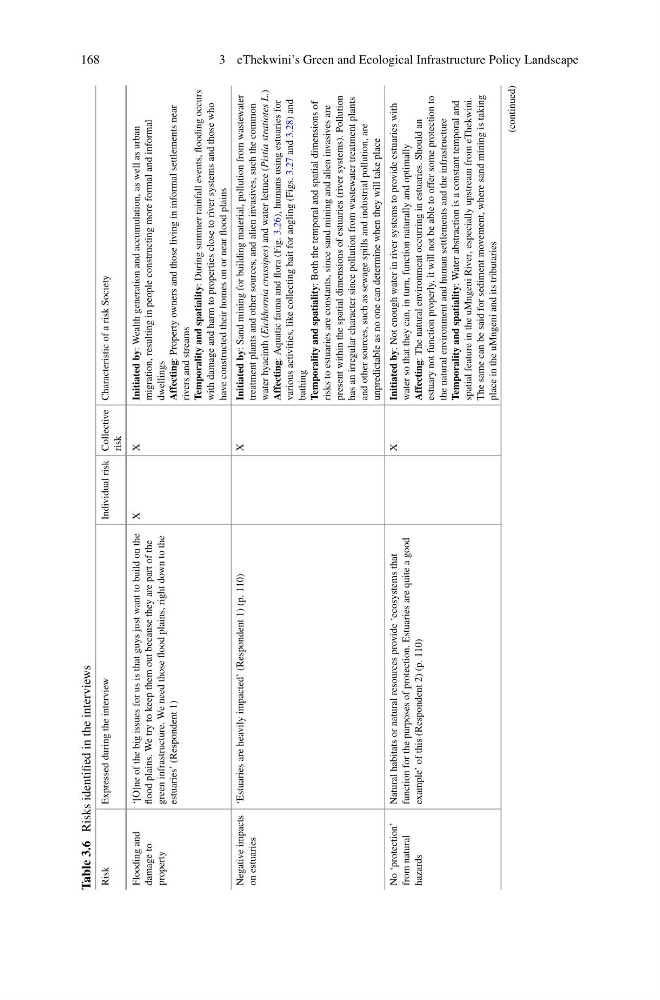
Table 3.6
Risks identified in the interviews
Risk
Expressed during the interview
Individual risk Collective
risk
Characteristic of a risk Society
Flooding and
damage to
property
‘[O]ne of the big issues for us is that guys just want to build on the
flood plains. We try to keep them out because they are part of the
green infrastructure. We need those flood plains, right down to the
estuaries’ (Respondent 1)
X
X
Initiated by:
Wealth generation and accumulation, as well as urban
migration, resulting in people constructing more formal and informal
dwellings
Affecting:
Property owners and those living in informal settlements near
rivers and streams
Temporality and spatiality:
During summer rainfall events, flooding occurs
with damage and harm to properties close to river systems and those who
have constructed their homes on or near flood plains
Negative impacts
on estuaries
‘Estuaries are heavily impacted’ (Respondent 1) (p. 110)
X
Initiated by:
Sand mining for building material, pollution from wastewater
treatment plants and other sources, and alien invasives, such the common
water hyacinth (Eichhornia crassipes)
and water lettuce (Pistia stratiotes L.)
Affecting:
Aquatic fauna and flora (Fig. 3.26), humans using estuaries for
various activities, like collecting bait for angling (Figs. 3.27 and 3.28) and
bathing
Temporality and spatiality:
Both the temporal and spatial dimensions of
risks to estuaries are constants, since sand mining and alien invasives are
present within the spatial dimensions of estuaries (river systems). Pollution
has an irregular character since pollution from wastewater treatment plants
and other sources, such as sewage spills and industrial pollution, are
unpredictable as no one can determine when they will take place
No ‘protection’
from natural
hazards
Natural habitats or natural resources provide ‘ecosystems that
function for the purposes of protection. Estuaries are quite a good
example’ of this (Respondent 2) (p. 110)
X
Initiated by:
Not enough water in river systems to provide estuaries with
water so that they can, in turn, function naturally and optimally
Affecting:
The natural environment occurring in estuaries. Should an
estuary not function properly, it will not be able to offer some protection to
the natural environment and human settlements and the infrastructure
Temporality and spatiality:
Water abstraction is a constant temporal and
spatial feature in the uMngeni River, especially upstream from eThekwini.
The same can be said for sediment movement, where sand mining is taking
place in the uMngeni and its tributaries
(continued)
3 eThekwini’s Green and Ecological Infrastructure Policy Landscape
Table 3.6
Risks identified in the interviews
Risk
Expressed during the interview
Individual risk Collective
risk
Characteristic of a risk Society
Flooding and
damage to
property
‘[O]ne of the big issues for us is that guys just want to build on the
flood plains. We try to keep them out because they are part of the
green infrastructure. We need those flood plains, right down to the
estuaries’ (Respondent 1)
X
X
Initiated by:
Wealth generation and accumulation, as well as urban
migration, resulting in people constructing more formal and informal
dwellings
Affecting:
Property owners and those living in informal settlements near
rivers and streams
Temporality and spatiality:
During summer rainfall events, flooding occurs
with damage and harm to properties close to river systems and those who
have constructed their homes on or near flood plains
Negative impacts
on estuaries
‘Estuaries are heavily impacted’ (Respondent 1) (p. 110)
X
Initiated by:
Sand mining for building material, pollution from wastewater
treatment plants and other sources, and alien invasives, such the common
water hyacinth (Eichhornia crassipes)
and water lettuce (Pistia stratiotes L.)
Affecting:
Aquatic fauna and flora (Fig. 3.26), humans using estuaries for
various activities, like collecting bait for angling (Figs. 3.27 and 3.28) and
bathing
Temporality and spatiality:
Both the temporal and spatial dimensions of
risks to estuaries are constants, since sand mining and alien invasives are
present within the spatial dimensions of estuaries (river systems). Pollution
has an irregular character since pollution from wastewater treatment plants
and other sources, such as sewage spills and industrial pollution, are
unpredictable as no one can determine when they will take place
No ‘protection’
from natural
hazards
Natural habitats or natural resources provide ‘ecosystems that
function for the purposes of protection. Estuaries are quite a good
example’ of this (Respondent 2) (p. 110)
X
Initiated by:
Not enough water in river systems to provide estuaries with
water so that they can, in turn, function naturally and optimally
Affecting:
The natural environment occurring in estuaries. Should an
estuary not function properly, it will not be able to offer some protection to
the natural environment and human settlements and the infrastructure
Temporality and spatiality:
Water abstraction is a constant temporal and
spatial feature in the uMngeni River, especially upstream from eThekwini.
The same can be said for sediment movement, where sand mining is taking
place in the uMngeni and its tributaries
(continued)