

3.4 Analysis
163
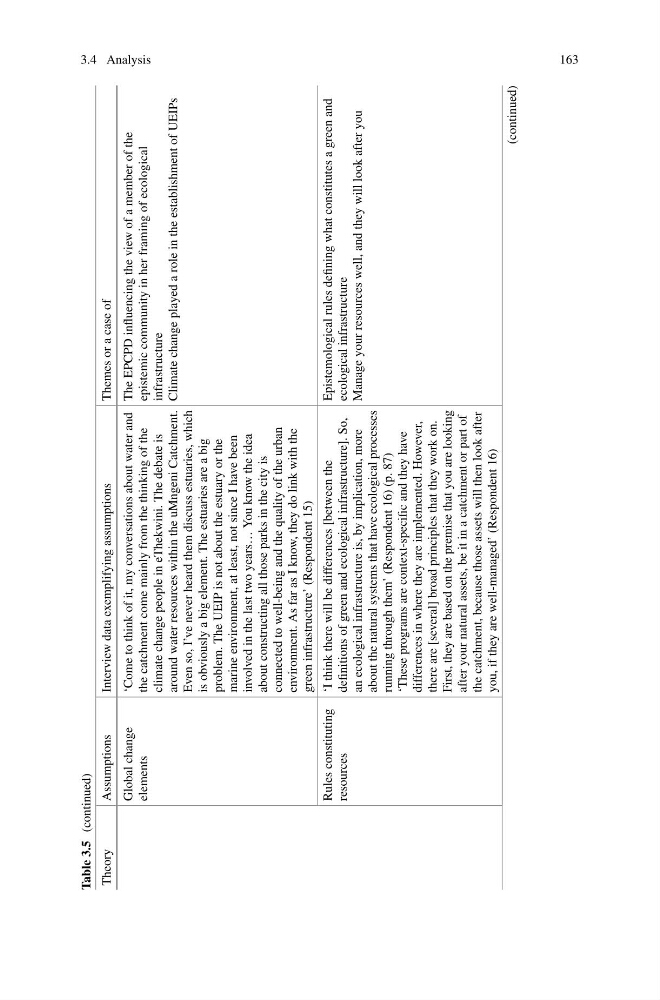
Table 3.5
(continued)
Theory
Assumptions
Interview data exemplifying assumptions
Themes or a case of
Global change
elements
‘Come to think of it, my conversations about water and
the catchment come mainly from the thinking of the
climate change people in eThekwini. The debate is
around water resources within the uMngeni Catchment.
Even so, I’ve never heard them discuss estuaries, which
is obviously a big element. The estuaries are a big
problem. The UEIP is not about the estuary or the
marine environment, at least, not since I have been
involved in the last two years… You know the idea
about constructing all those parks in the city is
connected to well-being and the quality of the urban
environment. As far as I know, they do link with the
green infrastructure’ (Respondent 15)
The EPCPD influencing the view of a member of the
epistemic community in her framing of ecological
infrastructure
Climate change played a role in the establishment of UEIPs
Rules constituting
resources
‘I think there will be differences [between the
definitions of green and ecological infrastructure]. So,
an ecological infrastructure is, by implication, more
about the natural systems that have ecological processes
running through them’ (Respondent 16) (p. 87)
‘These programs are context-specific and they have
differences in where they are implemented. However,
there are [several] broad principles that they work on.
First, they are based on the premise that you are looking
after your natural assets, be it in a catchment or part of
the catchment, because those assets will then look after
you, if they are well-managed’ (Respondent 16)
Epistemological rules defining what constitutes a green and
ecological infrastructure
Manage your resources well, and they will look after you
(continued)
163
Table 3.5
(continued)
Theory
Assumptions
Interview data exemplifying assumptions
Themes or a case of
Global change
elements
‘Come to think of it, my conversations about water and
the catchment come mainly from the thinking of the
climate change people in eThekwini. The debate is
around water resources within the uMngeni Catchment.
Even so, I’ve never heard them discuss estuaries, which
is obviously a big element. The estuaries are a big
problem. The UEIP is not about the estuary or the
marine environment, at least, not since I have been
involved in the last two years… You know the idea
about constructing all those parks in the city is
connected to well-being and the quality of the urban
environment. As far as I know, they do link with the
green infrastructure’ (Respondent 15)
The EPCPD influencing the view of a member of the
epistemic community in her framing of ecological
infrastructure
Climate change played a role in the establishment of UEIPs
Rules constituting
resources
‘I think there will be differences [between the
definitions of green and ecological infrastructure]. So,
an ecological infrastructure is, by implication, more
about the natural systems that have ecological processes
running through them’ (Respondent 16) (p. 87)
‘These programs are context-specific and they have
differences in where they are implemented. However,
there are [several] broad principles that they work on.
First, they are based on the premise that you are looking
after your natural assets, be it in a catchment or part of
the catchment, because those assets will then look after
you, if they are well-managed’ (Respondent 16)
Epistemological rules defining what constitutes a green and
ecological infrastructure
Manage your resources well, and they will look after you
(continued)