

3.4 Analysis
155
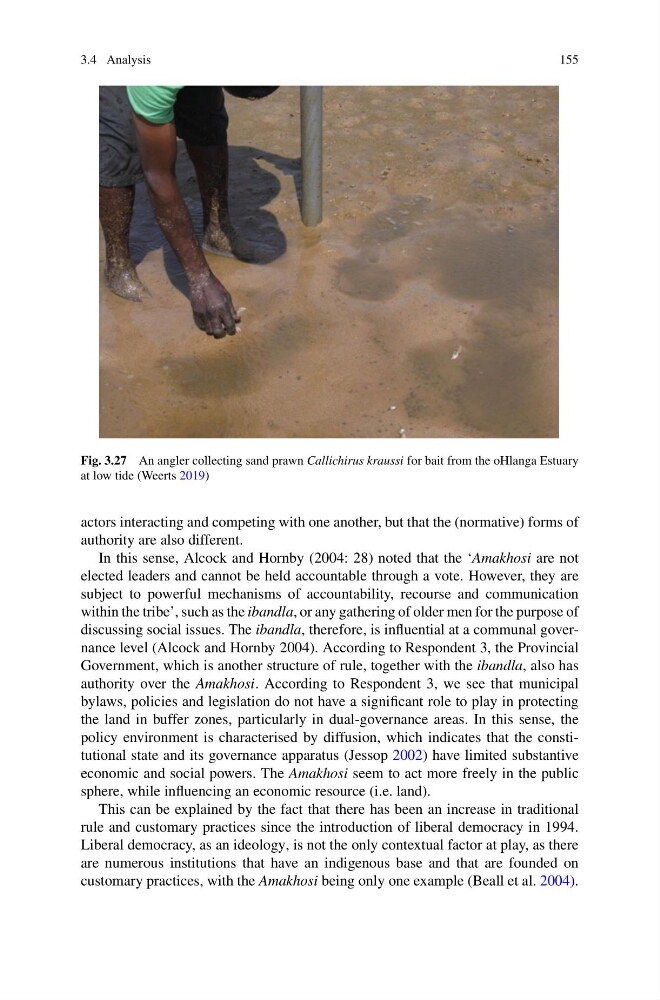
Fig. 3.27 An angler collecting sand prawn Callichirus kraussi for bait from the oHlanga Estuary
at low tide (Weerts 2019)
actors interacting and competing with one another, but that the (normative) forms of
authority are also different.
In this sense, Alcock and Hornby (2004: 28) noted that the ‘Amakhosi are not
elected leaders and cannot be held accountable through a vote. However, they are
subject to powerful mechanisms of accountability, recourse and communication
within the tribe’, such as the ibandla, or any gathering of older men for the purpose of
discussing social issues. The ibandla, therefore, is influential at a communal governance level (Alcock and Hornby 2004). According to Respondent 3, the Provincial
Government, which is another structure of rule, together with the ibandla, also has
authority over the Amakhosi. According to Respondent 3, we see that municipal
bylaws, policies and legislation do not have a significant role to play in protecting
the land in buffer zones, particularly in dual-governance areas. In this sense, the
policy environment is characterised by diffusion, which indicates that the constitutional state and its governance apparatus (Jessop 2002) have limited substantive
economic and social powers. The Amakhosi seem to act more freely in the public
sphere, while influencing an economic resource (i.e. land).
This can be explained by the fact that there has been an increase in traditional
rule and customary practices since the introduction of liberal democracy in 1994.
Liberal democracy, as an ideology, is not the only contextual factor at play, as there
are numerous institutions that have an indigenous base and that are founded on
customary practices, with the Amakhosi being only one example (Beall et al. 2004).
155
Fig. 3.27 An angler collecting sand prawn Callichirus kraussi for bait from the oHlanga Estuary
at low tide (Weerts 2019)
actors interacting and competing with one another, but that the (normative) forms of
authority are also different.
In this sense, Alcock and Hornby (2004: 28) noted that the ‘Amakhosi are not
elected leaders and cannot be held accountable through a vote. However, they are
subject to powerful mechanisms of accountability, recourse and communication
within the tribe’, such as the ibandla, or any gathering of older men for the purpose of
discussing social issues. The ibandla, therefore, is influential at a communal governance level (Alcock and Hornby 2004). According to Respondent 3, the Provincial
Government, which is another structure of rule, together with the ibandla, also has
authority over the Amakhosi. According to Respondent 3, we see that municipal
bylaws, policies and legislation do not have a significant role to play in protecting
the land in buffer zones, particularly in dual-governance areas. In this sense, the
policy environment is characterised by diffusion, which indicates that the constitutional state and its governance apparatus (Jessop 2002) have limited substantive
economic and social powers. The Amakhosi seem to act more freely in the public
sphere, while influencing an economic resource (i.e. land).
This can be explained by the fact that there has been an increase in traditional
rule and customary practices since the introduction of liberal democracy in 1994.
Liberal democracy, as an ideology, is not the only contextual factor at play, as there
are numerous institutions that have an indigenous base and that are founded on
customary practices, with the Amakhosi being only one example (Beall et al. 2004).