

154
3 eThekwini’s Green and Ecological Infrastructure Policy Landscape
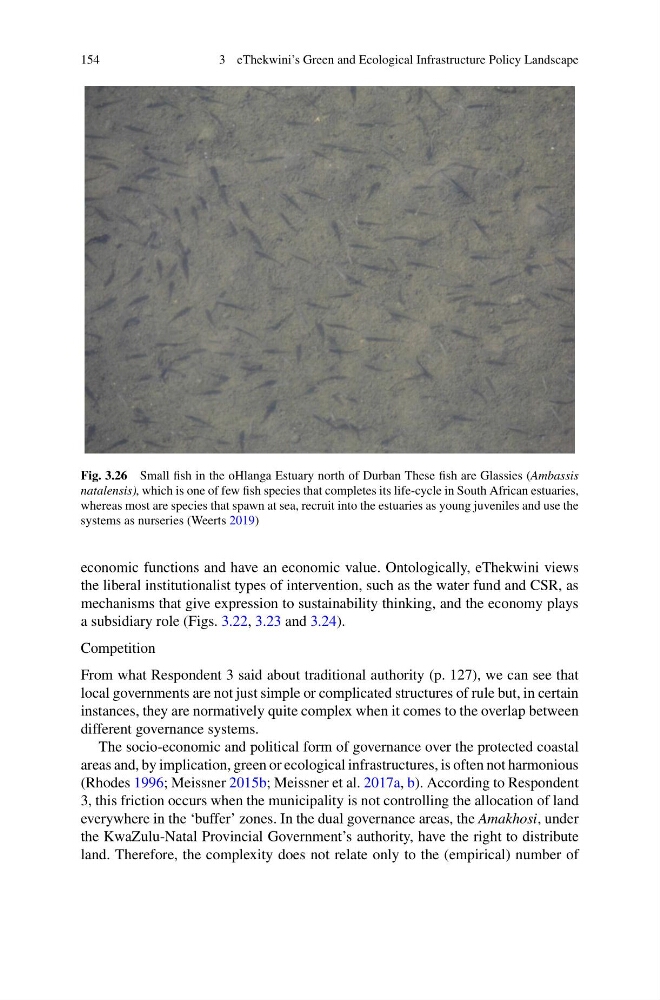
Fig. 3.26 Small fish in the oHlanga Estuary north of Durban These fish are Glassies (Ambassis
natalensis), which is one of few fish species that completes its life-cycle in South African estuaries,
whereas most are species that spawn at sea, recruit into the estuaries as young juveniles and use the
systems as nurseries (Weerts 2019)
economic functions and have an economic value. Ontologically, eThekwini views
the liberal institutionalist types of intervention, such as the water fund and CSR, as
mechanisms that give expression to sustainability thinking, and the economy plays
a subsidiary role (Figs. 3.22, 3.23 and 3.24).
Competition
From what Respondent 3 said about traditional authority (p. 127), we can see that
local governments are not just simple or complicated structures of rule but, in certain
instances, they are normatively quite complex when it comes to the overlap between
different governance systems.
The socio-economic and political form of governance over the protected coastal
areas and, by implication, green or ecological infrastructures, is often not harmonious
(Rhodes 1996; Meissner 2015b; Meissner et al. 2017a, b). According to Respondent
3, this friction occurs when the municipality is not controlling the allocation of land
everywhere in the ‘buffer’ zones. In the dual governance areas, the Amakhosi, under
the KwaZulu-Natal Provincial Government’s authority, have the right to distribute
land. Therefore, the complexity does not relate only to the (empirical) number of
3 eThekwini’s Green and Ecological Infrastructure Policy Landscape
Fig. 3.26 Small fish in the oHlanga Estuary north of Durban These fish are Glassies (Ambassis
natalensis), which is one of few fish species that completes its life-cycle in South African estuaries,
whereas most are species that spawn at sea, recruit into the estuaries as young juveniles and use the
systems as nurseries (Weerts 2019)
economic functions and have an economic value. Ontologically, eThekwini views
the liberal institutionalist types of intervention, such as the water fund and CSR, as
mechanisms that give expression to sustainability thinking, and the economy plays
a subsidiary role (Figs. 3.22, 3.23 and 3.24).
Competition
From what Respondent 3 said about traditional authority (p. 127), we can see that
local governments are not just simple or complicated structures of rule but, in certain
instances, they are normatively quite complex when it comes to the overlap between
different governance systems.
The socio-economic and political form of governance over the protected coastal
areas and, by implication, green or ecological infrastructures, is often not harmonious
(Rhodes 1996; Meissner 2015b; Meissner et al. 2017a, b). According to Respondent
3, this friction occurs when the municipality is not controlling the allocation of land
everywhere in the ‘buffer’ zones. In the dual governance areas, the Amakhosi, under
the KwaZulu-Natal Provincial Government’s authority, have the right to distribute
land. Therefore, the complexity does not relate only to the (empirical) number of