

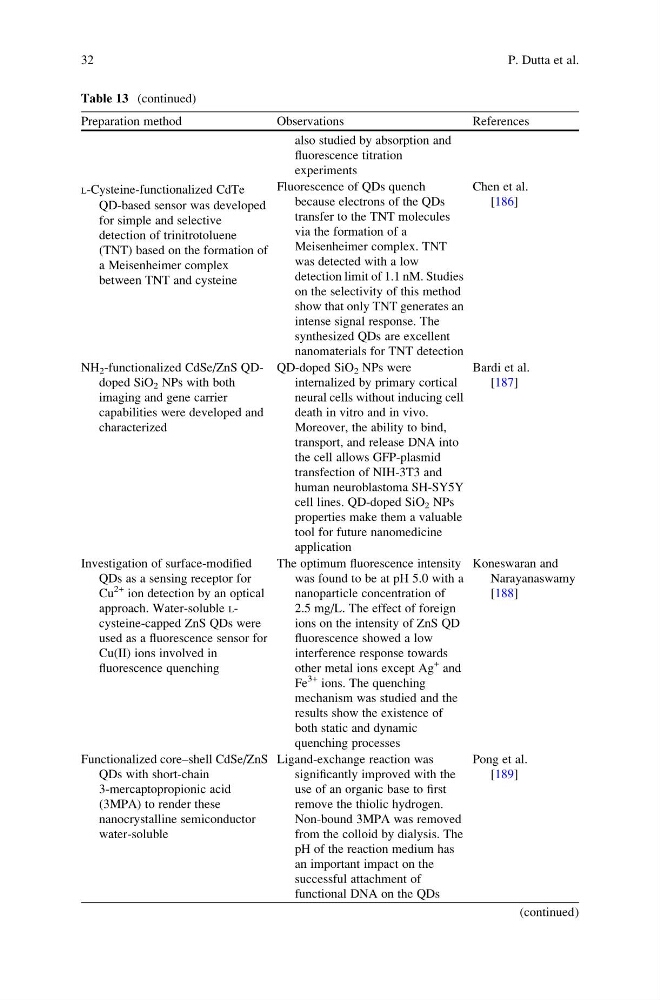
Table 13 (continued)
Preparation method
Observations
References
also studied by absorption and
fluorescence titration
experiments
L-Cysteine-functionalized CdTe
QD-based sensor was developed
for simple and selective
detection of trinitrotoluene
(TNT) based on the formation of
a Meisenheimer complex
between TNT and cysteine
Fluorescence of QDs quench
because electrons of the QDs
transfer to the TNT molecules
via the formation of a
Meisenheimer complex. TNT
was detected with a low
detection limit of 1.1 nM. Studies
on the selectivity of this method
show that only TNT generates an
intense signal response. The
synthesized QDs are excellent
nanomaterials for TNT detection
Chen et al.
[186]
NH 2 -functionalized CdSe/ZnS QDdoped SiO 2 NPs with both
imaging and gene carrier
capabilities were developed and
characterized
QD-doped SiO 2 NPs were
internalized by primary cortical
neural cells without inducing cell
death in vitro and in vivo.
Moreover, the ability to bind,
transport, and release DNA into
the cell allows GFP-plasmid
transfection of NIH-3T3 and
human neuroblastoma SH-SY5Y
cell lines. QD-doped SiO 2 NPs
properties make them a valuable
tool for future nanomedicine
application
Bardi et al.
[187]
Investigation of surface-modified
QDs as a sensing receptor for
Cu
2+ ion detection by an optical
approach. Water-soluble Lcysteine-capped ZnS QDs were
used as a fluorescence sensor for
Cu(II) ions involved in
fluorescence quenching
The optimum fluorescence intensity
was found to be at pH 5.0 with a
nanoparticle concentration of
2.5 mg/L. The effect of foreign
ions on the intensity of ZnS QD
fluorescence showed a low
interference response towards
other metal ions except Ag
+ and
Fe
3+ ions. The quenching
mechanism was studied and the
results show the existence of
both static and dynamic
quenching processes
Koneswaran and
Narayanaswamy
[188]
Functionalized core–shell CdSe/ZnS
QDs with short-chain
3-mercaptopropionic acid
(3MPA) to render these
nanocrystalline semiconductor
water-soluble
Ligand-exchange reaction was
significantly improved with the
use of an organic base to first
remove the thiolic hydrogen.
Non-bound 3MPA was removed
from the colloid by dialysis. The
pH of the reaction medium has
an important impact on the
successful attachment of
functional DNA on the QDs
Pong et al.
[189]
(continued)
32
P. Dutta et al.
Preparation method
Observations
References
also studied by absorption and
fluorescence titration
experiments
L-Cysteine-functionalized CdTe
QD-based sensor was developed
for simple and selective
detection of trinitrotoluene
(TNT) based on the formation of
a Meisenheimer complex
between TNT and cysteine
Fluorescence of QDs quench
because electrons of the QDs
transfer to the TNT molecules
via the formation of a
Meisenheimer complex. TNT
was detected with a low
detection limit of 1.1 nM. Studies
on the selectivity of this method
show that only TNT generates an
intense signal response. The
synthesized QDs are excellent
nanomaterials for TNT detection
Chen et al.
[186]
NH 2 -functionalized CdSe/ZnS QDdoped SiO 2 NPs with both
imaging and gene carrier
capabilities were developed and
characterized
QD-doped SiO 2 NPs were
internalized by primary cortical
neural cells without inducing cell
death in vitro and in vivo.
Moreover, the ability to bind,
transport, and release DNA into
the cell allows GFP-plasmid
transfection of NIH-3T3 and
human neuroblastoma SH-SY5Y
cell lines. QD-doped SiO 2 NPs
properties make them a valuable
tool for future nanomedicine
application
Bardi et al.
[187]
Investigation of surface-modified
QDs as a sensing receptor for
Cu
2+ ion detection by an optical
approach. Water-soluble Lcysteine-capped ZnS QDs were
used as a fluorescence sensor for
Cu(II) ions involved in
fluorescence quenching
The optimum fluorescence intensity
was found to be at pH 5.0 with a
nanoparticle concentration of
2.5 mg/L. The effect of foreign
ions on the intensity of ZnS QD
fluorescence showed a low
interference response towards
other metal ions except Ag
+ and
Fe
3+ ions. The quenching
mechanism was studied and the
results show the existence of
both static and dynamic
quenching processes
Koneswaran and
Narayanaswamy
[188]
Functionalized core–shell CdSe/ZnS
QDs with short-chain
3-mercaptopropionic acid
(3MPA) to render these
nanocrystalline semiconductor
water-soluble
Ligand-exchange reaction was
significantly improved with the
use of an organic base to first
remove the thiolic hydrogen.
Non-bound 3MPA was removed
from the colloid by dialysis. The
pH of the reaction medium has
an important impact on the
successful attachment of
functional DNA on the QDs
Pong et al.
[189]
(continued)
32
P. Dutta et al.