

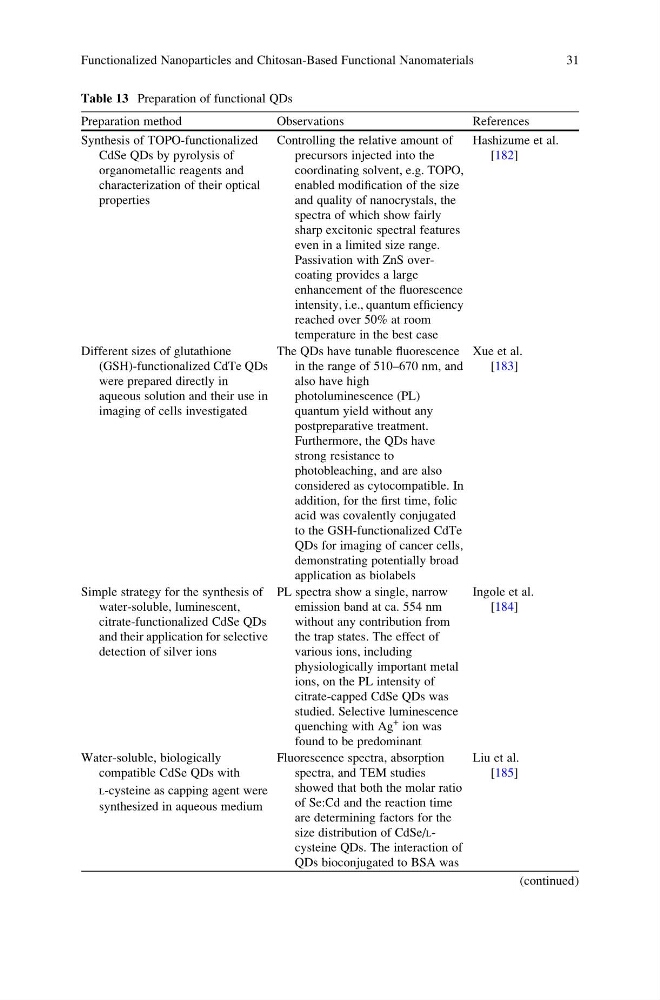
Table 13 Preparation of functional QDs
Preparation method
Observations
References
Synthesis of TOPO-functionalized
CdSe QDs by pyrolysis of
organometallic reagents and
characterization of their optical
properties
Controlling the relative amount of
precursors injected into the
coordinating solvent, e.g. TOPO,
enabled modification of the size
and quality of nanocrystals, the
spectra of which show fairly
sharp excitonic spectral features
even in a limited size range.
Passivation with ZnS overcoating provides a large
enhancement of the fluorescence
intensity, i.e., quantum efficiency
reached over 50% at room
temperature in the best case
Hashizume et al.
[182]
Different sizes of glutathione
(GSH)-functionalized CdTe QDs
were prepared directly in
aqueous solution and their use in
imaging of cells investigated
The QDs have tunable fluorescence
in the range of 510–670 nm, and
also have high
photoluminescence (PL)
quantum yield without any
postpreparative treatment.
Furthermore, the QDs have
strong resistance to
photobleaching, and are also
considered as cytocompatible. In
addition, for the first time, folic
acid was covalently conjugated
to the GSH-functionalized CdTe
QDs for imaging of cancer cells,
demonstrating potentially broad
application as biolabels
Xue et al.
[183]
Simple strategy for the synthesis of
water-soluble, luminescent,
citrate-functionalized CdSe QDs
and their application for selective
detection of silver ions
PL spectra show a single, narrow
emission band at ca. 554 nm
without any contribution from
the trap states. The effect of
various ions, including
physiologically important metal
ions, on the PL intensity of
citrate-capped CdSe QDs was
studied. Selective luminescence
quenching with Ag
+ ion was
found to be predominant
Ingole et al.
[184]
Water-soluble, biologically
compatible CdSe QDs with
L-cysteine as capping agent were
synthesized in aqueous medium
Fluorescence spectra, absorption
spectra, and TEM studies
showed that both the molar ratio
of Se:Cd and the reaction time
are determining factors for the
size distribution of CdSe/Lcysteine QDs. The interaction of
QDs bioconjugated to BSA was
Liu et al.
[185]
(continued)
Functionalized Nanoparticles and Chitosan-Based Functional Nanomaterials
31
Preparation method
Observations
References
Synthesis of TOPO-functionalized
CdSe QDs by pyrolysis of
organometallic reagents and
characterization of their optical
properties
Controlling the relative amount of
precursors injected into the
coordinating solvent, e.g. TOPO,
enabled modification of the size
and quality of nanocrystals, the
spectra of which show fairly
sharp excitonic spectral features
even in a limited size range.
Passivation with ZnS overcoating provides a large
enhancement of the fluorescence
intensity, i.e., quantum efficiency
reached over 50% at room
temperature in the best case
Hashizume et al.
[182]
Different sizes of glutathione
(GSH)-functionalized CdTe QDs
were prepared directly in
aqueous solution and their use in
imaging of cells investigated
The QDs have tunable fluorescence
in the range of 510–670 nm, and
also have high
photoluminescence (PL)
quantum yield without any
postpreparative treatment.
Furthermore, the QDs have
strong resistance to
photobleaching, and are also
considered as cytocompatible. In
addition, for the first time, folic
acid was covalently conjugated
to the GSH-functionalized CdTe
QDs for imaging of cancer cells,
demonstrating potentially broad
application as biolabels
Xue et al.
[183]
Simple strategy for the synthesis of
water-soluble, luminescent,
citrate-functionalized CdSe QDs
and their application for selective
detection of silver ions
PL spectra show a single, narrow
emission band at ca. 554 nm
without any contribution from
the trap states. The effect of
various ions, including
physiologically important metal
ions, on the PL intensity of
citrate-capped CdSe QDs was
studied. Selective luminescence
quenching with Ag
+ ion was
found to be predominant
Ingole et al.
[184]
Water-soluble, biologically
compatible CdSe QDs with
L-cysteine as capping agent were
synthesized in aqueous medium
Fluorescence spectra, absorption
spectra, and TEM studies
showed that both the molar ratio
of Se:Cd and the reaction time
are determining factors for the
size distribution of CdSe/Lcysteine QDs. The interaction of
QDs bioconjugated to BSA was
Liu et al.
[185]
(continued)
Functionalized Nanoparticles and Chitosan-Based Functional Nanomaterials
31