

metal nanoparticles, carbon-based materials (CNTs, graphene, fullerene), and QDs.
Here we will discuss nanocomposites based on these nanostructural materials.
SnSb nanoparticles were coated onto the surface of MWCNTs by reductive
precipitation of metal chloride salts within a CNT suspension [195]. The
composites have a possible application in lithium-ion batteries. The SnSb–CNT
nanocomposite showed a high reversible capacity of 480 mAh/g and stable cyclic
retention until the 50th cycle. The improvement of reversible capacity and cyclic
performance of the SnSb–CNT composite is attributed to the nanoscale dimension
of the SnSb alloy particles (<50 nm) and the structural advantages of CNTs as a
framework material. The CNTs could be pinning the SnSb alloy particles on their
surfaces so as to hinder the agglomeration of SnSb particles, while maintaining
electronic conduction as well as accommodating drastic volume variation during
electrochemical reactions.
Wang et al. [196] reported synthesis of MnO 2 /CNT nanocomposites. The MnO 2
nanoparticles were coated on the CNTs by a facile direct redox reaction
between KMNO 4 and CNT without any other oxidant or reductant addition.
Xia and coworkers [197] synthesized poly(E-caprolactone) (PCL)/functionalized
MWCNT nanocomposites and their electroactive shape memory properties were
demonstrated. The crosslinking reaction of the pristine PCL was realized by using
benzoyl peroxide as an initiator. The raw MWCNTS were prefunctionalized by
acid-oxidation processes and covalent grafting with PEG.
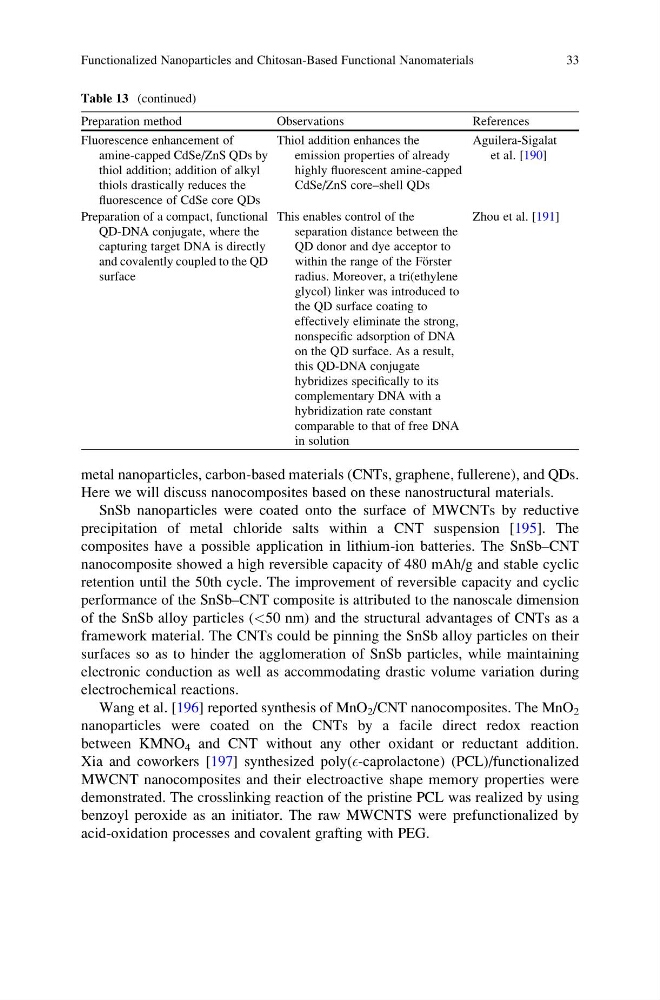
Table 13 (continued)
Preparation method
Observations
References
Fluorescence enhancement of
amine-capped CdSe/ZnS QDs by
thiol addition; addition of alkyl
thiols drastically reduces the
fluorescence of CdSe core QDs
Thiol addition enhances the
emission properties of already
highly fluorescent amine-capped
CdSe/ZnS core–shell QDs
Aguilera-Sigalat
et al. [190]
Preparation of a compact, functional
QD-DNA conjugate, where the
capturing target DNA is directly
and covalently coupled to the QD
surface
This enables control of the
separation distance between the
QD donor and dye acceptor to
within the range of the Fo ¨rster
radius. Moreover, a tri(ethylene
glycol) linker was introduced to
the QD surface coating to
effectively eliminate the strong,
nonspecific adsorption of DNA
on the QD surface. As a result,
this QD-DNA conjugate
hybridizes specifically to its
complementary DNA with a
hybridization rate constant
comparable to that of free DNA
in solution
Zhou et al. [191]
Functionalized Nanoparticles and Chitosan-Based Functional Nanomaterials
33
Here we will discuss nanocomposites based on these nanostructural materials.
SnSb nanoparticles were coated onto the surface of MWCNTs by reductive
precipitation of metal chloride salts within a CNT suspension [195]. The
composites have a possible application in lithium-ion batteries. The SnSb–CNT
nanocomposite showed a high reversible capacity of 480 mAh/g and stable cyclic
retention until the 50th cycle. The improvement of reversible capacity and cyclic
performance of the SnSb–CNT composite is attributed to the nanoscale dimension
of the SnSb alloy particles (<50 nm) and the structural advantages of CNTs as a
framework material. The CNTs could be pinning the SnSb alloy particles on their
surfaces so as to hinder the agglomeration of SnSb particles, while maintaining
electronic conduction as well as accommodating drastic volume variation during
electrochemical reactions.
Wang et al. [196] reported synthesis of MnO 2 /CNT nanocomposites. The MnO 2
nanoparticles were coated on the CNTs by a facile direct redox reaction
between KMNO 4 and CNT without any other oxidant or reductant addition.
Xia and coworkers [197] synthesized poly(E-caprolactone) (PCL)/functionalized
MWCNT nanocomposites and their electroactive shape memory properties were
demonstrated. The crosslinking reaction of the pristine PCL was realized by using
benzoyl peroxide as an initiator. The raw MWCNTS were prefunctionalized by
acid-oxidation processes and covalent grafting with PEG.
Table 13 (continued)
Preparation method
Observations
References
Fluorescence enhancement of
amine-capped CdSe/ZnS QDs by
thiol addition; addition of alkyl
thiols drastically reduces the
fluorescence of CdSe core QDs
Thiol addition enhances the
emission properties of already
highly fluorescent amine-capped
CdSe/ZnS core–shell QDs
Aguilera-Sigalat
et al. [190]
Preparation of a compact, functional
QD-DNA conjugate, where the
capturing target DNA is directly
and covalently coupled to the QD
surface
This enables control of the
separation distance between the
QD donor and dye acceptor to
within the range of the Fo ¨rster
radius. Moreover, a tri(ethylene
glycol) linker was introduced to
the QD surface coating to
effectively eliminate the strong,
nonspecific adsorption of DNA
on the QD surface. As a result,
this QD-DNA conjugate
hybridizes specifically to its
complementary DNA with a
hybridization rate constant
comparable to that of free DNA
in solution
Zhou et al. [191]
Functionalized Nanoparticles and Chitosan-Based Functional Nanomaterials
33