

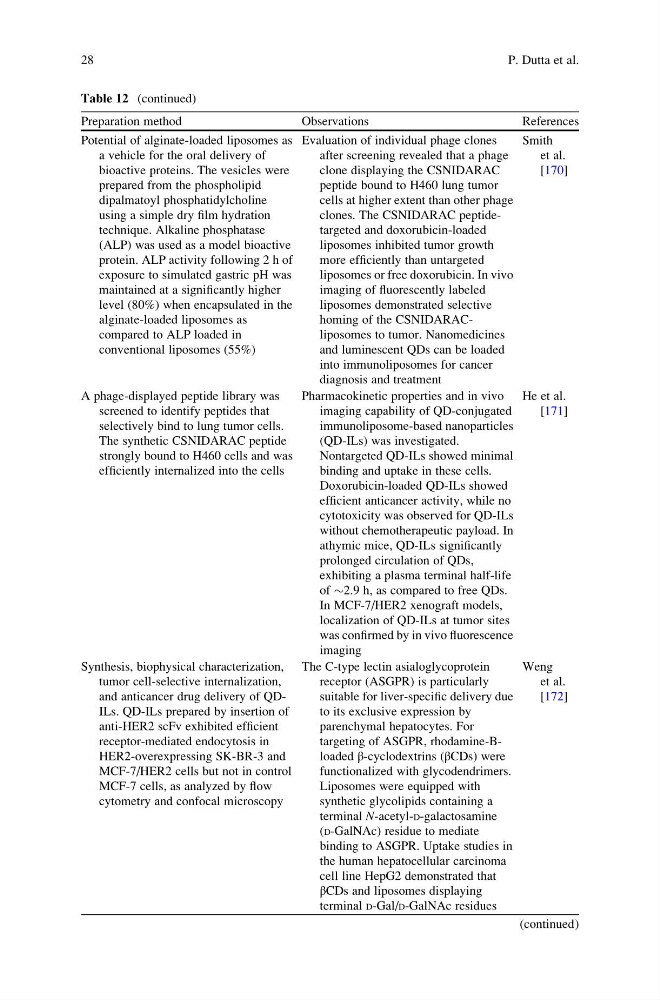
Table 12 (continued)
Preparation method
Observations
References
Potential of alginate-loaded liposomes as
a vehicle for the oral delivery of
bioactive proteins. The vesicles were
prepared from the phospholipid
dipalmatoyl phosphatidylcholine
using a simple dry film hydration
technique. Alkaline phosphatase
(ALP) was used as a model bioactive
protein. ALP activity following 2 h of
exposure to simulated gastric pH was
maintained at a significantly higher
level (80%) when encapsulated in the
alginate-loaded liposomes as
compared to ALP loaded in
conventional liposomes (55%)
Evaluation of individual phage clones
after screening revealed that a phage
clone displaying the CSNIDARAC
peptide bound to H460 lung tumor
cells at higher extent than other phage
clones. The CSNIDARAC peptidetargeted and doxorubicin-loaded
liposomes inhibited tumor growth
more efficiently than untargeted
liposomes or free doxorubicin. In vivo
imaging of fluorescently labeled
liposomes demonstrated selective
homing of the CSNIDARACliposomes to tumor. Nanomedicines
and luminescent QDs can be loaded
into immunoliposomes for cancer
diagnosis and treatment
Smith
et al.
[170]
A phage-displayed peptide library was
screened to identify peptides that
selectively bind to lung tumor cells.
The synthetic CSNIDARAC peptide
strongly bound to H460 cells and was
efficiently internalized into the cells
Pharmacokinetic properties and in vivo
imaging capability of QD-conjugated
immunoliposome-based nanoparticles
(QD-ILs) was investigated.
Nontargeted QD-ILs showed minimal
binding and uptake in these cells.
Doxorubicin-loaded QD-ILs showed
efficient anticancer activity, while no
cytotoxicity was observed for QD-ILs
without chemotherapeutic payload. In
athymic mice, QD-ILs significantly
prolonged circulation of QDs,
exhibiting a plasma terminal half-life
of $2.9 h, as compared to free QDs.
In MCF-7/HER2 xenograft models,
localization of QD-ILs at tumor sites
was confirmed by in vivo fluorescence
imaging
He et al.
[171]
Synthesis, biophysical characterization,
tumor cell-selective internalization,
and anticancer drug delivery of QDILs. QD-ILs prepared by insertion of
anti-HER2 scFv exhibited efficient
receptor-mediated endocytosis in
HER2-overexpressing SK-BR-3 and
MCF-7/HER2 cells but not in control
MCF-7 cells, as analyzed by flow
cytometry and confocal microscopy
The C-type lectin asialoglycoprotein
receptor (ASGPR) is particularly
suitable for liver-specific delivery due
to its exclusive expression by
parenchymal hepatocytes. For
targeting of ASGPR, rhodamine-Bloaded β-cyclodextrins (βCDs) were
functionalized with glycodendrimers.
Liposomes were equipped with
synthetic glycolipids containing a
terminal N-acetyl-D-galactosamine
(D-GalNAc) residue to mediate
binding to ASGPR. Uptake studies in
the human hepatocellular carcinoma
cell line HepG2 demonstrated that
βCDs and liposomes displaying
terminal D-Gal/D-GalNAc residues
Weng
et al.
[172]
(continued)
28
P. Dutta et al.
Preparation method
Observations
References
Potential of alginate-loaded liposomes as
a vehicle for the oral delivery of
bioactive proteins. The vesicles were
prepared from the phospholipid
dipalmatoyl phosphatidylcholine
using a simple dry film hydration
technique. Alkaline phosphatase
(ALP) was used as a model bioactive
protein. ALP activity following 2 h of
exposure to simulated gastric pH was
maintained at a significantly higher
level (80%) when encapsulated in the
alginate-loaded liposomes as
compared to ALP loaded in
conventional liposomes (55%)
Evaluation of individual phage clones
after screening revealed that a phage
clone displaying the CSNIDARAC
peptide bound to H460 lung tumor
cells at higher extent than other phage
clones. The CSNIDARAC peptidetargeted and doxorubicin-loaded
liposomes inhibited tumor growth
more efficiently than untargeted
liposomes or free doxorubicin. In vivo
imaging of fluorescently labeled
liposomes demonstrated selective
homing of the CSNIDARACliposomes to tumor. Nanomedicines
and luminescent QDs can be loaded
into immunoliposomes for cancer
diagnosis and treatment
Smith
et al.
[170]
A phage-displayed peptide library was
screened to identify peptides that
selectively bind to lung tumor cells.
The synthetic CSNIDARAC peptide
strongly bound to H460 cells and was
efficiently internalized into the cells
Pharmacokinetic properties and in vivo
imaging capability of QD-conjugated
immunoliposome-based nanoparticles
(QD-ILs) was investigated.
Nontargeted QD-ILs showed minimal
binding and uptake in these cells.
Doxorubicin-loaded QD-ILs showed
efficient anticancer activity, while no
cytotoxicity was observed for QD-ILs
without chemotherapeutic payload. In
athymic mice, QD-ILs significantly
prolonged circulation of QDs,
exhibiting a plasma terminal half-life
of $2.9 h, as compared to free QDs.
In MCF-7/HER2 xenograft models,
localization of QD-ILs at tumor sites
was confirmed by in vivo fluorescence
imaging
He et al.
[171]
Synthesis, biophysical characterization,
tumor cell-selective internalization,
and anticancer drug delivery of QDILs. QD-ILs prepared by insertion of
anti-HER2 scFv exhibited efficient
receptor-mediated endocytosis in
HER2-overexpressing SK-BR-3 and
MCF-7/HER2 cells but not in control
MCF-7 cells, as analyzed by flow
cytometry and confocal microscopy
The C-type lectin asialoglycoprotein
receptor (ASGPR) is particularly
suitable for liver-specific delivery due
to its exclusive expression by
parenchymal hepatocytes. For
targeting of ASGPR, rhodamine-Bloaded β-cyclodextrins (βCDs) were
functionalized with glycodendrimers.
Liposomes were equipped with
synthetic glycolipids containing a
terminal N-acetyl-D-galactosamine
(D-GalNAc) residue to mediate
binding to ASGPR. Uptake studies in
the human hepatocellular carcinoma
cell line HepG2 demonstrated that
βCDs and liposomes displaying
terminal D-Gal/D-GalNAc residues
Weng
et al.
[172]
(continued)
28
P. Dutta et al.