

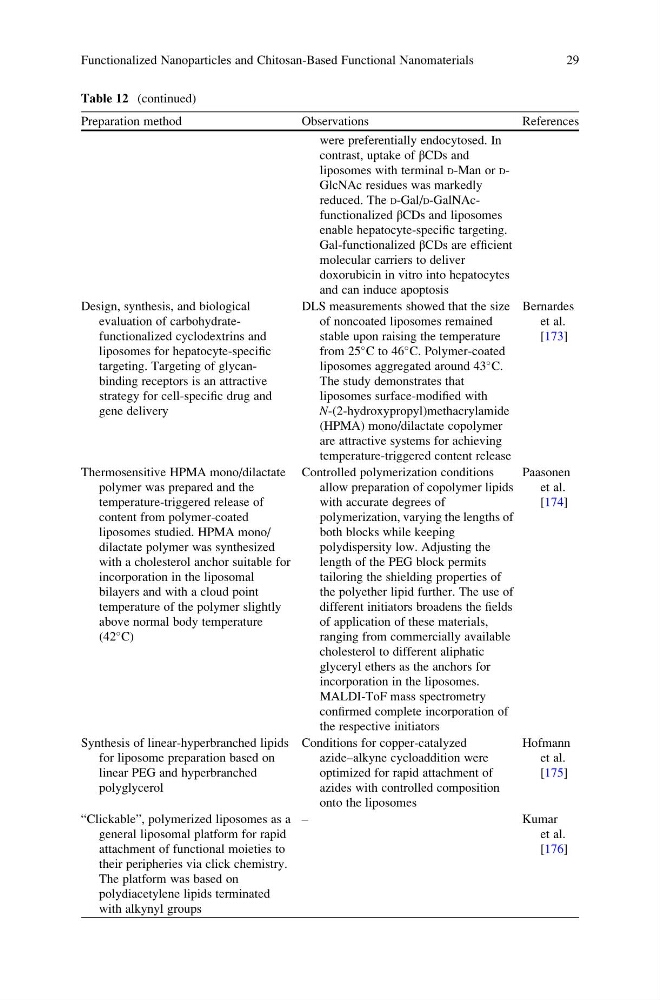
Table 12 (continued)
Preparation method
Observations
References
were preferentially endocytosed. In
contrast, uptake of βCDs and
liposomes with terminal D-Man or DGlcNAc residues was markedly
reduced. The D-Gal/D-GalNAcfunctionalized βCDs and liposomes
enable hepatocyte-specific targeting.
Gal-functionalized βCDs are efficient
molecular carriers to deliver
doxorubicin in vitro into hepatocytes
and can induce apoptosis
Design, synthesis, and biological
evaluation of carbohydratefunctionalized cyclodextrins and
liposomes for hepatocyte-specific
targeting. Targeting of glycanbinding receptors is an attractive
strategy for cell-specific drug and
gene delivery
DLS measurements showed that the size
of noncoated liposomes remained
stable upon raising the temperature
from 25
C to 46
C. Polymer-coated
liposomes aggregated around 43
C.
The study demonstrates that
liposomes surface-modified with
N-(2-hydroxypropyl)methacrylamide
(HPMA) mono/dilactate copolymer
are attractive systems for achieving
temperature-triggered content release
Bernardes
et al.
[173]
Thermosensitive HPMA mono/dilactate
polymer was prepared and the
temperature-triggered release of
content from polymer-coated
liposomes studied. HPMA mono/
dilactate polymer was synthesized
with a cholesterol anchor suitable for
incorporation in the liposomal
bilayers and with a cloud point
temperature of the polymer slightly
above normal body temperature
(42
C)
Controlled polymerization conditions
allow preparation of copolymer lipids
with accurate degrees of
polymerization, varying the lengths of
both blocks while keeping
polydispersity low. Adjusting the
length of the PEG block permits
tailoring the shielding properties of
the polyether lipid further. The use of
different initiators broadens the fields
of application of these materials,
ranging from commercially available
cholesterol to different aliphatic
glyceryl ethers as the anchors for
incorporation in the liposomes.
MALDI-ToF mass spectrometry
confirmed complete incorporation of
the respective initiators
Paasonen
et al.
[174]
Synthesis of linear-hyperbranched lipids
for liposome preparation based on
linear PEG and hyperbranched
polyglycerol
Conditions for copper-catalyzed
azide–alkyne cycloaddition were
optimized for rapid attachment of
azides with controlled composition
onto the liposomes
Hofmann
et al.
[175]
“Clickable”, polymerized liposomes as a
general liposomal platform for rapid
attachment of functional moieties to
their peripheries via click chemistry.
The platform was based on
polydiacetylene lipids terminated
with alkynyl groups
–
Kumar
et al.
[176]
Functionalized Nanoparticles and Chitosan-Based Functional Nanomaterials
29
Preparation method
Observations
References
were preferentially endocytosed. In
contrast, uptake of βCDs and
liposomes with terminal D-Man or DGlcNAc residues was markedly
reduced. The D-Gal/D-GalNAcfunctionalized βCDs and liposomes
enable hepatocyte-specific targeting.
Gal-functionalized βCDs are efficient
molecular carriers to deliver
doxorubicin in vitro into hepatocytes
and can induce apoptosis
Design, synthesis, and biological
evaluation of carbohydratefunctionalized cyclodextrins and
liposomes for hepatocyte-specific
targeting. Targeting of glycanbinding receptors is an attractive
strategy for cell-specific drug and
gene delivery
DLS measurements showed that the size
of noncoated liposomes remained
stable upon raising the temperature
from 25
C to 46
C. Polymer-coated
liposomes aggregated around 43
C.
The study demonstrates that
liposomes surface-modified with
N-(2-hydroxypropyl)methacrylamide
(HPMA) mono/dilactate copolymer
are attractive systems for achieving
temperature-triggered content release
Bernardes
et al.
[173]
Thermosensitive HPMA mono/dilactate
polymer was prepared and the
temperature-triggered release of
content from polymer-coated
liposomes studied. HPMA mono/
dilactate polymer was synthesized
with a cholesterol anchor suitable for
incorporation in the liposomal
bilayers and with a cloud point
temperature of the polymer slightly
above normal body temperature
(42
C)
Controlled polymerization conditions
allow preparation of copolymer lipids
with accurate degrees of
polymerization, varying the lengths of
both blocks while keeping
polydispersity low. Adjusting the
length of the PEG block permits
tailoring the shielding properties of
the polyether lipid further. The use of
different initiators broadens the fields
of application of these materials,
ranging from commercially available
cholesterol to different aliphatic
glyceryl ethers as the anchors for
incorporation in the liposomes.
MALDI-ToF mass spectrometry
confirmed complete incorporation of
the respective initiators
Paasonen
et al.
[174]
Synthesis of linear-hyperbranched lipids
for liposome preparation based on
linear PEG and hyperbranched
polyglycerol
Conditions for copper-catalyzed
azide–alkyne cycloaddition were
optimized for rapid attachment of
azides with controlled composition
onto the liposomes
Hofmann
et al.
[175]
“Clickable”, polymerized liposomes as a
general liposomal platform for rapid
attachment of functional moieties to
their peripheries via click chemistry.
The platform was based on
polydiacetylene lipids terminated
with alkynyl groups
–
Kumar
et al.
[176]
Functionalized Nanoparticles and Chitosan-Based Functional Nanomaterials
29