

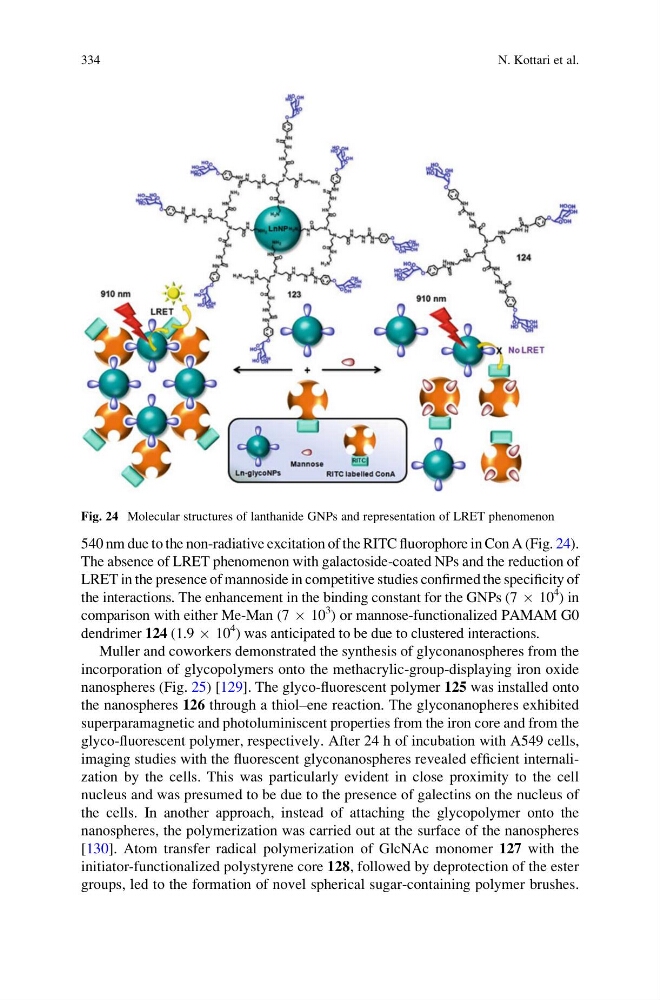
540 nm due to the non-radiative excitation of the RITC fluorophore in Con A (Fig. 24).
The absence of LRET phenomenon with galactoside-coated NPs and the reduction of
LRET in the presence of mannoside in competitive studies confirmed the specificity of
the interactions. The enhancement in the binding constant for the GNPs (7 Â 10
4
) in
comparison with either Me-Man (7 Â 10
3
) or mannose-functionalized PAMAM G0
dendrimer 124 (1.9 Â 10
4
) was anticipated to be due to clustered interactions.
Muller and coworkers demonstrated the synthesis of glyconanospheres from the
incorporation of glycopolymers onto the methacrylic-group-displaying iron oxide
nanospheres (Fig. 25) [129]. The glyco-fluorescent polymer 125 was installed onto
the nanospheres 126 through a thiol–ene reaction. The glyconanopheres exhibited
superparamagnetic and photoluminiscent properties from the iron core and from the
glyco-fluorescent polymer, respectively. After 24 h of incubation with A549 cells,
imaging studies with the fluorescent glyconanospheres revealed efficient internalization by the cells. This was particularly evident in close proximity to the cell
nucleus and was presumed to be due to the presence of galectins on the nucleus of
the cells. In another approach, instead of attaching the glycopolymer onto the
nanospheres, the polymerization was carried out at the surface of the nanospheres
[130]. Atom transfer radical polymerization of GlcNAc monomer 127 with the
initiator-functionalized polystyrene core 128, followed by deprotection of the ester
groups, led to the formation of novel spherical sugar-containing polymer brushes.
Fig. 24 Molecular structures of lanthanide GNPs and representation of LRET phenomenon
334
N. Kottari et al.
The absence of LRET phenomenon with galactoside-coated NPs and the reduction of
LRET in the presence of mannoside in competitive studies confirmed the specificity of
the interactions. The enhancement in the binding constant for the GNPs (7 Â 10
4
) in
comparison with either Me-Man (7 Â 10
3
) or mannose-functionalized PAMAM G0
dendrimer 124 (1.9 Â 10
4
) was anticipated to be due to clustered interactions.
Muller and coworkers demonstrated the synthesis of glyconanospheres from the
incorporation of glycopolymers onto the methacrylic-group-displaying iron oxide
nanospheres (Fig. 25) [129]. The glyco-fluorescent polymer 125 was installed onto
the nanospheres 126 through a thiol–ene reaction. The glyconanopheres exhibited
superparamagnetic and photoluminiscent properties from the iron core and from the
glyco-fluorescent polymer, respectively. After 24 h of incubation with A549 cells,
imaging studies with the fluorescent glyconanospheres revealed efficient internalization by the cells. This was particularly evident in close proximity to the cell
nucleus and was presumed to be due to the presence of galectins on the nucleus of
the cells. In another approach, instead of attaching the glycopolymer onto the
nanospheres, the polymerization was carried out at the surface of the nanospheres
[130]. Atom transfer radical polymerization of GlcNAc monomer 127 with the
initiator-functionalized polystyrene core 128, followed by deprotection of the ester
groups, led to the formation of novel spherical sugar-containing polymer brushes.
Fig. 24 Molecular structures of lanthanide GNPs and representation of LRET phenomenon
334
N. Kottari et al.