

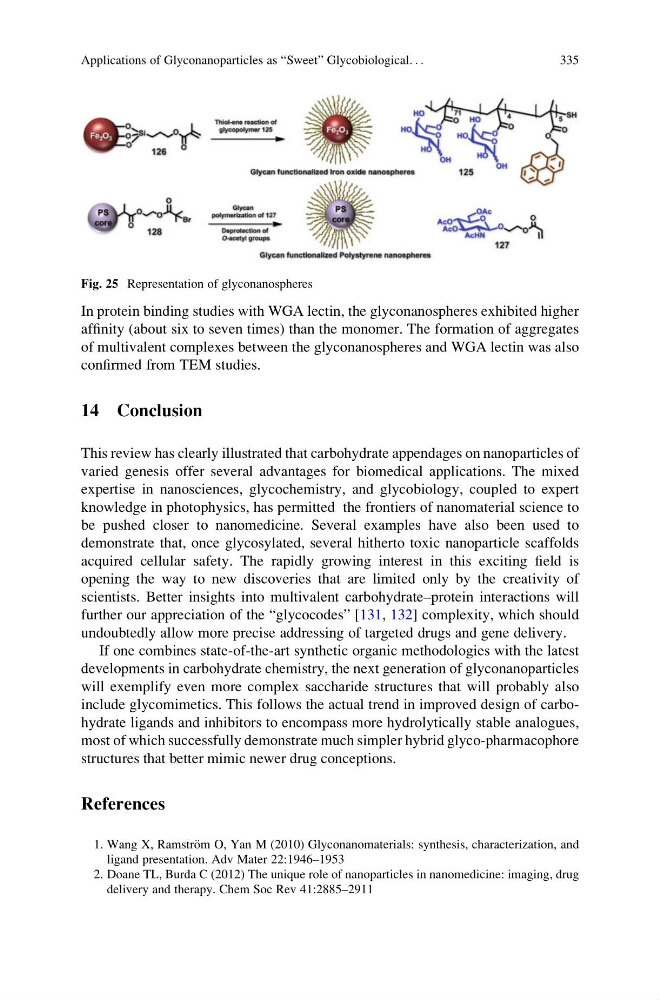
In protein binding studies with WGA lectin, the glyconanospheres exhibited higher
affinity (about six to seven times) than the monomer. The formation of aggregates
of multivalent complexes between the glyconanospheres and WGA lectin was also
confirmed from TEM studies.
14 Conclusion
This review has clearly illustrated that carbohydrate appendages on nanoparticles of
varied genesis offer several advantages for biomedical applications. The mixed
expertise in nanosciences, glycochemistry, and glycobiology, coupled to expert
knowledge in photophysics, has permitted the frontiers of nanomaterial science to
be pushed closer to nanomedicine. Several examples have also been used to
demonstrate that, once glycosylated, several hitherto toxic nanoparticle scaffolds
acquired cellular safety. The rapidly growing interest in this exciting field is
opening the way to new discoveries that are limited only by the creativity of
scientists. Better insights into multivalent carbohydrate–protein interactions will
further our appreciation of the “glycocodes” [131, 132] complexity, which should
undoubtedly allow more precise addressing of targeted drugs and gene delivery.
If one combines state-of-the-art synthetic organic methodologies with the latest
developments in carbohydrate chemistry, the next generation of glyconanoparticles
will exemplify even more complex saccharide structures that will probably also
include glycomimetics. This follows the actual trend in improved design of carbohydrate ligands and inhibitors to encompass more hydrolytically stable analogues,
most of which successfully demonstrate much simpler hybrid glyco-pharmacophore
structures that better mimic newer drug conceptions.
References
1. Wang X, Ramstro ¨m O, Yan M (2010) Glyconanomaterials: synthesis, characterization, and
ligand presentation. Adv Mater 22:1946–1953
2. Doane TL, Burda C (2012) The unique role of nanoparticles in nanomedicine: imaging, drug
delivery and therapy. Chem Soc Rev 41:2885–2911
Fig. 25 Representation of glyconanospheres
Applications of Glyconanoparticles as “Sweet” Glycobiological. . .
335
affinity (about six to seven times) than the monomer. The formation of aggregates
of multivalent complexes between the glyconanospheres and WGA lectin was also
confirmed from TEM studies.
14 Conclusion
This review has clearly illustrated that carbohydrate appendages on nanoparticles of
varied genesis offer several advantages for biomedical applications. The mixed
expertise in nanosciences, glycochemistry, and glycobiology, coupled to expert
knowledge in photophysics, has permitted the frontiers of nanomaterial science to
be pushed closer to nanomedicine. Several examples have also been used to
demonstrate that, once glycosylated, several hitherto toxic nanoparticle scaffolds
acquired cellular safety. The rapidly growing interest in this exciting field is
opening the way to new discoveries that are limited only by the creativity of
scientists. Better insights into multivalent carbohydrate–protein interactions will
further our appreciation of the “glycocodes” [131, 132] complexity, which should
undoubtedly allow more precise addressing of targeted drugs and gene delivery.
If one combines state-of-the-art synthetic organic methodologies with the latest
developments in carbohydrate chemistry, the next generation of glyconanoparticles
will exemplify even more complex saccharide structures that will probably also
include glycomimetics. This follows the actual trend in improved design of carbohydrate ligands and inhibitors to encompass more hydrolytically stable analogues,
most of which successfully demonstrate much simpler hybrid glyco-pharmacophore
structures that better mimic newer drug conceptions.
References
1. Wang X, Ramstro ¨m O, Yan M (2010) Glyconanomaterials: synthesis, characterization, and
ligand presentation. Adv Mater 22:1946–1953
2. Doane TL, Burda C (2012) The unique role of nanoparticles in nanomedicine: imaging, drug
delivery and therapy. Chem Soc Rev 41:2885–2911
Fig. 25 Representation of glyconanospheres
Applications of Glyconanoparticles as “Sweet” Glycobiological. . .
335