

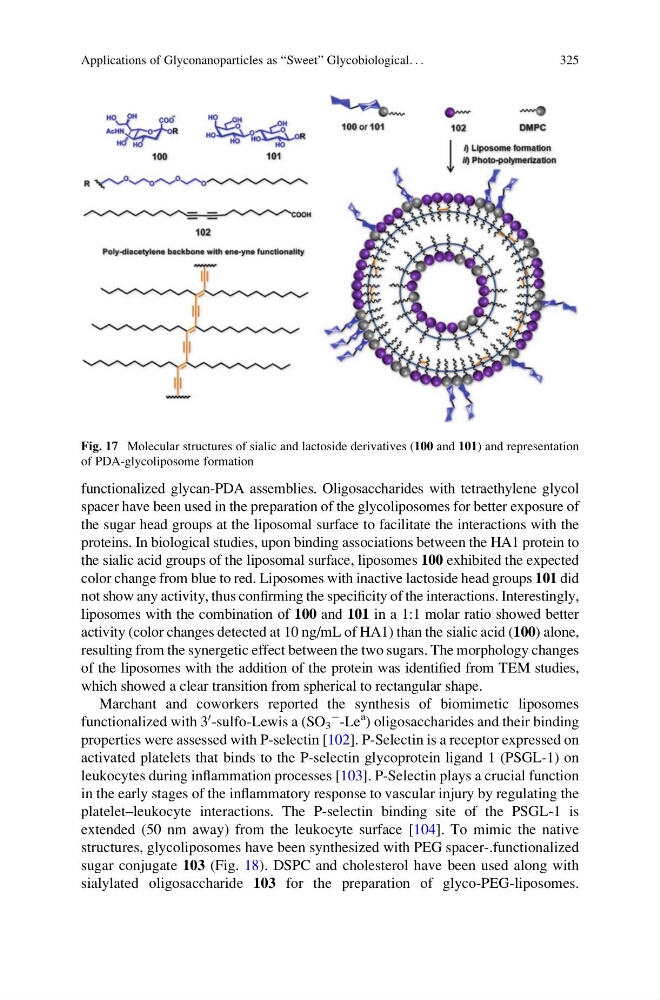
functionalized glycan-PDA assemblies. Oligosaccharides with tetraethylene glycol
spacer have been used in the preparation of the glycoliposomes for better exposure of
the sugar head groups at the liposomal surface to facilitate the interactions with the
proteins. In biological studies, upon binding associations between the HA1 protein to
the sialic acid groups of the liposomal surface, liposomes 100 exhibited the expected
color change from blue to red. Liposomes with inactive lactoside head groups 101 did
not show any activity, thus confirming the specificity of the interactions. Interestingly,
liposomes with the combination of 100 and 101 in a 1:1 molar ratio showed better
activity (color changes detected at 10 ng/mL of HA1) than the sialic acid (100) alone,
resulting from the synergetic effect between the two sugars. The morphology changes
of the liposomes with the addition of the protein was identified from TEM studies,
which showed a clear transition from spherical to rectangular shape.
Marchant and coworkers reported the synthesis of biomimetic liposomes
functionalized with 3
0 -sulfo-Lewis a (SO 3
À -Le
a ) oligosaccharides and their binding
properties were assessed with P-selectin [102]. P-Selectin is a receptor expressed on
activated platelets that binds to the P-selectin glycoprotein ligand 1 (PSGL-1) on
leukocytes during inflammation processes [103]. P-Selectin plays a crucial function
in the early stages of the inflammatory response to vascular injury by regulating the
platelet–leukocyte interactions. The P-selectin binding site of the PSGL-1 is
extended (50 nm away) from the leukocyte surface [104]. To mimic the native
structures, glycoliposomes have been synthesized with PEG spacer-.functionalized
sugar conjugate 103 (Fig. 18). DSPC and cholesterol have been used along with
sialylated oligosaccharide 103 for the preparation of glyco-PEG-liposomes.
Fig. 17 Molecular structures of sialic and lactoside derivatives (100 and 101) and representation
of PDA-glycoliposome formation
Applications of Glyconanoparticles as “Sweet” Glycobiological. . .
325
spacer have been used in the preparation of the glycoliposomes for better exposure of
the sugar head groups at the liposomal surface to facilitate the interactions with the
proteins. In biological studies, upon binding associations between the HA1 protein to
the sialic acid groups of the liposomal surface, liposomes 100 exhibited the expected
color change from blue to red. Liposomes with inactive lactoside head groups 101 did
not show any activity, thus confirming the specificity of the interactions. Interestingly,
liposomes with the combination of 100 and 101 in a 1:1 molar ratio showed better
activity (color changes detected at 10 ng/mL of HA1) than the sialic acid (100) alone,
resulting from the synergetic effect between the two sugars. The morphology changes
of the liposomes with the addition of the protein was identified from TEM studies,
which showed a clear transition from spherical to rectangular shape.
Marchant and coworkers reported the synthesis of biomimetic liposomes
functionalized with 3
0 -sulfo-Lewis a (SO 3
À -Le
a ) oligosaccharides and their binding
properties were assessed with P-selectin [102]. P-Selectin is a receptor expressed on
activated platelets that binds to the P-selectin glycoprotein ligand 1 (PSGL-1) on
leukocytes during inflammation processes [103]. P-Selectin plays a crucial function
in the early stages of the inflammatory response to vascular injury by regulating the
platelet–leukocyte interactions. The P-selectin binding site of the PSGL-1 is
extended (50 nm away) from the leukocyte surface [104]. To mimic the native
structures, glycoliposomes have been synthesized with PEG spacer-.functionalized
sugar conjugate 103 (Fig. 18). DSPC and cholesterol have been used along with
sialylated oligosaccharide 103 for the preparation of glyco-PEG-liposomes.
Fig. 17 Molecular structures of sialic and lactoside derivatives (100 and 101) and representation
of PDA-glycoliposome formation
Applications of Glyconanoparticles as “Sweet” Glycobiological. . .
325