

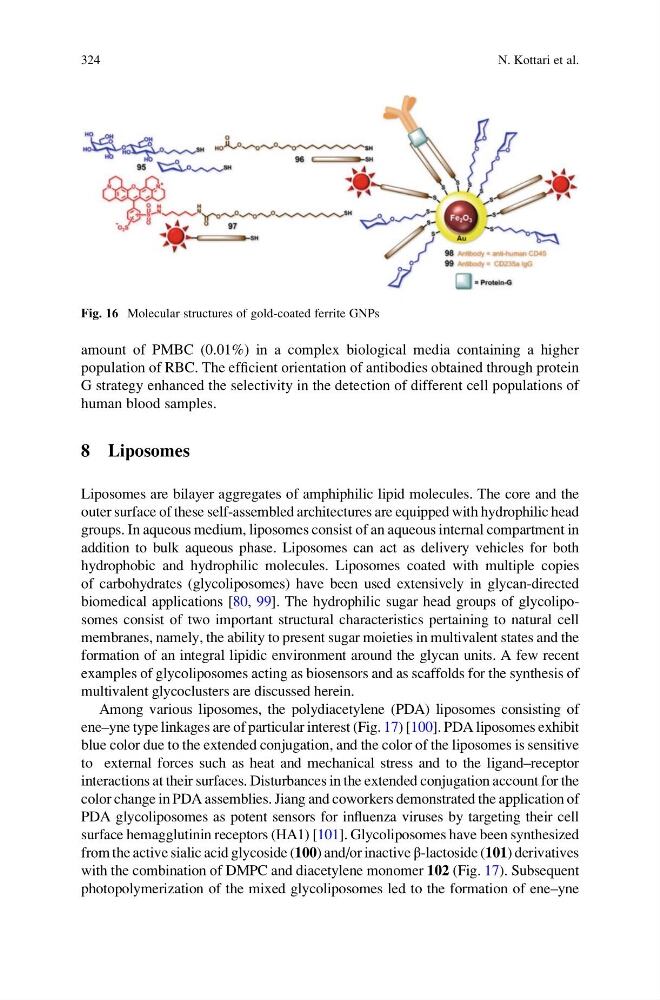
amount of PMBC (0.01%) in a complex biological media containing a higher
population of RBC. The efficient orientation of antibodies obtained through protein
G strategy enhanced the selectivity in the detection of different cell populations of
human blood samples.
8 Liposomes
Liposomes are bilayer aggregates of amphiphilic lipid molecules. The core and the
outer surface of these self-assembled architectures are equipped with hydrophilic head
groups. In aqueous medium, liposomes consist of an aqueous internal compartment in
addition to bulk aqueous phase. Liposomes can act as delivery vehicles for both
hydrophobic and hydrophilic molecules. Liposomes coated with multiple copies
of carbohydrates (glycoliposomes) have been used extensively in glycan-directed
biomedical applications [80, 99]. The hydrophilic sugar head groups of glycoliposomes consist of two important structural characteristics pertaining to natural cell
membranes, namely, the ability to present sugar moieties in multivalent states and the
formation of an integral lipidic environment around the glycan units. A few recent
examples of glycoliposomes acting as biosensors and as scaffolds for the synthesis of
multivalent glycoclusters are discussed herein.
Among various liposomes, the polydiacetylene (PDA) liposomes consisting of
ene–yne type linkages are of particular interest (Fig. 17) [100]. PDA liposomes exhibit
blue color due to the extended conjugation, and the color of the liposomes is sensitive
to external forces such as heat and mechanical stress and to the ligand–receptor
interactions at their surfaces. Disturbances in the extended conjugation account for the
color change in PDA assemblies. Jiang and coworkers demonstrated the application of
PDA glycoliposomes as potent sensors for influenza viruses by targeting their cell
surface hemagglutinin receptors (HA1) [101]. Glycoliposomes have been synthesized
from the active sialic acid glycoside (100) and/or inactive β-lactoside (101) derivatives
with the combination of DMPC and diacetylene monomer 102 (Fig. 17). Subsequent
photopolymerization of the mixed glycoliposomes led to the formation of ene–yne
Fig. 16 Molecular structures of gold-coated ferrite GNPs
324
N. Kottari et al.
population of RBC. The efficient orientation of antibodies obtained through protein
G strategy enhanced the selectivity in the detection of different cell populations of
human blood samples.
8 Liposomes
Liposomes are bilayer aggregates of amphiphilic lipid molecules. The core and the
outer surface of these self-assembled architectures are equipped with hydrophilic head
groups. In aqueous medium, liposomes consist of an aqueous internal compartment in
addition to bulk aqueous phase. Liposomes can act as delivery vehicles for both
hydrophobic and hydrophilic molecules. Liposomes coated with multiple copies
of carbohydrates (glycoliposomes) have been used extensively in glycan-directed
biomedical applications [80, 99]. The hydrophilic sugar head groups of glycoliposomes consist of two important structural characteristics pertaining to natural cell
membranes, namely, the ability to present sugar moieties in multivalent states and the
formation of an integral lipidic environment around the glycan units. A few recent
examples of glycoliposomes acting as biosensors and as scaffolds for the synthesis of
multivalent glycoclusters are discussed herein.
Among various liposomes, the polydiacetylene (PDA) liposomes consisting of
ene–yne type linkages are of particular interest (Fig. 17) [100]. PDA liposomes exhibit
blue color due to the extended conjugation, and the color of the liposomes is sensitive
to external forces such as heat and mechanical stress and to the ligand–receptor
interactions at their surfaces. Disturbances in the extended conjugation account for the
color change in PDA assemblies. Jiang and coworkers demonstrated the application of
PDA glycoliposomes as potent sensors for influenza viruses by targeting their cell
surface hemagglutinin receptors (HA1) [101]. Glycoliposomes have been synthesized
from the active sialic acid glycoside (100) and/or inactive β-lactoside (101) derivatives
with the combination of DMPC and diacetylene monomer 102 (Fig. 17). Subsequent
photopolymerization of the mixed glycoliposomes led to the formation of ene–yne
Fig. 16 Molecular structures of gold-coated ferrite GNPs
324
N. Kottari et al.