

3.4.3 Graphene
In recent years, graphene has become a very hot topic of research in the field of
nanomaterials. In graphite, each graphene layer is arranged such that half of the
atoms lie directly over the center of a hexagon in the lower graphene sheet, and half
of the atoms lie directly over an atom in the lower layer. A number of researchers
have developed a range of approaches for synthesizing graphene, including
micromechanical cleavage, liquid-phase exfoliation of graphite, epitaxial growth,
and reduction from graphite oxide (the precursor of graphene) by chemical or
thermal exfoliation. Recently, the biological applications have also started to be
investigated [138, 139].
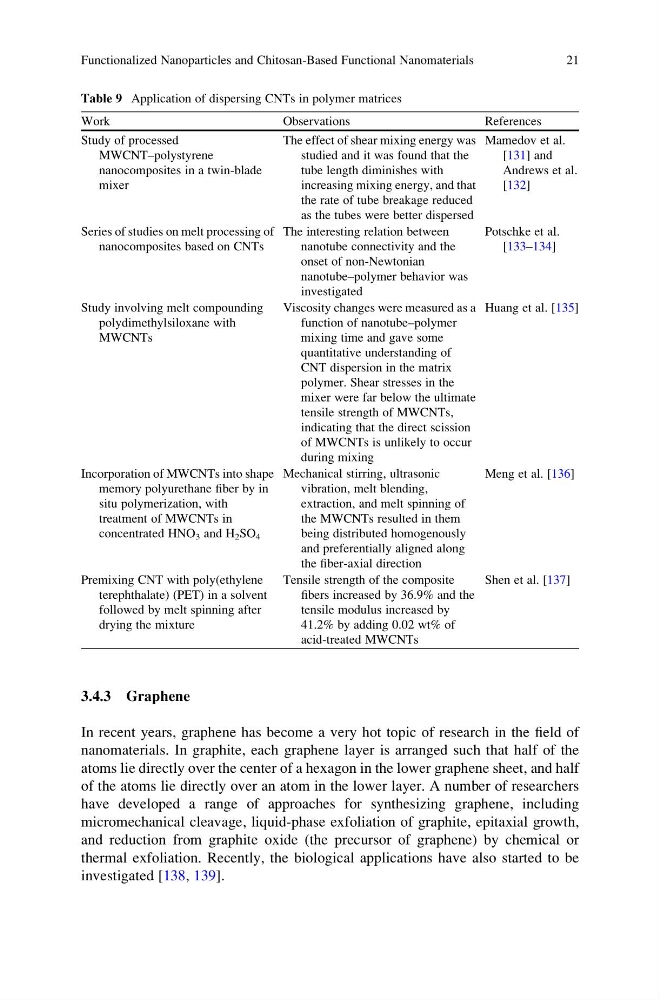
Table 9 Application of dispersing CNTs in polymer matrices
Work
Observations
References
Study of processed
MWCNT–polystyrene
nanocomposites in a twin-blade
mixer
The effect of shear mixing energy was
studied and it was found that the
tube length diminishes with
increasing mixing energy, and that
the rate of tube breakage reduced
as the tubes were better dispersed
Mamedov et al.
[131] and
Andrews et al.
[132]
Series of studies on melt processing of
nanocomposites based on CNTs
The interesting relation between
nanotube connectivity and the
onset of non-Newtonian
nanotube–polymer behavior was
investigated
Potschke et al.
[133–134]
Study involving melt compounding
polydimethylsiloxane with
MWCNTs
Viscosity changes were measured as a
function of nanotube–polymer
mixing time and gave some
quantitative understanding of
CNT dispersion in the matrix
polymer. Shear stresses in the
mixer were far below the ultimate
tensile strength of MWCNTs,
indicating that the direct scission
of MWCNTs is unlikely to occur
during mixing
Huang et al. [135]
Incorporation of MWCNTs into shape
memory polyurethane fiber by in
situ polymerization, with
treatment of MWCNTs in
concentrated HNO 3 and H 2 SO 4
Mechanical stirring, ultrasonic
vibration, melt blending,
extraction, and melt spinning of
the MWCNTs resulted in them
being distributed homogenously
and preferentially aligned along
the fiber-axial direction
Meng et al. [136]
Premixing CNT with poly(ethylene
terephthalate) (PET) in a solvent
followed by melt spinning after
drying the mixture
Tensile strength of the composite
fibers increased by 36.9% and the
tensile modulus increased by
41.2% by adding 0.02 wt% of
acid-treated MWCNTs
Shen et al. [137]
Functionalized Nanoparticles and Chitosan-Based Functional Nanomaterials
21
In recent years, graphene has become a very hot topic of research in the field of
nanomaterials. In graphite, each graphene layer is arranged such that half of the
atoms lie directly over the center of a hexagon in the lower graphene sheet, and half
of the atoms lie directly over an atom in the lower layer. A number of researchers
have developed a range of approaches for synthesizing graphene, including
micromechanical cleavage, liquid-phase exfoliation of graphite, epitaxial growth,
and reduction from graphite oxide (the precursor of graphene) by chemical or
thermal exfoliation. Recently, the biological applications have also started to be
investigated [138, 139].
Table 9 Application of dispersing CNTs in polymer matrices
Work
Observations
References
Study of processed
MWCNT–polystyrene
nanocomposites in a twin-blade
mixer
The effect of shear mixing energy was
studied and it was found that the
tube length diminishes with
increasing mixing energy, and that
the rate of tube breakage reduced
as the tubes were better dispersed
Mamedov et al.
[131] and
Andrews et al.
[132]
Series of studies on melt processing of
nanocomposites based on CNTs
The interesting relation between
nanotube connectivity and the
onset of non-Newtonian
nanotube–polymer behavior was
investigated
Potschke et al.
[133–134]
Study involving melt compounding
polydimethylsiloxane with
MWCNTs
Viscosity changes were measured as a
function of nanotube–polymer
mixing time and gave some
quantitative understanding of
CNT dispersion in the matrix
polymer. Shear stresses in the
mixer were far below the ultimate
tensile strength of MWCNTs,
indicating that the direct scission
of MWCNTs is unlikely to occur
during mixing
Huang et al. [135]
Incorporation of MWCNTs into shape
memory polyurethane fiber by in
situ polymerization, with
treatment of MWCNTs in
concentrated HNO 3 and H 2 SO 4
Mechanical stirring, ultrasonic
vibration, melt blending,
extraction, and melt spinning of
the MWCNTs resulted in them
being distributed homogenously
and preferentially aligned along
the fiber-axial direction
Meng et al. [136]
Premixing CNT with poly(ethylene
terephthalate) (PET) in a solvent
followed by melt spinning after
drying the mixture
Tensile strength of the composite
fibers increased by 36.9% and the
tensile modulus increased by
41.2% by adding 0.02 wt% of
acid-treated MWCNTs
Shen et al. [137]
Functionalized Nanoparticles and Chitosan-Based Functional Nanomaterials
21