

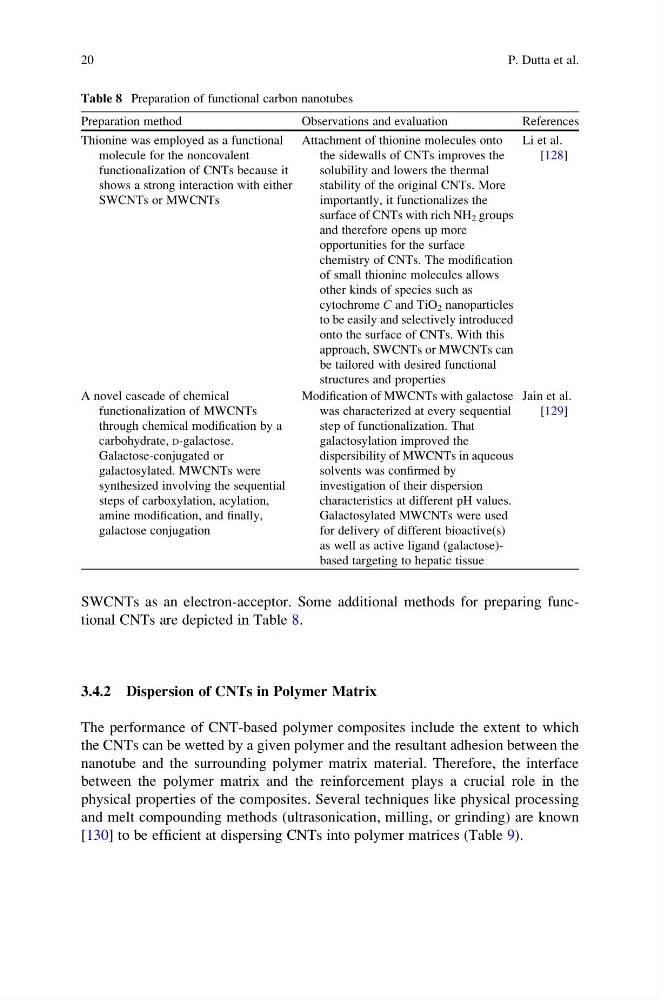
SWCNTs as an electron-acceptor. Some additional methods for preparing functional CNTs are depicted in Table 8.
3.4.2 Dispersion of CNTs in Polymer Matrix
The performance of CNT-based polymer composites include the extent to which
the CNTs can be wetted by a given polymer and the resultant adhesion between the
nanotube and the surrounding polymer matrix material. Therefore, the interface
between the polymer matrix and the reinforcement plays a crucial role in the
physical properties of the composites. Several techniques like physical processing
and melt compounding methods (ultrasonication, milling, or grinding) are known
[130] to be efficient at dispersing CNTs into polymer matrices (Table 9).
Table 8 Preparation of functional carbon nanotubes
Preparation method
Observations and evaluation
References
Thionine was employed as a functional
molecule for the noncovalent
functionalization of CNTs because it
shows a strong interaction with either
SWCNTs or MWCNTs
Attachment of thionine molecules onto
the sidewalls of CNTs improves the
solubility and lowers the thermal
stability of the original CNTs. More
importantly, it functionalizes the
surface of CNTs with rich NH 2 groups
and therefore opens up more
opportunities for the surface
chemistry of CNTs. The modification
of small thionine molecules allows
other kinds of species such as
cytochrome C and TiO 2 nanoparticles
to be easily and selectively introduced
onto the surface of CNTs. With this
approach, SWCNTs or MWCNTs can
be tailored with desired functional
structures and properties
Li et al.
[128]
A novel cascade of chemical
functionalization of MWCNTs
through chemical modification by a
carbohydrate, D-galactose.
Galactose-conjugated or
galactosylated. MWCNTs were
synthesized involving the sequential
steps of carboxylation, acylation,
amine modification, and finally,
galactose conjugation
Modification of MWCNTs with galactose
was characterized at every sequential
step of functionalization. That
galactosylation improved the
dispersibility of MWCNTs in aqueous
solvents was confirmed by
investigation of their dispersion
characteristics at different pH values.
Galactosylated MWCNTs were used
for delivery of different bioactive(s)
as well as active ligand (galactose)based targeting to hepatic tissue
Jain et al.
[129]
20
P. Dutta et al.
3.4.2 Dispersion of CNTs in Polymer Matrix
The performance of CNT-based polymer composites include the extent to which
the CNTs can be wetted by a given polymer and the resultant adhesion between the
nanotube and the surrounding polymer matrix material. Therefore, the interface
between the polymer matrix and the reinforcement plays a crucial role in the
physical properties of the composites. Several techniques like physical processing
and melt compounding methods (ultrasonication, milling, or grinding) are known
[130] to be efficient at dispersing CNTs into polymer matrices (Table 9).
Table 8 Preparation of functional carbon nanotubes
Preparation method
Observations and evaluation
References
Thionine was employed as a functional
molecule for the noncovalent
functionalization of CNTs because it
shows a strong interaction with either
SWCNTs or MWCNTs
Attachment of thionine molecules onto
the sidewalls of CNTs improves the
solubility and lowers the thermal
stability of the original CNTs. More
importantly, it functionalizes the
surface of CNTs with rich NH 2 groups
and therefore opens up more
opportunities for the surface
chemistry of CNTs. The modification
of small thionine molecules allows
other kinds of species such as
cytochrome C and TiO 2 nanoparticles
to be easily and selectively introduced
onto the surface of CNTs. With this
approach, SWCNTs or MWCNTs can
be tailored with desired functional
structures and properties
Li et al.
[128]
A novel cascade of chemical
functionalization of MWCNTs
through chemical modification by a
carbohydrate, D-galactose.
Galactose-conjugated or
galactosylated. MWCNTs were
synthesized involving the sequential
steps of carboxylation, acylation,
amine modification, and finally,
galactose conjugation
Modification of MWCNTs with galactose
was characterized at every sequential
step of functionalization. That
galactosylation improved the
dispersibility of MWCNTs in aqueous
solvents was confirmed by
investigation of their dispersion
characteristics at different pH values.
Galactosylated MWCNTs were used
for delivery of different bioactive(s)
as well as active ligand (galactose)based targeting to hepatic tissue
Jain et al.
[129]
20
P. Dutta et al.