

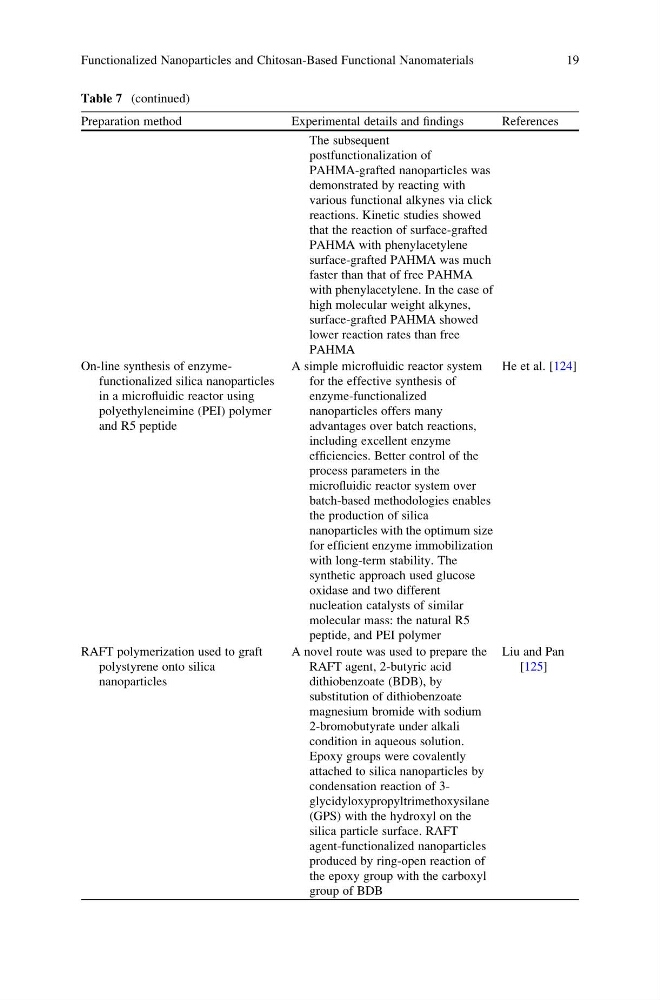
Table 7 (continued)
Preparation method
Experimental details and findings
References
The subsequent
postfunctionalization of
PAHMA-grafted nanoparticles was
demonstrated by reacting with
various functional alkynes via click
reactions. Kinetic studies showed
that the reaction of surface-grafted
PAHMA with phenylacetylene
surface-grafted PAHMA was much
faster than that of free PAHMA
with phenylacetylene. In the case of
high molecular weight alkynes,
surface-grafted PAHMA showed
lower reaction rates than free
PAHMA
On-line synthesis of enzymefunctionalized silica nanoparticles
in a microfluidic reactor using
polyethyleneimine (PEI) polymer
and R5 peptide
A simple microfluidic reactor system
for the effective synthesis of
enzyme-functionalized
nanoparticles offers many
advantages over batch reactions,
including excellent enzyme
efficiencies. Better control of the
process parameters in the
microfluidic reactor system over
batch-based methodologies enables
the production of silica
nanoparticles with the optimum size
for efficient enzyme immobilization
with long-term stability. The
synthetic approach used glucose
oxidase and two different
nucleation catalysts of similar
molecular mass: the natural R5
peptide, and PEI polymer
He et al. [124]
RAFT polymerization used to graft
polystyrene onto silica
nanoparticles
A novel route was used to prepare the
RAFT agent, 2-butyric acid
dithiobenzoate (BDB), by
substitution of dithiobenzoate
magnesium bromide with sodium
2-bromobutyrate under alkali
condition in aqueous solution.
Epoxy groups were covalently
attached to silica nanoparticles by
condensation reaction of 3glycidyloxypropyltrimethoxysilane
(GPS) with the hydroxyl on the
silica particle surface. RAFT
agent-functionalized nanoparticles
produced by ring-open reaction of
the epoxy group with the carboxyl
group of BDB
Liu and Pan
[125]
Functionalized Nanoparticles and Chitosan-Based Functional Nanomaterials
19
Preparation method
Experimental details and findings
References
The subsequent
postfunctionalization of
PAHMA-grafted nanoparticles was
demonstrated by reacting with
various functional alkynes via click
reactions. Kinetic studies showed
that the reaction of surface-grafted
PAHMA with phenylacetylene
surface-grafted PAHMA was much
faster than that of free PAHMA
with phenylacetylene. In the case of
high molecular weight alkynes,
surface-grafted PAHMA showed
lower reaction rates than free
PAHMA
On-line synthesis of enzymefunctionalized silica nanoparticles
in a microfluidic reactor using
polyethyleneimine (PEI) polymer
and R5 peptide
A simple microfluidic reactor system
for the effective synthesis of
enzyme-functionalized
nanoparticles offers many
advantages over batch reactions,
including excellent enzyme
efficiencies. Better control of the
process parameters in the
microfluidic reactor system over
batch-based methodologies enables
the production of silica
nanoparticles with the optimum size
for efficient enzyme immobilization
with long-term stability. The
synthetic approach used glucose
oxidase and two different
nucleation catalysts of similar
molecular mass: the natural R5
peptide, and PEI polymer
He et al. [124]
RAFT polymerization used to graft
polystyrene onto silica
nanoparticles
A novel route was used to prepare the
RAFT agent, 2-butyric acid
dithiobenzoate (BDB), by
substitution of dithiobenzoate
magnesium bromide with sodium
2-bromobutyrate under alkali
condition in aqueous solution.
Epoxy groups were covalently
attached to silica nanoparticles by
condensation reaction of 3glycidyloxypropyltrimethoxysilane
(GPS) with the hydroxyl on the
silica particle surface. RAFT
agent-functionalized nanoparticles
produced by ring-open reaction of
the epoxy group with the carboxyl
group of BDB
Liu and Pan
[125]
Functionalized Nanoparticles and Chitosan-Based Functional Nanomaterials
19