

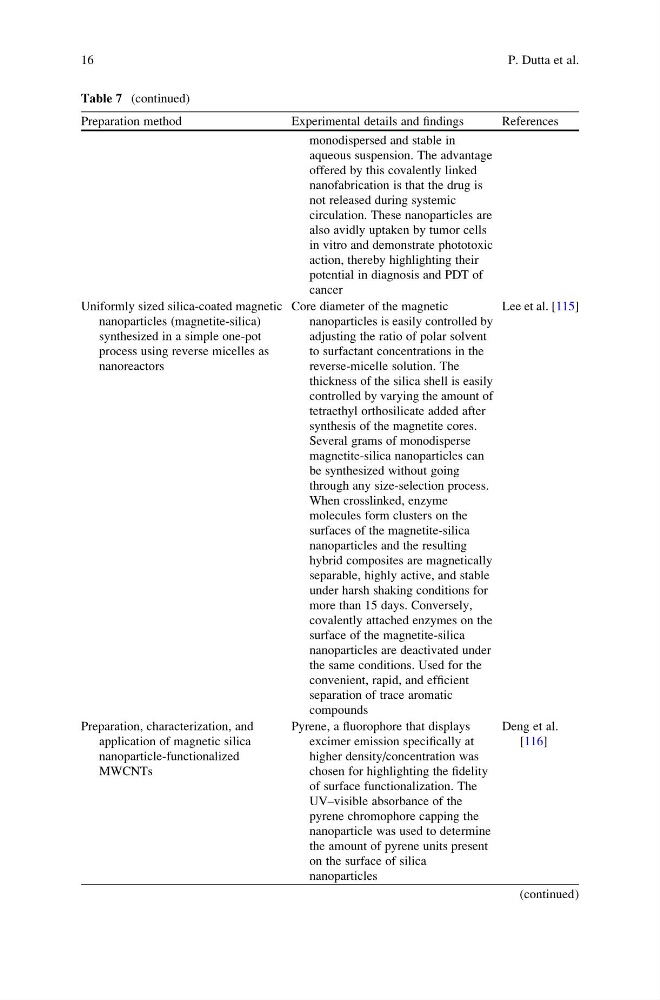
Table 7 (continued)
Preparation method
Experimental details and findings
References
monodispersed and stable in
aqueous suspension. The advantage
offered by this covalently linked
nanofabrication is that the drug is
not released during systemic
circulation. These nanoparticles are
also avidly uptaken by tumor cells
in vitro and demonstrate phototoxic
action, thereby highlighting their
potential in diagnosis and PDT of
cancer
Uniformly sized silica-coated magnetic
nanoparticles (magnetite-silica)
synthesized in a simple one-pot
process using reverse micelles as
nanoreactors
Core diameter of the magnetic
nanoparticles is easily controlled by
adjusting the ratio of polar solvent
to surfactant concentrations in the
reverse-micelle solution. The
thickness of the silica shell is easily
controlled by varying the amount of
tetraethyl orthosilicate added after
synthesis of the magnetite cores.
Several grams of monodisperse
magnetite-silica nanoparticles can
be synthesized without going
through any size-selection process.
When crosslinked, enzyme
molecules form clusters on the
surfaces of the magnetite-silica
nanoparticles and the resulting
hybrid composites are magnetically
separable, highly active, and stable
under harsh shaking conditions for
more than 15 days. Conversely,
covalently attached enzymes on the
surface of the magnetite-silica
nanoparticles are deactivated under
the same conditions. Used for the
convenient, rapid, and efficient
separation of trace aromatic
compounds
Lee et al. [115]
Preparation, characterization, and
application of magnetic silica
nanoparticle-functionalized
MWCNTs
Pyrene, a fluorophore that displays
excimer emission specifically at
higher density/concentration was
chosen for highlighting the fidelity
of surface functionalization. The
UV–visible absorbance of the
pyrene chromophore capping the
nanoparticle was used to determine
the amount of pyrene units present
on the surface of silica
nanoparticles
Deng et al.
[116]
(continued)
16
P. Dutta et al.
Preparation method
Experimental details and findings
References
monodispersed and stable in
aqueous suspension. The advantage
offered by this covalently linked
nanofabrication is that the drug is
not released during systemic
circulation. These nanoparticles are
also avidly uptaken by tumor cells
in vitro and demonstrate phototoxic
action, thereby highlighting their
potential in diagnosis and PDT of
cancer
Uniformly sized silica-coated magnetic
nanoparticles (magnetite-silica)
synthesized in a simple one-pot
process using reverse micelles as
nanoreactors
Core diameter of the magnetic
nanoparticles is easily controlled by
adjusting the ratio of polar solvent
to surfactant concentrations in the
reverse-micelle solution. The
thickness of the silica shell is easily
controlled by varying the amount of
tetraethyl orthosilicate added after
synthesis of the magnetite cores.
Several grams of monodisperse
magnetite-silica nanoparticles can
be synthesized without going
through any size-selection process.
When crosslinked, enzyme
molecules form clusters on the
surfaces of the magnetite-silica
nanoparticles and the resulting
hybrid composites are magnetically
separable, highly active, and stable
under harsh shaking conditions for
more than 15 days. Conversely,
covalently attached enzymes on the
surface of the magnetite-silica
nanoparticles are deactivated under
the same conditions. Used for the
convenient, rapid, and efficient
separation of trace aromatic
compounds
Lee et al. [115]
Preparation, characterization, and
application of magnetic silica
nanoparticle-functionalized
MWCNTs
Pyrene, a fluorophore that displays
excimer emission specifically at
higher density/concentration was
chosen for highlighting the fidelity
of surface functionalization. The
UV–visible absorbance of the
pyrene chromophore capping the
nanoparticle was used to determine
the amount of pyrene units present
on the surface of silica
nanoparticles
Deng et al.
[116]
(continued)
16
P. Dutta et al.