

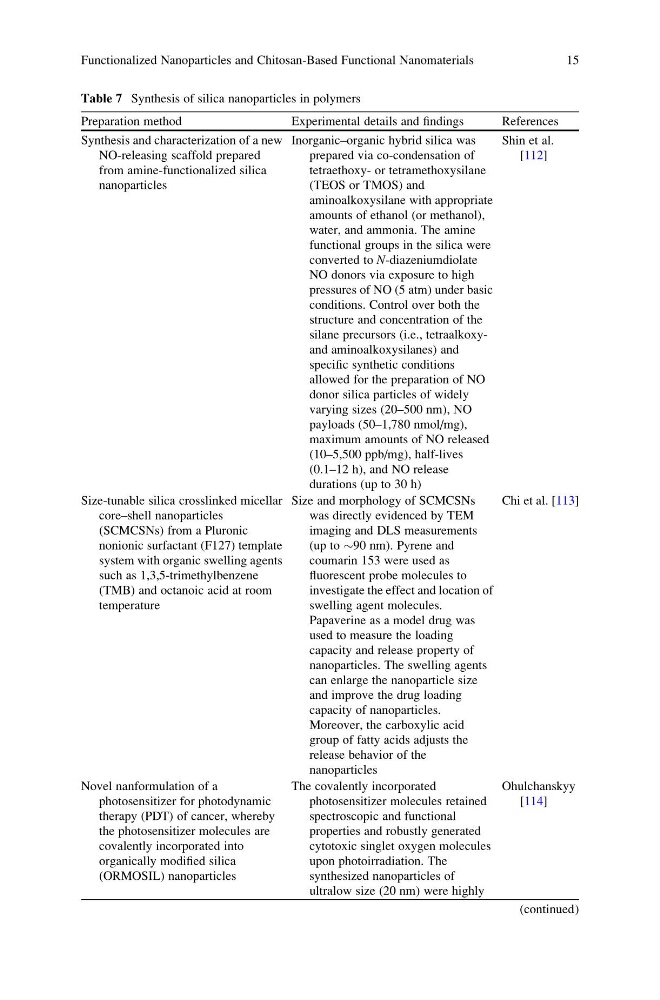
Table 7 Synthesis of silica nanoparticles in polymers
Preparation method
Experimental details and findings
References
Synthesis and characterization of a new
NO-releasing scaffold prepared
from amine-functionalized silica
nanoparticles
Inorganic–organic hybrid silica was
prepared via co-condensation of
tetraethoxy- or tetramethoxysilane
(TEOS or TMOS) and
aminoalkoxysilane with appropriate
amounts of ethanol (or methanol),
water, and ammonia. The amine
functional groups in the silica were
converted to N-diazeniumdiolate
NO donors via exposure to high
pressures of NO (5 atm) under basic
conditions. Control over both the
structure and concentration of the
silane precursors (i.e., tetraalkoxyand aminoalkoxysilanes) and
specific synthetic conditions
allowed for the preparation of NO
donor silica particles of widely
varying sizes (20–500 nm), NO
payloads (50–1,780 nmol/mg),
maximum amounts of NO released
(10–5,500 ppb/mg), half-lives
(0.1–12 h), and NO release
durations (up to 30 h)
Shin et al.
[112]
Size-tunable silica crosslinked micellar
core–shell nanoparticles
(SCMCSNs) from a Pluronic
nonionic surfactant (F127) template
system with organic swelling agents
such as 1,3,5-trimethylbenzene
(TMB) and octanoic acid at room
temperature
Size and morphology of SCMCSNs
was directly evidenced by TEM
imaging and DLS measurements
(up to $90 nm). Pyrene and
coumarin 153 were used as
fluorescent probe molecules to
investigate the effect and location of
swelling agent molecules.
Papaverine as a model drug was
used to measure the loading
capacity and release property of
nanoparticles. The swelling agents
can enlarge the nanoparticle size
and improve the drug loading
capacity of nanoparticles.
Moreover, the carboxylic acid
group of fatty acids adjusts the
release behavior of the
nanoparticles
Chi et al. [113]
Novel nanformulation of a
photosensitizer for photodynamic
therapy (PDT) of cancer, whereby
the photosensitizer molecules are
covalently incorporated into
organically modified silica
(ORMOSIL) nanoparticles
The covalently incorporated
photosensitizer molecules retained
spectroscopic and functional
properties and robustly generated
cytotoxic singlet oxygen molecules
upon photoirradiation. The
synthesized nanoparticles of
ultralow size (20 nm) were highly
Ohulchanskyy
[114]
(continued)
Functionalized Nanoparticles and Chitosan-Based Functional Nanomaterials
15
Preparation method
Experimental details and findings
References
Synthesis and characterization of a new
NO-releasing scaffold prepared
from amine-functionalized silica
nanoparticles
Inorganic–organic hybrid silica was
prepared via co-condensation of
tetraethoxy- or tetramethoxysilane
(TEOS or TMOS) and
aminoalkoxysilane with appropriate
amounts of ethanol (or methanol),
water, and ammonia. The amine
functional groups in the silica were
converted to N-diazeniumdiolate
NO donors via exposure to high
pressures of NO (5 atm) under basic
conditions. Control over both the
structure and concentration of the
silane precursors (i.e., tetraalkoxyand aminoalkoxysilanes) and
specific synthetic conditions
allowed for the preparation of NO
donor silica particles of widely
varying sizes (20–500 nm), NO
payloads (50–1,780 nmol/mg),
maximum amounts of NO released
(10–5,500 ppb/mg), half-lives
(0.1–12 h), and NO release
durations (up to 30 h)
Shin et al.
[112]
Size-tunable silica crosslinked micellar
core–shell nanoparticles
(SCMCSNs) from a Pluronic
nonionic surfactant (F127) template
system with organic swelling agents
such as 1,3,5-trimethylbenzene
(TMB) and octanoic acid at room
temperature
Size and morphology of SCMCSNs
was directly evidenced by TEM
imaging and DLS measurements
(up to $90 nm). Pyrene and
coumarin 153 were used as
fluorescent probe molecules to
investigate the effect and location of
swelling agent molecules.
Papaverine as a model drug was
used to measure the loading
capacity and release property of
nanoparticles. The swelling agents
can enlarge the nanoparticle size
and improve the drug loading
capacity of nanoparticles.
Moreover, the carboxylic acid
group of fatty acids adjusts the
release behavior of the
nanoparticles
Chi et al. [113]
Novel nanformulation of a
photosensitizer for photodynamic
therapy (PDT) of cancer, whereby
the photosensitizer molecules are
covalently incorporated into
organically modified silica
(ORMOSIL) nanoparticles
The covalently incorporated
photosensitizer molecules retained
spectroscopic and functional
properties and robustly generated
cytotoxic singlet oxygen molecules
upon photoirradiation. The
synthesized nanoparticles of
ultralow size (20 nm) were highly
Ohulchanskyy
[114]
(continued)
Functionalized Nanoparticles and Chitosan-Based Functional Nanomaterials
15