

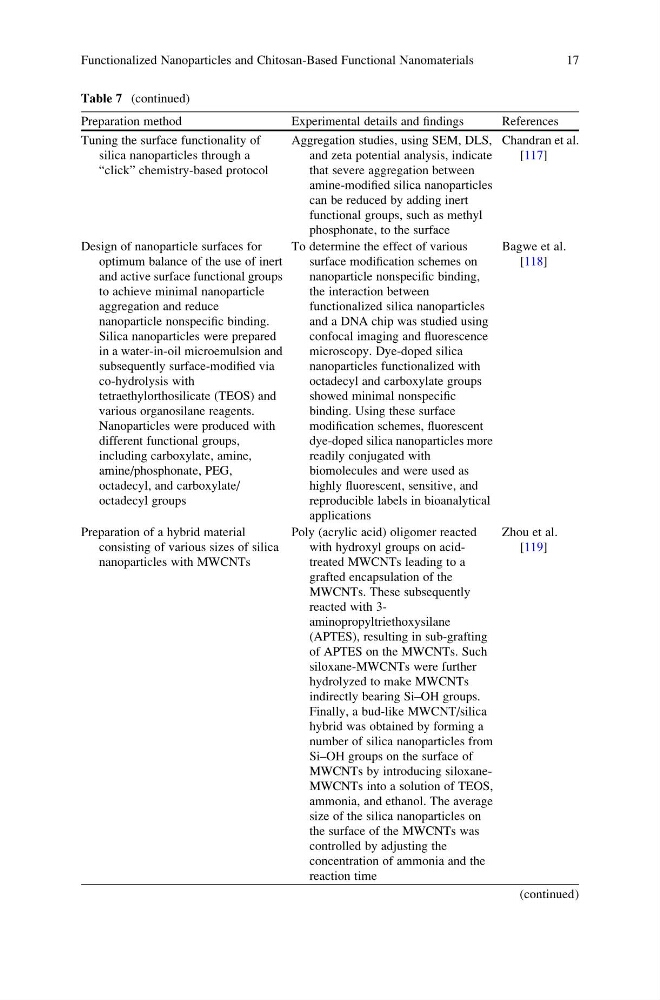
Table 7 (continued)
Preparation method
Experimental details and findings
References
Tuning the surface functionality of
silica nanoparticles through a
“click” chemistry-based protocol
Aggregation studies, using SEM, DLS,
and zeta potential analysis, indicate
that severe aggregation between
amine-modified silica nanoparticles
can be reduced by adding inert
functional groups, such as methyl
phosphonate, to the surface
Chandran et al.
[117]
Design of nanoparticle surfaces for
optimum balance of the use of inert
and active surface functional groups
to achieve minimal nanoparticle
aggregation and reduce
nanoparticle nonspecific binding.
Silica nanoparticles were prepared
in a water-in-oil microemulsion and
subsequently surface-modified via
co-hydrolysis with
tetraethylorthosilicate (TEOS) and
various organosilane reagents.
Nanoparticles were produced with
different functional groups,
including carboxylate, amine,
amine/phosphonate, PEG,
octadecyl, and carboxylate/
octadecyl groups
To determine the effect of various
surface modification schemes on
nanoparticle nonspecific binding,
the interaction between
functionalized silica nanoparticles
and a DNA chip was studied using
confocal imaging and fluorescence
microscopy. Dye-doped silica
nanoparticles functionalized with
octadecyl and carboxylate groups
showed minimal nonspecific
binding. Using these surface
modification schemes, fluorescent
dye-doped silica nanoparticles more
readily conjugated with
biomolecules and were used as
highly fluorescent, sensitive, and
reproducible labels in bioanalytical
applications
Bagwe et al.
[118]
Preparation of a hybrid material
consisting of various sizes of silica
nanoparticles with MWCNTs
Poly (acrylic acid) oligomer reacted
with hydroxyl groups on acidtreated MWCNTs leading to a
grafted encapsulation of the
MWCNTs. These subsequently
reacted with 3aminopropyltriethoxysilane
(APTES), resulting in sub-grafting
of APTES on the MWCNTs. Such
siloxane-MWCNTs were further
hydrolyzed to make MWCNTs
indirectly bearing Si–OH groups.
Finally, a bud-like MWCNT/silica
hybrid was obtained by forming a
number of silica nanoparticles from
Si–OH groups on the surface of
MWCNTs by introducing siloxaneMWCNTs into a solution of TEOS,
ammonia, and ethanol. The average
size of the silica nanoparticles on
the surface of the MWCNTs was
controlled by adjusting the
concentration of ammonia and the
reaction time
Zhou et al.
[119]
(continued)
Functionalized Nanoparticles and Chitosan-Based Functional Nanomaterials
17
Preparation method
Experimental details and findings
References
Tuning the surface functionality of
silica nanoparticles through a
“click” chemistry-based protocol
Aggregation studies, using SEM, DLS,
and zeta potential analysis, indicate
that severe aggregation between
amine-modified silica nanoparticles
can be reduced by adding inert
functional groups, such as methyl
phosphonate, to the surface
Chandran et al.
[117]
Design of nanoparticle surfaces for
optimum balance of the use of inert
and active surface functional groups
to achieve minimal nanoparticle
aggregation and reduce
nanoparticle nonspecific binding.
Silica nanoparticles were prepared
in a water-in-oil microemulsion and
subsequently surface-modified via
co-hydrolysis with
tetraethylorthosilicate (TEOS) and
various organosilane reagents.
Nanoparticles were produced with
different functional groups,
including carboxylate, amine,
amine/phosphonate, PEG,
octadecyl, and carboxylate/
octadecyl groups
To determine the effect of various
surface modification schemes on
nanoparticle nonspecific binding,
the interaction between
functionalized silica nanoparticles
and a DNA chip was studied using
confocal imaging and fluorescence
microscopy. Dye-doped silica
nanoparticles functionalized with
octadecyl and carboxylate groups
showed minimal nonspecific
binding. Using these surface
modification schemes, fluorescent
dye-doped silica nanoparticles more
readily conjugated with
biomolecules and were used as
highly fluorescent, sensitive, and
reproducible labels in bioanalytical
applications
Bagwe et al.
[118]
Preparation of a hybrid material
consisting of various sizes of silica
nanoparticles with MWCNTs
Poly (acrylic acid) oligomer reacted
with hydroxyl groups on acidtreated MWCNTs leading to a
grafted encapsulation of the
MWCNTs. These subsequently
reacted with 3aminopropyltriethoxysilane
(APTES), resulting in sub-grafting
of APTES on the MWCNTs. Such
siloxane-MWCNTs were further
hydrolyzed to make MWCNTs
indirectly bearing Si–OH groups.
Finally, a bud-like MWCNT/silica
hybrid was obtained by forming a
number of silica nanoparticles from
Si–OH groups on the surface of
MWCNTs by introducing siloxaneMWCNTs into a solution of TEOS,
ammonia, and ethanol. The average
size of the silica nanoparticles on
the surface of the MWCNTs was
controlled by adjusting the
concentration of ammonia and the
reaction time
Zhou et al.
[119]
(continued)
Functionalized Nanoparticles and Chitosan-Based Functional Nanomaterials
17