

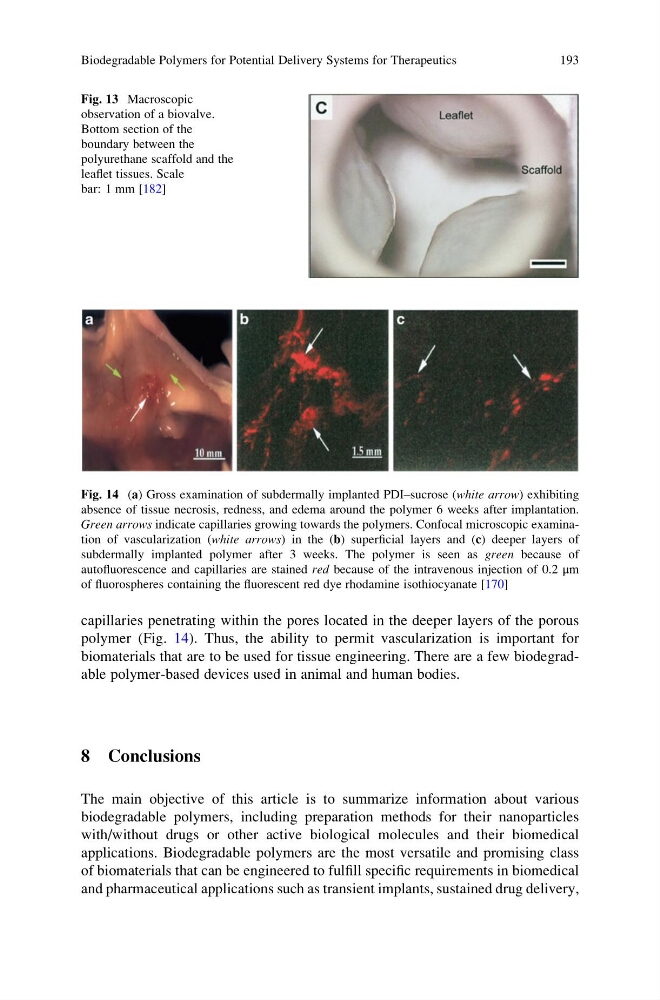
capillaries penetrating within the pores located in the deeper layers of the porous
polymer (Fig. 14). Thus, the ability to permit vascularization is important for
biomaterials that are to be used for tissue engineering. There are a few biodegradable polymer-based devices used in animal and human bodies.
8 Conclusions
The main objective of this article is to summarize information about various
biodegradable polymers, including preparation methods for their nanoparticles
with/without drugs or other active biological molecules and their biomedical
applications. Biodegradable polymers are the most versatile and promising class
of biomaterials that can be engineered to fulfill specific requirements in biomedical
and pharmaceutical applications such as transient implants, sustained drug delivery,
Fig. 14 (a) Gross examination of subdermally implanted PDI–sucrose (white arrow) exhibiting
absence of tissue necrosis, redness, and edema around the polymer 6 weeks after implantation.
Green arrows indicate capillaries growing towards the polymers. Confocal microscopic examination of vascularization (white arrows) in the (b) superficial layers and (c) deeper layers of
subdermally implanted polymer after 3 weeks. The polymer is seen as green because of
autofluorescence and capillaries are stained red because of the intravenous injection of 0.2 μm
of fluorospheres containing the fluorescent red dye rhodamine isothiocyanate [170]
Fig. 13 Macroscopic
observation of a biovalve.
Bottom section of the
boundary between the
polyurethane scaffold and the
leaflet tissues. Scale
bar: 1 mm [182]
Biodegradable Polymers for Potential Delivery Systems for Therapeutics
193
polymer (Fig. 14). Thus, the ability to permit vascularization is important for
biomaterials that are to be used for tissue engineering. There are a few biodegradable polymer-based devices used in animal and human bodies.
8 Conclusions
The main objective of this article is to summarize information about various
biodegradable polymers, including preparation methods for their nanoparticles
with/without drugs or other active biological molecules and their biomedical
applications. Biodegradable polymers are the most versatile and promising class
of biomaterials that can be engineered to fulfill specific requirements in biomedical
and pharmaceutical applications such as transient implants, sustained drug delivery,
Fig. 14 (a) Gross examination of subdermally implanted PDI–sucrose (white arrow) exhibiting
absence of tissue necrosis, redness, and edema around the polymer 6 weeks after implantation.
Green arrows indicate capillaries growing towards the polymers. Confocal microscopic examination of vascularization (white arrows) in the (b) superficial layers and (c) deeper layers of
subdermally implanted polymer after 3 weeks. The polymer is seen as green because of
autofluorescence and capillaries are stained red because of the intravenous injection of 0.2 μm
of fluorospheres containing the fluorescent red dye rhodamine isothiocyanate [170]
Fig. 13 Macroscopic
observation of a biovalve.
Bottom section of the
boundary between the
polyurethane scaffold and the
leaflet tissues. Scale
bar: 1 mm [182]
Biodegradable Polymers for Potential Delivery Systems for Therapeutics
193