

Preparation of low density PLGA (85:15) foams having high interstitial void
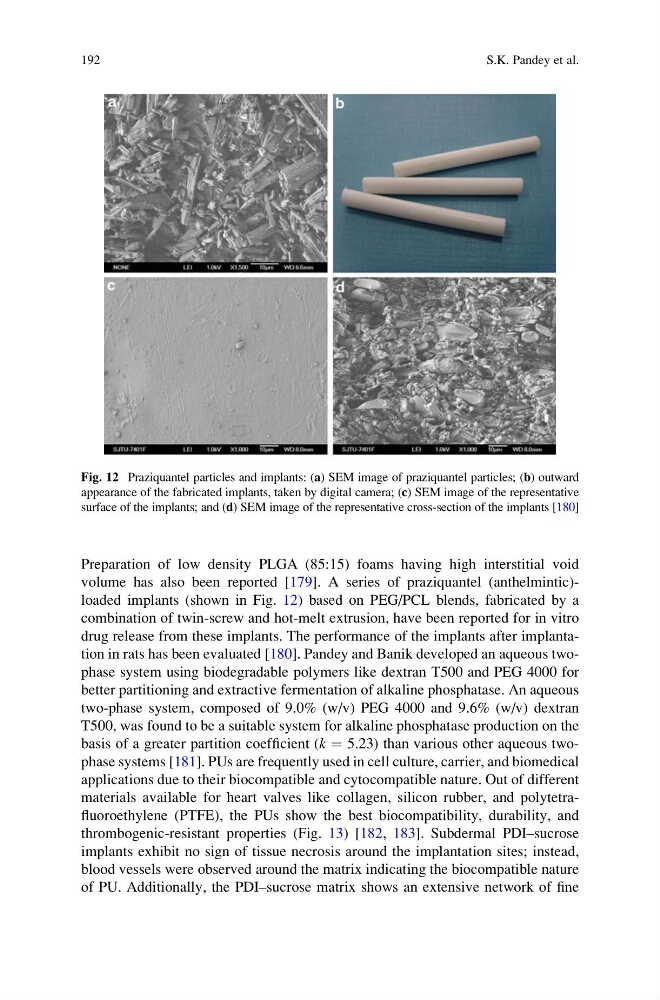
volume has also been reported [179]. A series of praziquantel (anthelmintic)loaded implants (shown in Fig. 12) based on PEG/PCL blends, fabricated by a
combination of twin-screw and hot-melt extrusion, have been reported for in vitro
drug release from these implants. The performance of the implants after implantation in rats has been evaluated [180]. Pandey and Banik developed an aqueous twophase system using biodegradable polymers like dextran T500 and PEG 4000 for
better partitioning and extractive fermentation of alkaline phosphatase. An aqueous
two-phase system, composed of 9.0% (w/v) PEG 4000 and 9.6% (w/v) dextran
T500, was found to be a suitable system for alkaline phosphatase production on the
basis of a greater partition coefficient (k ¼ 5.23) than various other aqueous twophase systems [181]. PUs are frequently used in cell culture, carrier, and biomedical
applications due to their biocompatible and cytocompatible nature. Out of different
materials available for heart valves like collagen, silicon rubber, and polytetrafluoroethylene (PTFE), the PUs show the best biocompatibility, durability, and
thrombogenic-resistant properties (Fig. 13) [182, 183]. Subdermal PDI–sucrose
implants exhibit no sign of tissue necrosis around the implantation sites; instead,
blood vessels were observed around the matrix indicating the biocompatible nature
of PU. Additionally, the PDI–sucrose matrix shows an extensive network of fine
Fig. 12 Praziquantel particles and implants: (a) SEM image of praziquantel particles; (b) outward
appearance of the fabricated implants, taken by digital camera; (c) SEM image of the representative
surface of the implants; and (d) SEM image of the representative cross-section of the implants [180]
192
S.K. Pandey et al.
volume has also been reported [179]. A series of praziquantel (anthelmintic)loaded implants (shown in Fig. 12) based on PEG/PCL blends, fabricated by a
combination of twin-screw and hot-melt extrusion, have been reported for in vitro
drug release from these implants. The performance of the implants after implantation in rats has been evaluated [180]. Pandey and Banik developed an aqueous twophase system using biodegradable polymers like dextran T500 and PEG 4000 for
better partitioning and extractive fermentation of alkaline phosphatase. An aqueous
two-phase system, composed of 9.0% (w/v) PEG 4000 and 9.6% (w/v) dextran
T500, was found to be a suitable system for alkaline phosphatase production on the
basis of a greater partition coefficient (k ¼ 5.23) than various other aqueous twophase systems [181]. PUs are frequently used in cell culture, carrier, and biomedical
applications due to their biocompatible and cytocompatible nature. Out of different
materials available for heart valves like collagen, silicon rubber, and polytetrafluoroethylene (PTFE), the PUs show the best biocompatibility, durability, and
thrombogenic-resistant properties (Fig. 13) [182, 183]. Subdermal PDI–sucrose
implants exhibit no sign of tissue necrosis around the implantation sites; instead,
blood vessels were observed around the matrix indicating the biocompatible nature
of PU. Additionally, the PDI–sucrose matrix shows an extensive network of fine
Fig. 12 Praziquantel particles and implants: (a) SEM image of praziquantel particles; (b) outward
appearance of the fabricated implants, taken by digital camera; (c) SEM image of the representative
surface of the implants; and (d) SEM image of the representative cross-section of the implants [180]
192
S.K. Pandey et al.