

physicochemical properties of benzophenone (hydrophobic)-loaded PLA
nanoparticles in the range of 150 nm. Elucidation of its release mechanisms revealed
the retention of nanoparticle integrity during the process and the dilution-induced
total release of encapsulated benzophenone with slow kinetics [47]. The preparation
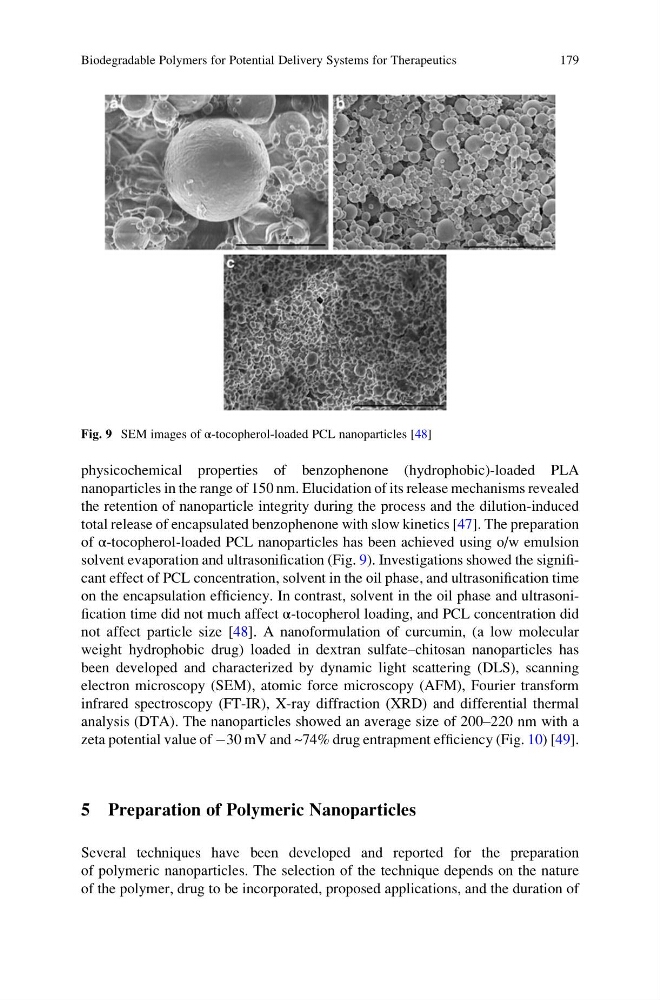
of α-tocopherol-loaded PCL nanoparticles has been achieved using o/w emulsion
solvent evaporation and ultrasonification (Fig. 9). Investigations showed the significant effect of PCL concentration, solvent in the oil phase, and ultrasonification time
on the encapsulation efficiency. In contrast, solvent in the oil phase and ultrasonification time did not much affect α-tocopherol loading, and PCL concentration did
not affect particle size [48]. A nanoformulation of curcumin, (a low molecular
weight hydrophobic drug) loaded in dextran sulfate–chitosan nanoparticles has
been developed and characterized by dynamic light scattering (DLS), scanning
electron microscopy (SEM), atomic force microscopy (AFM), Fourier transform
infrared spectroscopy (FT-IR), X-ray diffraction (XRD) and differential thermal
analysis (DTA). The nanoparticles showed an average size of 200–220 nm with a
zeta potential value of À30 mV and ~74% drug entrapment efficiency (Fig. 10) [49].
5 Preparation of Polymeric Nanoparticles
Several techniques have been developed and reported for the preparation
of polymeric nanoparticles. The selection of the technique depends on the nature
of the polymer, drug to be incorporated, proposed applications, and the duration of
Fig. 9 SEM images of α-tocopherol-loaded PCL nanoparticles [48]
Biodegradable Polymers for Potential Delivery Systems for Therapeutics
179
nanoparticles in the range of 150 nm. Elucidation of its release mechanisms revealed
the retention of nanoparticle integrity during the process and the dilution-induced
total release of encapsulated benzophenone with slow kinetics [47]. The preparation
of α-tocopherol-loaded PCL nanoparticles has been achieved using o/w emulsion
solvent evaporation and ultrasonification (Fig. 9). Investigations showed the significant effect of PCL concentration, solvent in the oil phase, and ultrasonification time
on the encapsulation efficiency. In contrast, solvent in the oil phase and ultrasonification time did not much affect α-tocopherol loading, and PCL concentration did
not affect particle size [48]. A nanoformulation of curcumin, (a low molecular
weight hydrophobic drug) loaded in dextran sulfate–chitosan nanoparticles has
been developed and characterized by dynamic light scattering (DLS), scanning
electron microscopy (SEM), atomic force microscopy (AFM), Fourier transform
infrared spectroscopy (FT-IR), X-ray diffraction (XRD) and differential thermal
analysis (DTA). The nanoparticles showed an average size of 200–220 nm with a
zeta potential value of À30 mV and ~74% drug entrapment efficiency (Fig. 10) [49].
5 Preparation of Polymeric Nanoparticles
Several techniques have been developed and reported for the preparation
of polymeric nanoparticles. The selection of the technique depends on the nature
of the polymer, drug to be incorporated, proposed applications, and the duration of
Fig. 9 SEM images of α-tocopherol-loaded PCL nanoparticles [48]
Biodegradable Polymers for Potential Delivery Systems for Therapeutics
179