

dispersion medium and with substantially higher stirring conditions [37]. PLGA
nanoparticles have been developed by using organic/water emulsification/solvent
evaporation techniques to produce nanoparticles having a size of 150 nm and drug
loading of 15.5% (w/w) [38]. Several groups have applied different process
variables to get appropriate nanoparticles based on their size and encapsulation
efficiency. The nanoparticles were also prepared by using the oil–water (o/w)
emulsification technique to determine the effect of some variables on the size
distribution of PLGA nanoparticles [39]. The homogenization pressure and PLGA
concentration have a linear and predictable effect on both size and polydispersity of
the particles. The concentrations of Tween 80 and dichloromethane (DCM) (organic
phase) had a large effect on the diameter and polydispersity. Magnetite-containing
PLA/PLGA nanoparticles were prepared by high-pressure homogenization of the
constituents in aqueous poloxamer-188 solutions [40]. Magnesium salts containing
5
1 0
1 5
2 0
20
40
60
80
100
PHBV-30B
PHBV-15A
PHBV
t / h
Wt. Loss / %
0
0
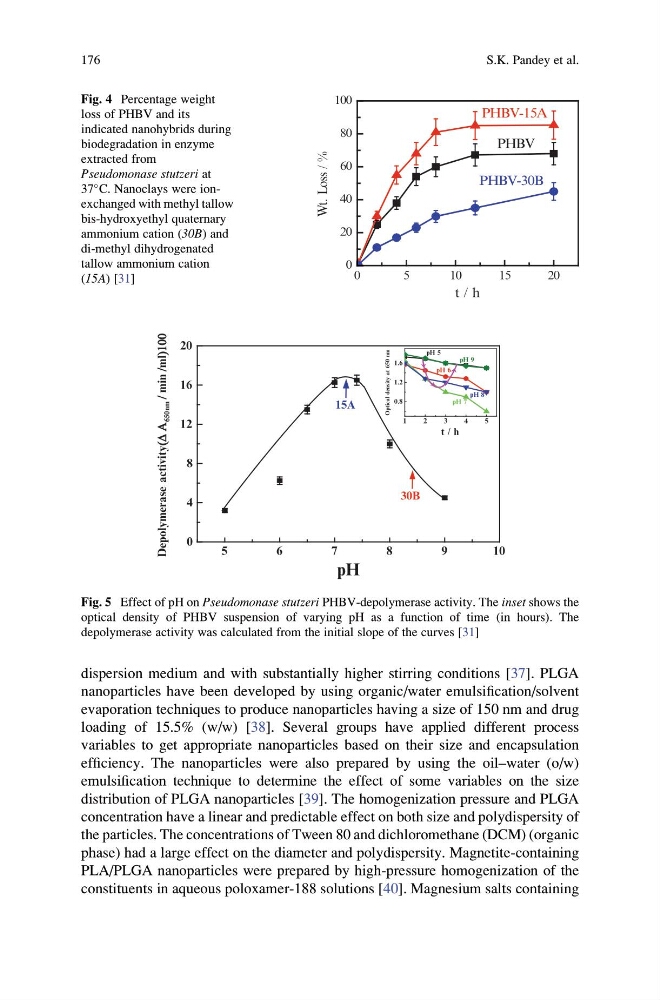
Fig. 4 Percentage weight
loss of PHBV and its
indicated nanohybrids during
biodegradation in enzyme
extracted from
Pseudomonase stutzeri at
37
C. Nanoclays were ionexchanged with methyl tallow
bis-hydroxyethyl quaternary
ammonium cation (30B) and
di-methyl dihydrogenated
tallow ammonium cation
(15A) [31]
5
6
7
8
9
1 0
0
4
8
12
16
20
30B
15A
Depolymerase activity(Δ
(Δ Α
65 650nm / / min
/
/ml)100 )100
pH
1
2
3
4
5
0.8
1.2
1.6
pH 8
pH 9
pH 5
pH 6
pH 7
t / h
Optical density at 650 nm
Fig. 5 Effect of pH on Pseudomonase stutzeri PHBV-depolymerase activity. The inset shows the
optical density of PHBV suspension of varying pH as a function of time (in hours). The
depolymerase activity was calculated from the initial slope of the curves [31]
176
S.K. Pandey et al.
nanoparticles have been developed by using organic/water emulsification/solvent
evaporation techniques to produce nanoparticles having a size of 150 nm and drug
loading of 15.5% (w/w) [38]. Several groups have applied different process
variables to get appropriate nanoparticles based on their size and encapsulation
efficiency. The nanoparticles were also prepared by using the oil–water (o/w)
emulsification technique to determine the effect of some variables on the size
distribution of PLGA nanoparticles [39]. The homogenization pressure and PLGA
concentration have a linear and predictable effect on both size and polydispersity of
the particles. The concentrations of Tween 80 and dichloromethane (DCM) (organic
phase) had a large effect on the diameter and polydispersity. Magnetite-containing
PLA/PLGA nanoparticles were prepared by high-pressure homogenization of the
constituents in aqueous poloxamer-188 solutions [40]. Magnesium salts containing
5
1 0
1 5
2 0
20
40
60
80
100
PHBV-30B
PHBV-15A
PHBV
t / h
Wt. Loss / %
0
0
Fig. 4 Percentage weight
loss of PHBV and its
indicated nanohybrids during
biodegradation in enzyme
extracted from
Pseudomonase stutzeri at
37
C. Nanoclays were ionexchanged with methyl tallow
bis-hydroxyethyl quaternary
ammonium cation (30B) and
di-methyl dihydrogenated
tallow ammonium cation
(15A) [31]
5
6
7
8
9
1 0
0
4
8
12
16
20
30B
15A
Depolymerase activity(Δ
(Δ Α
65 650nm / / min
/
/ml)100 )100
pH
1
2
3
4
5
0.8
1.2
1.6
pH 8
pH 9
pH 5
pH 6
pH 7
t / h
Optical density at 650 nm
Fig. 5 Effect of pH on Pseudomonase stutzeri PHBV-depolymerase activity. The inset shows the
optical density of PHBV suspension of varying pH as a function of time (in hours). The
depolymerase activity was calculated from the initial slope of the curves [31]
176
S.K. Pandey et al.