

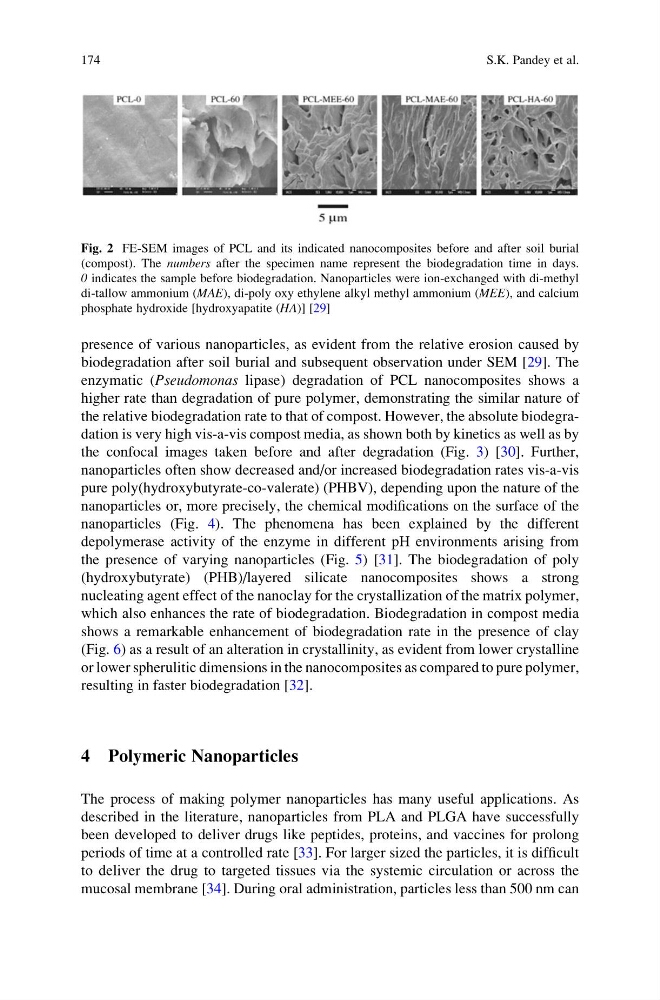
presence of various nanoparticles, as evident from the relative erosion caused by
biodegradation after soil burial and subsequent observation under SEM [29]. The
enzymatic (Pseudomonas lipase) degradation of PCL nanocomposites shows a
higher rate than degradation of pure polymer, demonstrating the similar nature of
the relative biodegradation rate to that of compost. However, the absolute biodegradation is very high vis-a-vis compost media, as shown both by kinetics as well as by
the confocal images taken before and after degradation (Fig. 3) [30]. Further,
nanoparticles often show decreased and/or increased biodegradation rates vis-a-vis
pure poly(hydroxybutyrate-co-valerate) (PHBV), depending upon the nature of the
nanoparticles or, more precisely, the chemical modifications on the surface of the
nanoparticles (Fig. 4). The phenomena has been explained by the different
depolymerase activity of the enzyme in different pH environments arising from
the presence of varying nanoparticles (Fig. 5) [31]. The biodegradation of poly
(hydroxybutyrate) (PHB)/layered silicate nanocomposites shows a strong
nucleating agent effect of the nanoclay for the crystallization of the matrix polymer,
which also enhances the rate of biodegradation. Biodegradation in compost media
shows a remarkable enhancement of biodegradation rate in the presence of clay
(Fig. 6) as a result of an alteration in crystallinity, as evident from lower crystalline
or lower spherulitic dimensions in the nanocomposites as compared to pure polymer,
resulting in faster biodegradation [32].
4 Polymeric Nanoparticles
The process of making polymer nanoparticles has many useful applications. As
described in the literature, nanoparticles from PLA and PLGA have successfully
been developed to deliver drugs like peptides, proteins, and vaccines for prolong
periods of time at a controlled rate [33]. For larger sized the particles, it is difficult
to deliver the drug to targeted tissues via the systemic circulation or across the
mucosal membrane [34]. During oral administration, particles less than 500 nm can
Fig. 2 FE-SEM images of PCL and its indicated nanocomposites before and after soil burial
(compost). The numbers after the specimen name represent the biodegradation time in days.
0 indicates the sample before biodegradation. Nanoparticles were ion-exchanged with di-methyl
di-tallow ammonium (MAE), di-poly oxy ethylene alkyl methyl ammonium (MEE), and calcium
phosphate hydroxide [hydroxyapatite (HA)] [29]
174
S.K. Pandey et al.
biodegradation after soil burial and subsequent observation under SEM [29]. The
enzymatic (Pseudomonas lipase) degradation of PCL nanocomposites shows a
higher rate than degradation of pure polymer, demonstrating the similar nature of
the relative biodegradation rate to that of compost. However, the absolute biodegradation is very high vis-a-vis compost media, as shown both by kinetics as well as by
the confocal images taken before and after degradation (Fig. 3) [30]. Further,
nanoparticles often show decreased and/or increased biodegradation rates vis-a-vis
pure poly(hydroxybutyrate-co-valerate) (PHBV), depending upon the nature of the
nanoparticles or, more precisely, the chemical modifications on the surface of the
nanoparticles (Fig. 4). The phenomena has been explained by the different
depolymerase activity of the enzyme in different pH environments arising from
the presence of varying nanoparticles (Fig. 5) [31]. The biodegradation of poly
(hydroxybutyrate) (PHB)/layered silicate nanocomposites shows a strong
nucleating agent effect of the nanoclay for the crystallization of the matrix polymer,
which also enhances the rate of biodegradation. Biodegradation in compost media
shows a remarkable enhancement of biodegradation rate in the presence of clay
(Fig. 6) as a result of an alteration in crystallinity, as evident from lower crystalline
or lower spherulitic dimensions in the nanocomposites as compared to pure polymer,
resulting in faster biodegradation [32].
4 Polymeric Nanoparticles
The process of making polymer nanoparticles has many useful applications. As
described in the literature, nanoparticles from PLA and PLGA have successfully
been developed to deliver drugs like peptides, proteins, and vaccines for prolong
periods of time at a controlled rate [33]. For larger sized the particles, it is difficult
to deliver the drug to targeted tissues via the systemic circulation or across the
mucosal membrane [34]. During oral administration, particles less than 500 nm can
Fig. 2 FE-SEM images of PCL and its indicated nanocomposites before and after soil burial
(compost). The numbers after the specimen name represent the biodegradation time in days.
0 indicates the sample before biodegradation. Nanoparticles were ion-exchanged with di-methyl
di-tallow ammonium (MAE), di-poly oxy ethylene alkyl methyl ammonium (MEE), and calcium
phosphate hydroxide [hydroxyapatite (HA)] [29]
174
S.K. Pandey et al.