

3.2 Hydrolysis
Hydrolysis reactions are usually catalyzed by acids, bases, salts, or enzymes [19].
Polymer hydrolytic degradation is defined as the breakdown of chemical bonds of
the polymer backbone by the water molecules to form oligomers or monomers. After
implantation, the biomaterial absorbs water and swells and, thereby, degradation
starts from the exterior part of the material toward its interior. The hydrophilic and
hydrophobic nature of polymeric materials influences their degradation rate because
they contain hydrolyzable bonds such as glycosides, esters, orthoesters, anhydrides,
carbonates, amides, urethanes, ureas, etc. [19, 23]. Hydrolysis reactions may be
catalyzed by enzymes known as hydrolases, which include proteases, esterases,
glycosidases, and phosphatases. This class of enzymes comprises cell-derived
proteins that play an important role in the degradation of biomaterials by catalyzing
the hydrolysis [24]. Aliphatic polyesters such as PLA, PGA, and their copolymer
PLGA are biodegradable and are successfully used in medical applications [25].
Degradation of PLA, PGA, and PLGA occurs in an aqueous environment through
simple hydrolysis of ester bonds that are auto-catalyzed by carboxylic groups. The
rate of hydrolysis increases exponentially with degradation time [26]. The initial
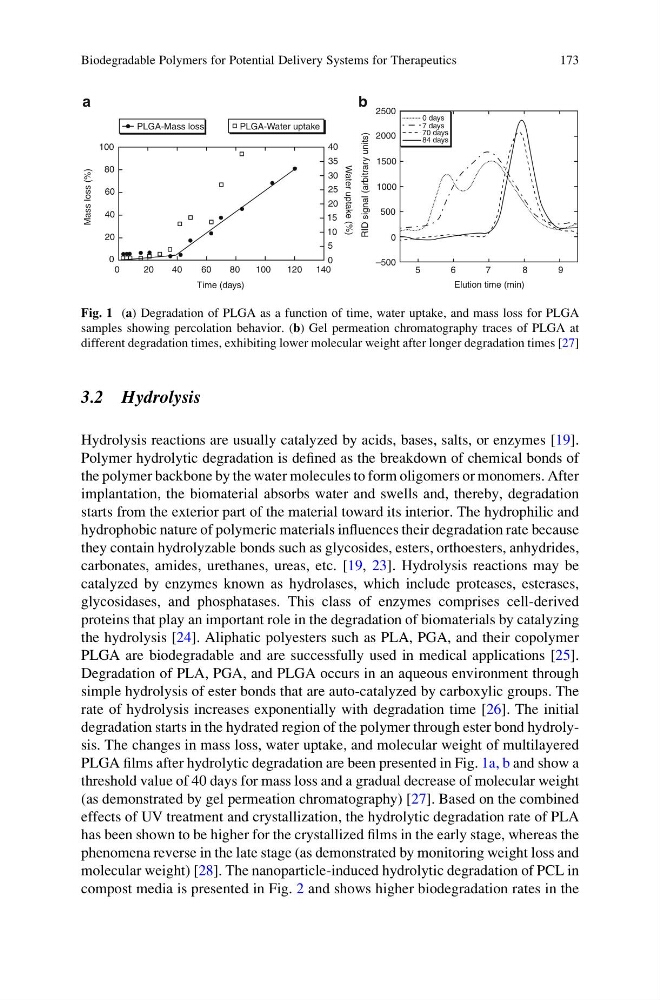
degradation starts in the hydrated region of the polymer through ester bond hydrolysis. The changes in mass loss, water uptake, and molecular weight of multilayered
PLGA films after hydrolytic degradation are been presented in Fig. 1a, b and show a
threshold value of 40 days for mass loss and a gradual decrease of molecular weight
(as demonstrated by gel permeation chromatography) [27]. Based on the combined
effects of UV treatment and crystallization, the hydrolytic degradation rate of PLA
has been shown to be higher for the crystallized films in the early stage, whereas the
phenomena reverse in the late stage (as demonstrated by monitoring weight loss and
molecular weight) [28]. The nanoparticle-induced hydrolytic degradation of PCL in
compost media is presented in Fig. 2 and shows higher biodegradation rates in the
100
100
120
140
80
80
60
60
40
40
20
20
0
0
0
5
10
15
20
25
30
35
40
Mass loss (%)
Time (days)
Water uptake (%)
PLGA-Mass loss
PLGA-Water uptake
2500
2000
1500
1000
500
–500
0
5
6
7
8
9
Elution time (min)
RID signal (arbitrary units)
a
b
0 days
7 days
70 days
84 days
Fig. 1 (a) Degradation of PLGA as a function of time, water uptake, and mass loss for PLGA
samples showing percolation behavior. (b) Gel permeation chromatography traces of PLGA at
different degradation times, exhibiting lower molecular weight after longer degradation times [27]
Biodegradable Polymers for Potential Delivery Systems for Therapeutics
173
Hydrolysis reactions are usually catalyzed by acids, bases, salts, or enzymes [19].
Polymer hydrolytic degradation is defined as the breakdown of chemical bonds of
the polymer backbone by the water molecules to form oligomers or monomers. After
implantation, the biomaterial absorbs water and swells and, thereby, degradation
starts from the exterior part of the material toward its interior. The hydrophilic and
hydrophobic nature of polymeric materials influences their degradation rate because
they contain hydrolyzable bonds such as glycosides, esters, orthoesters, anhydrides,
carbonates, amides, urethanes, ureas, etc. [19, 23]. Hydrolysis reactions may be
catalyzed by enzymes known as hydrolases, which include proteases, esterases,
glycosidases, and phosphatases. This class of enzymes comprises cell-derived
proteins that play an important role in the degradation of biomaterials by catalyzing
the hydrolysis [24]. Aliphatic polyesters such as PLA, PGA, and their copolymer
PLGA are biodegradable and are successfully used in medical applications [25].
Degradation of PLA, PGA, and PLGA occurs in an aqueous environment through
simple hydrolysis of ester bonds that are auto-catalyzed by carboxylic groups. The
rate of hydrolysis increases exponentially with degradation time [26]. The initial
degradation starts in the hydrated region of the polymer through ester bond hydrolysis. The changes in mass loss, water uptake, and molecular weight of multilayered
PLGA films after hydrolytic degradation are been presented in Fig. 1a, b and show a
threshold value of 40 days for mass loss and a gradual decrease of molecular weight
(as demonstrated by gel permeation chromatography) [27]. Based on the combined
effects of UV treatment and crystallization, the hydrolytic degradation rate of PLA
has been shown to be higher for the crystallized films in the early stage, whereas the
phenomena reverse in the late stage (as demonstrated by monitoring weight loss and
molecular weight) [28]. The nanoparticle-induced hydrolytic degradation of PCL in
compost media is presented in Fig. 2 and shows higher biodegradation rates in the
100
100
120
140
80
80
60
60
40
40
20
20
0
0
0
5
10
15
20
25
30
35
40
Mass loss (%)
Time (days)
Water uptake (%)
PLGA-Mass loss
PLGA-Water uptake
2500
2000
1500
1000
500
–500
0
5
6
7
8
9
Elution time (min)
RID signal (arbitrary units)
a
b
0 days
7 days
70 days
84 days
Fig. 1 (a) Degradation of PLGA as a function of time, water uptake, and mass loss for PLGA
samples showing percolation behavior. (b) Gel permeation chromatography traces of PLGA at
different degradation times, exhibiting lower molecular weight after longer degradation times [27]
Biodegradable Polymers for Potential Delivery Systems for Therapeutics
173