

particles can heat up under the influence of a localized high-frequency magnetic
field.
There are many chemical methods that can be used to synthesize magnetic
nanoparticles for biomedical applications, i.e., microemulsification [85], sol–gel
syntheses [86], sonochemical reactions [87], hydrothermal reactions [88], hydrolysis
and thermolysis of precursors [89], flow injection syntheses [90], and electrospray
syntheses [91].
Biofunctionalization of IONPs with biological molecules is an alternative
functionalization approach, which displays unique characteristics. Biofunctionalized
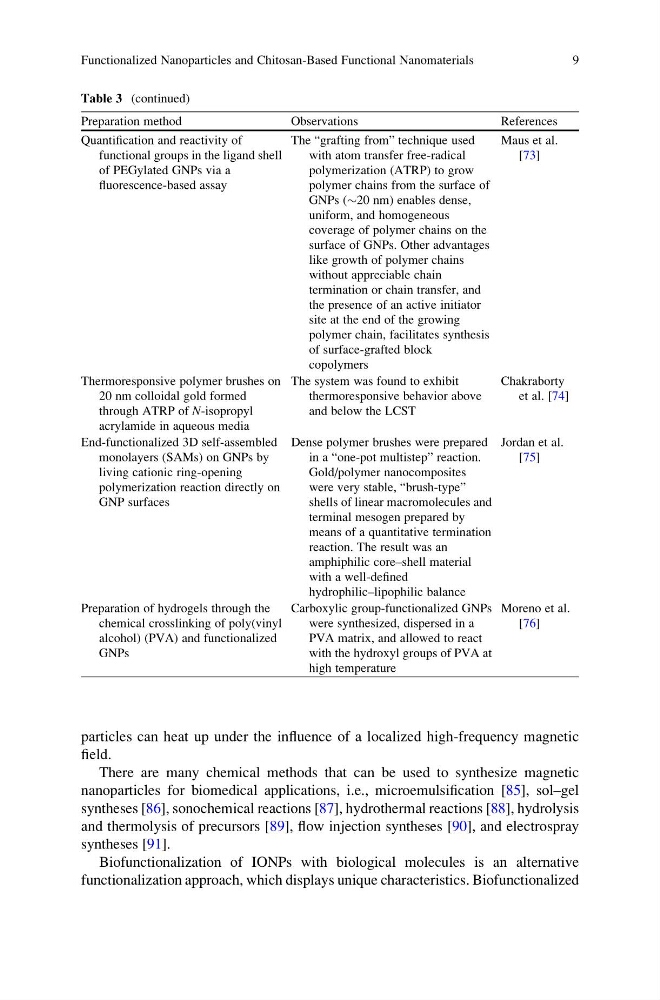
Table 3 (continued)
Preparation method
Observations
References
Quantification and reactivity of
functional groups in the ligand shell
of PEGylated GNPs via a
fluorescence-based assay
The “grafting from” technique used
with atom transfer free-radical
polymerization (ATRP) to grow
polymer chains from the surface of
GNPs ($20 nm) enables dense,
uniform, and homogeneous
coverage of polymer chains on the
surface of GNPs. Other advantages
like growth of polymer chains
without appreciable chain
termination or chain transfer, and
the presence of an active initiator
site at the end of the growing
polymer chain, facilitates synthesis
of surface-grafted block
copolymers
Maus et al.
[73]
Thermoresponsive polymer brushes on
20 nm colloidal gold formed
through ATRP of N-isopropyl
acrylamide in aqueous media
The system was found to exhibit
thermoresponsive behavior above
and below the LCST
Chakraborty
et al. [74]
End-functionalized 3D self-assembled
monolayers (SAMs) on GNPs by
living cationic ring-opening
polymerization reaction directly on
GNP surfaces
Dense polymer brushes were prepared
in a “one-pot multistep” reaction.
Gold/polymer nanocomposites
were very stable, “brush-type”
shells of linear macromolecules and
terminal mesogen prepared by
means of a quantitative termination
reaction. The result was an
amphiphilic core–shell material
with a well-defined
hydrophilic–lipophilic balance
Jordan et al.
[75]
Preparation of hydrogels through the
chemical crosslinking of poly(vinyl
alcohol) (PVA) and functionalized
GNPs
Carboxylic group-functionalized GNPs
were synthesized, dispersed in a
PVA matrix, and allowed to react
with the hydroxyl groups of PVA at
high temperature
Moreno et al.
[76]
Functionalized Nanoparticles and Chitosan-Based Functional Nanomaterials
9
field.
There are many chemical methods that can be used to synthesize magnetic
nanoparticles for biomedical applications, i.e., microemulsification [85], sol–gel
syntheses [86], sonochemical reactions [87], hydrothermal reactions [88], hydrolysis
and thermolysis of precursors [89], flow injection syntheses [90], and electrospray
syntheses [91].
Biofunctionalization of IONPs with biological molecules is an alternative
functionalization approach, which displays unique characteristics. Biofunctionalized
Table 3 (continued)
Preparation method
Observations
References
Quantification and reactivity of
functional groups in the ligand shell
of PEGylated GNPs via a
fluorescence-based assay
The “grafting from” technique used
with atom transfer free-radical
polymerization (ATRP) to grow
polymer chains from the surface of
GNPs ($20 nm) enables dense,
uniform, and homogeneous
coverage of polymer chains on the
surface of GNPs. Other advantages
like growth of polymer chains
without appreciable chain
termination or chain transfer, and
the presence of an active initiator
site at the end of the growing
polymer chain, facilitates synthesis
of surface-grafted block
copolymers
Maus et al.
[73]
Thermoresponsive polymer brushes on
20 nm colloidal gold formed
through ATRP of N-isopropyl
acrylamide in aqueous media
The system was found to exhibit
thermoresponsive behavior above
and below the LCST
Chakraborty
et al. [74]
End-functionalized 3D self-assembled
monolayers (SAMs) on GNPs by
living cationic ring-opening
polymerization reaction directly on
GNP surfaces
Dense polymer brushes were prepared
in a “one-pot multistep” reaction.
Gold/polymer nanocomposites
were very stable, “brush-type”
shells of linear macromolecules and
terminal mesogen prepared by
means of a quantitative termination
reaction. The result was an
amphiphilic core–shell material
with a well-defined
hydrophilic–lipophilic balance
Jordan et al.
[75]
Preparation of hydrogels through the
chemical crosslinking of poly(vinyl
alcohol) (PVA) and functionalized
GNPs
Carboxylic group-functionalized GNPs
were synthesized, dispersed in a
PVA matrix, and allowed to react
with the hydroxyl groups of PVA at
high temperature
Moreno et al.
[76]
Functionalized Nanoparticles and Chitosan-Based Functional Nanomaterials
9