

4.1.3 Copolymerization
In copolymerization, a mixture of more than one monomer is allowed to polymerize
and co-polymer is formed. Co-polymers contains multiple units of each monomer
used for polymerization in the same polymeric chain. The copolymer with a
relatively random distribution of the different monomer in its structure is referred
to as a random copolymer. For example, a random copolymer with two different
monomers A and B can be depicted as AABBBABAAAABBA. The other types of
copolymers are alternating, block, and graft. In the alternating copolymer, two
monomers alternate in a regular fashion, e.g., ABABABABABABAB. In a block
copolymer, one or more long uninterrupted sequence of each monomer can be seen,
e.g., AAAAAABBBBBBBB; it is a linear copolymer. A graft copolymer is a
branched copolymer with a backbone of one type of polymer to which one or
more side chains of another type of polymer are attached:
AAAAAAAAAAAAAA:
B
B
B
B
B
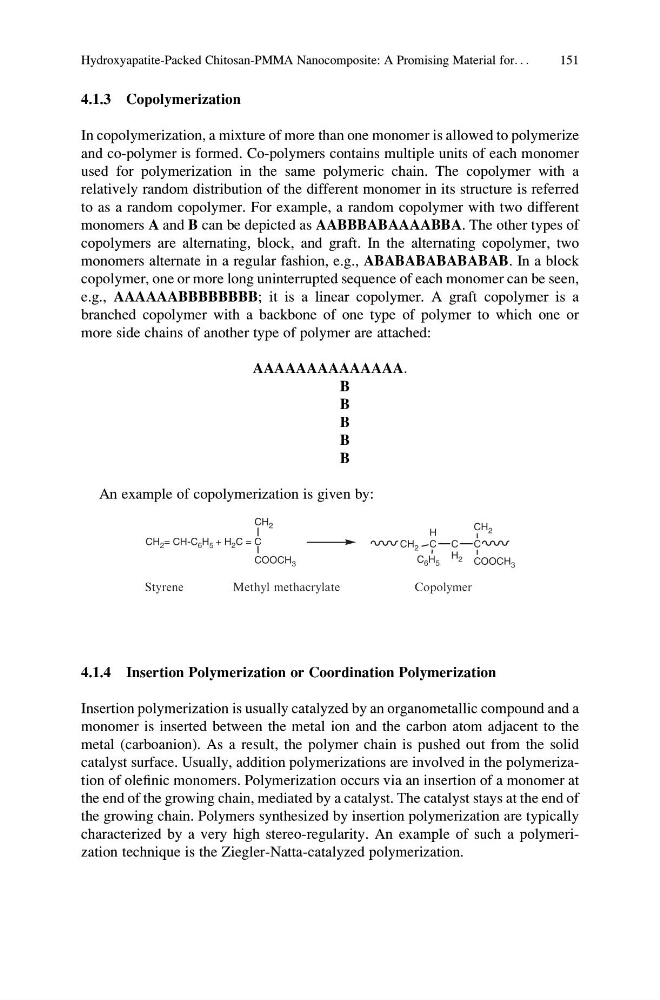
An example of copolymerization is given by:
CH 2 = CH-C 6 H 5 + H 2 C = C
CH 2
COOCH 3
CH 2
H
C
C 6 H 5
C
H 2
C
CH 2
COOCH 3
Styrene
Methyl methacrylate
Copolymer
4.1.4 Insertion Polymerization or Coordination Polymerization
Insertion polymerization is usually catalyzed by an organometallic compound and a
monomer is inserted between the metal ion and the carbon atom adjacent to the
metal (carboanion). As a result, the polymer chain is pushed out from the solid
catalyst surface. Usually, addition polymerizations are involved in the polymerization of olefinic monomers. Polymerization occurs via an insertion of a monomer at
the end of the growing chain, mediated by a catalyst. The catalyst stays at the end of
the growing chain. Polymers synthesized by insertion polymerization are typically
characterized by a very high stereo-regularity. An example of such a polymerization technique is the Ziegler-Natta-catalyzed polymerization.
Hydroxyapatite-Packed Chitosan-PMMA Nanocomposite: A Promising Material for. . .
151
In copolymerization, a mixture of more than one monomer is allowed to polymerize
and co-polymer is formed. Co-polymers contains multiple units of each monomer
used for polymerization in the same polymeric chain. The copolymer with a
relatively random distribution of the different monomer in its structure is referred
to as a random copolymer. For example, a random copolymer with two different
monomers A and B can be depicted as AABBBABAAAABBA. The other types of
copolymers are alternating, block, and graft. In the alternating copolymer, two
monomers alternate in a regular fashion, e.g., ABABABABABABAB. In a block
copolymer, one or more long uninterrupted sequence of each monomer can be seen,
e.g., AAAAAABBBBBBBB; it is a linear copolymer. A graft copolymer is a
branched copolymer with a backbone of one type of polymer to which one or
more side chains of another type of polymer are attached:
AAAAAAAAAAAAAA:
B
B
B
B
B
An example of copolymerization is given by:
CH 2 = CH-C 6 H 5 + H 2 C = C
CH 2
COOCH 3
CH 2
H
C
C 6 H 5
C
H 2
C
CH 2
COOCH 3
Styrene
Methyl methacrylate
Copolymer
4.1.4 Insertion Polymerization or Coordination Polymerization
Insertion polymerization is usually catalyzed by an organometallic compound and a
monomer is inserted between the metal ion and the carbon atom adjacent to the
metal (carboanion). As a result, the polymer chain is pushed out from the solid
catalyst surface. Usually, addition polymerizations are involved in the polymerization of olefinic monomers. Polymerization occurs via an insertion of a monomer at
the end of the growing chain, mediated by a catalyst. The catalyst stays at the end of
the growing chain. Polymers synthesized by insertion polymerization are typically
characterized by a very high stereo-regularity. An example of such a polymerization technique is the Ziegler-Natta-catalyzed polymerization.
Hydroxyapatite-Packed Chitosan-PMMA Nanocomposite: A Promising Material for. . .
151