

4.2 Classification of Polymers
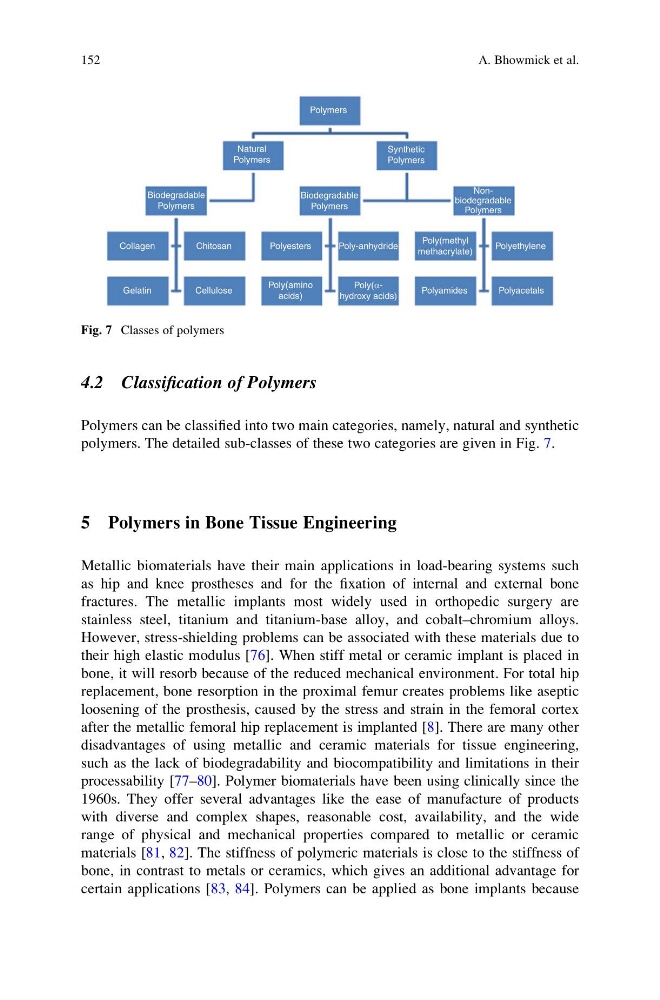
Polymers can be classified into two main categories, namely, natural and synthetic
polymers. The detailed sub-classes of these two categories are given in Fig. 7.
5 Polymers in Bone Tissue Engineering
Metallic biomaterials have their main applications in load-bearing systems such
as hip and knee prostheses and for the fixation of internal and external bone
fractures. The metallic implants most widely used in orthopedic surgery are
stainless steel, titanium and titanium-base alloy, and cobalt–chromium alloys.
However, stress-shielding problems can be associated with these materials due to
their high elastic modulus [76]. When stiff metal or ceramic implant is placed in
bone, it will resorb because of the reduced mechanical environment. For total hip
replacement, bone resorption in the proximal femur creates problems like aseptic
loosening of the prosthesis, caused by the stress and strain in the femoral cortex
after the metallic femoral hip replacement is implanted [8]. There are many other
disadvantages of using metallic and ceramic materials for tissue engineering,
such as the lack of biodegradability and biocompatibility and limitations in their
processability [77–80]. Polymer biomaterials have been using clinically since the
1960s. They offer several advantages like the ease of manufacture of products
with diverse and complex shapes, reasonable cost, availability, and the wide
range of physical and mechanical properties compared to metallic or ceramic
materials [81, 82]. The stiffness of polymeric materials is close to the stiffness of
bone, in contrast to metals or ceramics, which gives an additional advantage for
certain applications [83, 84]. Polymers can be applied as bone implants because
Polymers
Polyamides
Polyacetals
Polyethylene
Collagen
Gelatin
Chitosan
Polyesters
Poly-anhydride
Poly(αhydroxy acids)
Cellulose
Biodegradable
Polymers
Biodegradable
Polymers
Synthetic
Polymers
Natural
Polymers
Nonbiodegradable
Polymers
Poly(methyl
methacrylate)
Poly(amino
acids)
Fig. 7 Classes of polymers
152
A. Bhowmick et al.
Polymers can be classified into two main categories, namely, natural and synthetic
polymers. The detailed sub-classes of these two categories are given in Fig. 7.
5 Polymers in Bone Tissue Engineering
Metallic biomaterials have their main applications in load-bearing systems such
as hip and knee prostheses and for the fixation of internal and external bone
fractures. The metallic implants most widely used in orthopedic surgery are
stainless steel, titanium and titanium-base alloy, and cobalt–chromium alloys.
However, stress-shielding problems can be associated with these materials due to
their high elastic modulus [76]. When stiff metal or ceramic implant is placed in
bone, it will resorb because of the reduced mechanical environment. For total hip
replacement, bone resorption in the proximal femur creates problems like aseptic
loosening of the prosthesis, caused by the stress and strain in the femoral cortex
after the metallic femoral hip replacement is implanted [8]. There are many other
disadvantages of using metallic and ceramic materials for tissue engineering,
such as the lack of biodegradability and biocompatibility and limitations in their
processability [77–80]. Polymer biomaterials have been using clinically since the
1960s. They offer several advantages like the ease of manufacture of products
with diverse and complex shapes, reasonable cost, availability, and the wide
range of physical and mechanical properties compared to metallic or ceramic
materials [81, 82]. The stiffness of polymeric materials is close to the stiffness of
bone, in contrast to metals or ceramics, which gives an additional advantage for
certain applications [83, 84]. Polymers can be applied as bone implants because
Polymers
Polyamides
Polyacetals
Polyethylene
Collagen
Gelatin
Chitosan
Polyesters
Poly-anhydride
Poly(αhydroxy acids)
Cellulose
Biodegradable
Polymers
Biodegradable
Polymers
Synthetic
Polymers
Natural
Polymers
Nonbiodegradable
Polymers
Poly(methyl
methacrylate)
Poly(amino
acids)
Fig. 7 Classes of polymers
152
A. Bhowmick et al.