

amount of one reagent is used up. The equilibrium for these reactions can be
controlled. An example of condensation polymerization is given by:
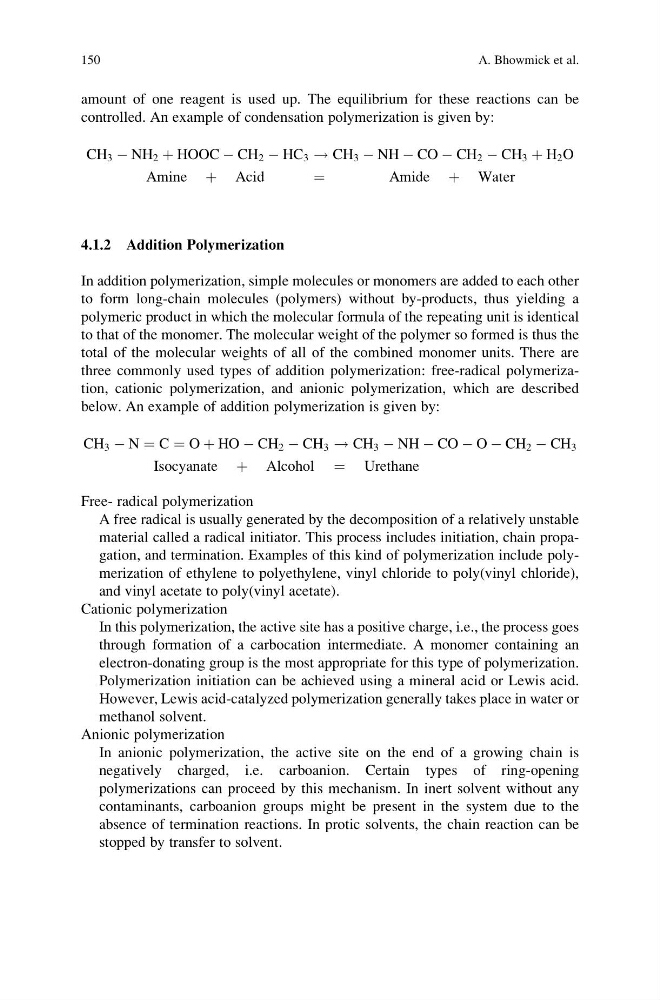
CH 3 À NH 2 þ HOOC À CH 2 À HC 3 ! CH 3 À NH À CO À CH 2 À CH 3 þ H 2 O
Amine þ Acid
¼
Amide þ Water
4.1.2 Addition Polymerization
In addition polymerization, simple molecules or monomers are added to each other
to form long-chain molecules (polymers) without by-products, thus yielding a
polymeric product in which the molecular formula of the repeating unit is identical
to that of the monomer. The molecular weight of the polymer so formed is thus the
total of the molecular weights of all of the combined monomer units. There are
three commonly used types of addition polymerization: free-radical polymerization, cationic polymerization, and anionic polymerization, which are described
below. An example of addition polymerization is given by:
CH 3 À N ¼ C ¼ O þ HO À CH 2 À CH 3 ! CH 3 À NH À CO À O À CH 2 À CH 3
Isocyanate þ Alcohol ¼ Urethane
Free- radical polymerization
A free radical is usually generated by the decomposition of a relatively unstable
material called a radical initiator. This process includes initiation, chain propagation, and termination. Examples of this kind of polymerization include polymerization of ethylene to polyethylene, vinyl chloride to poly(vinyl chloride),
and vinyl acetate to poly(vinyl acetate).
Cationic polymerization
In this polymerization, the active site has a positive charge, i.e., the process goes
through formation of a carbocation intermediate. A monomer containing an
electron-donating group is the most appropriate for this type of polymerization.
Polymerization initiation can be achieved using a mineral acid or Lewis acid.
However, Lewis acid-catalyzed polymerization generally takes place in water or
methanol solvent.
Anionic polymerization
In anionic polymerization, the active site on the end of a growing chain is
negatively charged, i.e. carboanion. Certain types of ring-opening
polymerizations can proceed by this mechanism. In inert solvent without any
contaminants, carboanion groups might be present in the system due to the
absence of termination reactions. In protic solvents, the chain reaction can be
stopped by transfer to solvent.
150
A. Bhowmick et al.
controlled. An example of condensation polymerization is given by:
CH 3 À NH 2 þ HOOC À CH 2 À HC 3 ! CH 3 À NH À CO À CH 2 À CH 3 þ H 2 O
Amine þ Acid
¼
Amide þ Water
4.1.2 Addition Polymerization
In addition polymerization, simple molecules or monomers are added to each other
to form long-chain molecules (polymers) without by-products, thus yielding a
polymeric product in which the molecular formula of the repeating unit is identical
to that of the monomer. The molecular weight of the polymer so formed is thus the
total of the molecular weights of all of the combined monomer units. There are
three commonly used types of addition polymerization: free-radical polymerization, cationic polymerization, and anionic polymerization, which are described
below. An example of addition polymerization is given by:
CH 3 À N ¼ C ¼ O þ HO À CH 2 À CH 3 ! CH 3 À NH À CO À O À CH 2 À CH 3
Isocyanate þ Alcohol ¼ Urethane
Free- radical polymerization
A free radical is usually generated by the decomposition of a relatively unstable
material called a radical initiator. This process includes initiation, chain propagation, and termination. Examples of this kind of polymerization include polymerization of ethylene to polyethylene, vinyl chloride to poly(vinyl chloride),
and vinyl acetate to poly(vinyl acetate).
Cationic polymerization
In this polymerization, the active site has a positive charge, i.e., the process goes
through formation of a carbocation intermediate. A monomer containing an
electron-donating group is the most appropriate for this type of polymerization.
Polymerization initiation can be achieved using a mineral acid or Lewis acid.
However, Lewis acid-catalyzed polymerization generally takes place in water or
methanol solvent.
Anionic polymerization
In anionic polymerization, the active site on the end of a growing chain is
negatively charged, i.e. carboanion. Certain types of ring-opening
polymerizations can proceed by this mechanism. In inert solvent without any
contaminants, carboanion groups might be present in the system due to the
absence of termination reactions. In protic solvents, the chain reaction can be
stopped by transfer to solvent.
150
A. Bhowmick et al.