

4 Polymers
Polymers are molecules consisting of a long chain of repeating smaller units called
monomers. Polymers have the highest molecular weight of any molecules and may
consist of billions of atoms. Human DNA is a polymer with over 20 billion
constituent atoms. Proteins, or the polymers of amino acids, and many other
molecules that make up life are polymers. Polymers are the largest and most diverse
class of known molecules. The length of the polymer chain is specified by the
number of repeat unit in the chain and depends on the degree of polymerization
(DP). The molecular weight of the polymer is the product of the molecular weight
of the repeat unit and the DP. In the next section, different methods for the synthesis
of polymers are described.
4.1 Synthesis of Polymers
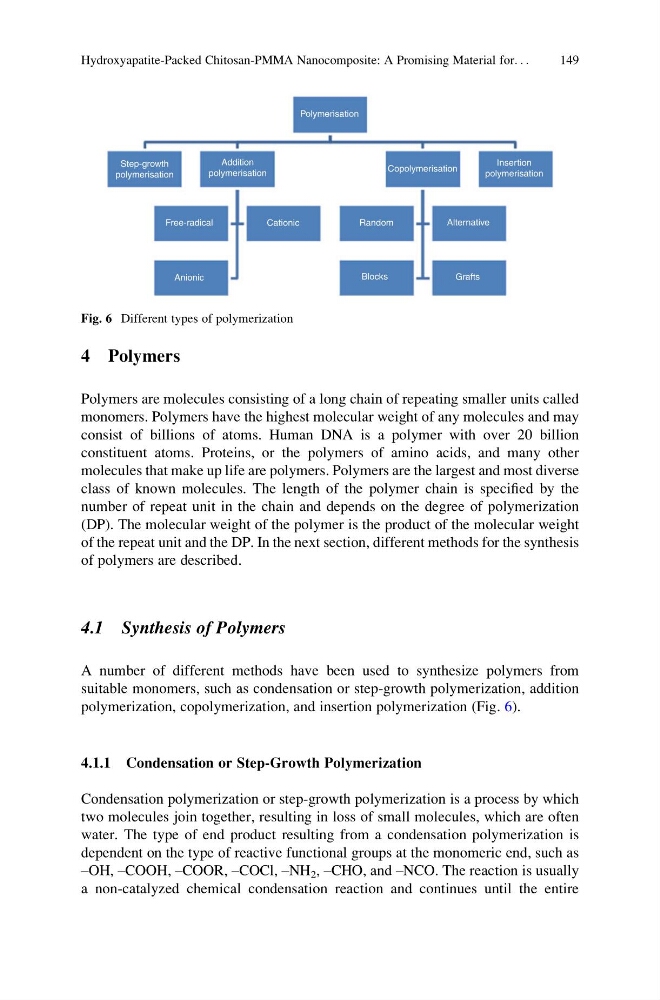
A number of different methods have been used to synthesize polymers from
suitable monomers, such as condensation or step-growth polymerization, addition
polymerization, copolymerization, and insertion polymerization (Fig. 6).
4.1.1 Condensation or Step-Growth Polymerization
Condensation polymerization or step-growth polymerization is a process by which
two molecules join together, resulting in loss of small molecules, which are often
water. The type of end product resulting from a condensation polymerization is
dependent on the type of reactive functional groups at the monomeric end, such as
–OH, –COOH, –COOR, –COCl, –NH 2 , –CHO, and –NCO. The reaction is usually
a non-catalyzed chemical condensation reaction and continues until the entire
Polymerisation
Free-radical
Cationic
Anionic
Random
Alternative
Blocks
Grafts
Copolymerisation
Addition
polymerisation
Insertion
polymerisation
Step-growth
polymerisation
Fig. 6 Different types of polymerization
Hydroxyapatite-Packed Chitosan-PMMA Nanocomposite: A Promising Material for. . .
149
Polymers are molecules consisting of a long chain of repeating smaller units called
monomers. Polymers have the highest molecular weight of any molecules and may
consist of billions of atoms. Human DNA is a polymer with over 20 billion
constituent atoms. Proteins, or the polymers of amino acids, and many other
molecules that make up life are polymers. Polymers are the largest and most diverse
class of known molecules. The length of the polymer chain is specified by the
number of repeat unit in the chain and depends on the degree of polymerization
(DP). The molecular weight of the polymer is the product of the molecular weight
of the repeat unit and the DP. In the next section, different methods for the synthesis
of polymers are described.
4.1 Synthesis of Polymers
A number of different methods have been used to synthesize polymers from
suitable monomers, such as condensation or step-growth polymerization, addition
polymerization, copolymerization, and insertion polymerization (Fig. 6).
4.1.1 Condensation or Step-Growth Polymerization
Condensation polymerization or step-growth polymerization is a process by which
two molecules join together, resulting in loss of small molecules, which are often
water. The type of end product resulting from a condensation polymerization is
dependent on the type of reactive functional groups at the monomeric end, such as
–OH, –COOH, –COOR, –COCl, –NH 2 , –CHO, and –NCO. The reaction is usually
a non-catalyzed chemical condensation reaction and continues until the entire
Polymerisation
Free-radical
Cationic
Anionic
Random
Alternative
Blocks
Grafts
Copolymerisation
Addition
polymerisation
Insertion
polymerisation
Step-growth
polymerisation
Fig. 6 Different types of polymerization
Hydroxyapatite-Packed Chitosan-PMMA Nanocomposite: A Promising Material for. . .
149